
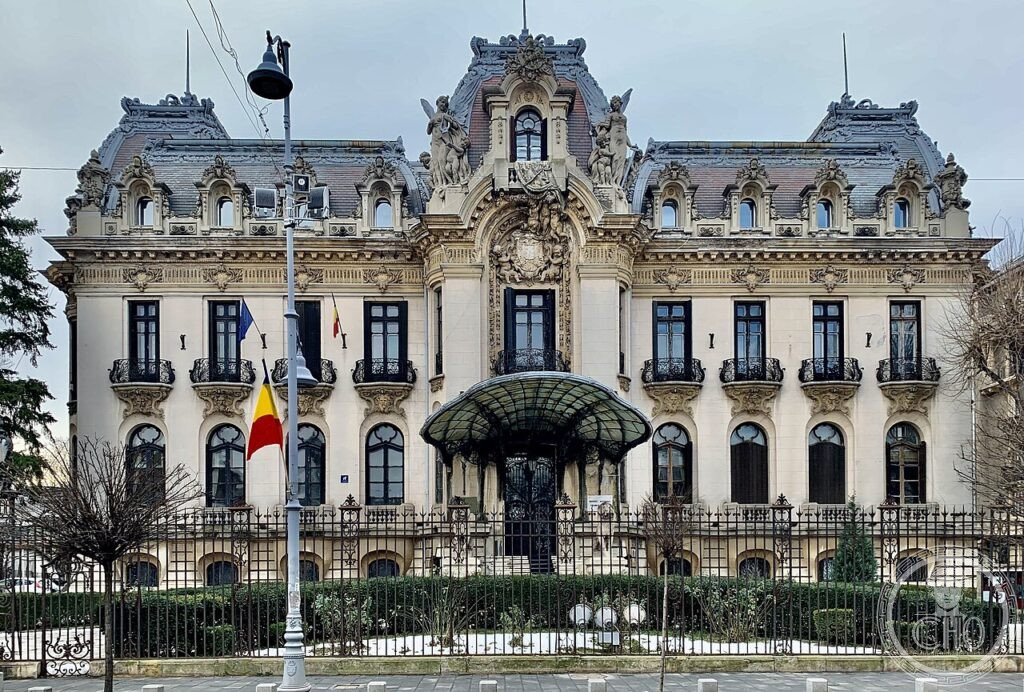
Built for Prince Gheorghe Grigore Cantacuzino on Calea Victoriei — the grand promenade of Bucharest’s “Little Paris” period — Ion D. Berindey’s Beaux-Arts palace took eight years to complete and became the most lavish private residence on the street. It now preserves the instruments, scores, and salon of Romania’s greatest composer.
At a glance
The Cantacuzino Palace stands at Calea Victoriei 141 in central Bucharest, on the city’s most celebrated street — a north-south promenade that earned Bucharest its nineteenth-century nickname of the “Paris of the East.” Commissioned by Prince Gheorghe Grigore Cantacuzino — one of the wealthiest men in Romania at the time — and designed by the French-trained Romanian architect Ion D. Berindey, it was built between 1898 and 1906 in the Beaux-Arts style, with several rooms completed in Rococo Revival. Since 1956 it has housed the George Enescu National Museum, dedicated to the composer George Enescu (1881–1955), who lived in the palace. It is Romania’s most visited music museum and a UNESCO-affiliated memorial to one of Europe’s greatest twentieth-century composers.
Key facts
- Architect: Ion D. Berindey (French-trained Romanian architect)
- Commissioned by: Prince Gheorghe Grigore Cantacuzino (“Nababul”)
- Built: 1898–1906
- Style: Beaux-Arts with Rococo Revival interior rooms
- Address: Calea Victoriei 141, Sector 1, Bucharest
- GPS: 44.4487, 26.0883 — Google Maps
- Current use: George Enescu National Museum (since 1956)
History
Prince Gheorghe Grigore Cantacuzino (1832–1913), known as “Nababul” (the Nabob) on account of his enormous fortune, was one of the dominant figures of the late Romanian Kingdom. A former Prime Minister and head of the Conservative Party, he had accumulated vast landholdings and the kind of wealth that, in the Belle Époque, could only find adequate expression in architecture. The commission for the Calea Victoriei palace went to Ion D. Berindey, who had trained at the École des Beaux-Arts in Paris — the natural choice for an aristocratic client who wanted to bring the spirit of the great Parisian hôtels particuliers to Bucharest’s principal boulevard.
Construction began in 1898 and took eight years, a duration that reflected both the complexity of the programme and the ambition of the decorative scheme. The exterior was executed in the Beaux-Arts language of the French Second Empire and Third Republic — arched windows, carved stone cartouches, wrought-iron balcony railings — while several interior rooms were completed in a more exuberant Rococo Revival style, with gilded ornament, silk damask wallcoverings, and painted ceilings. The palace opened in 1906.
George Enescu (1881–1955) — violinist, composer, conductor, and the foundational figure of modern Romanian classical music — came to live in the palace after marrying Princess Maria Cantacuzino in 1939, a late marriage that gave him access to the most spectacular private apartment in Bucharest. He composed and taught here until the communist takeover of 1947 made life in Romania increasingly difficult; he spent his last years in Paris, dying there in 1955. The palace was nationalised in 1948 and converted to a museum in 1956, using Enescu’s personal collection of instruments, scores, photographs, and furnishings to create one of the most intimate composer memorials in Europe.
What you see
The façade on Calea Victoriei presents a symmetrical composition of dressed stone — three bays wide, three storeys tall — in which French Beaux-Arts logic is animated by a particularly rich surface programme: carved cartouches over the arched windows, wrought-iron balcony railings of sinuous botanical form, and a rusticated ground floor that gives the building a solid base before the more decorative registers above. The entrance portal is especially elaborate, with its iron-and-glass canopy supported by carved stone brackets. The building reads as one of the most complete examples of the early twentieth-century French academic style in Romania — a building that belongs firmly to the “Little Paris” period of Bucharest’s cultural self-fashioning.
Inside, the Enescu museum preserves several rooms in their early twentieth-century condition: the music salon with Enescu’s personal piano, his violins, and the scores of his major works; the dining room with its original furniture; and the Rococo Revival reception room with its gilded ceiling and carved boiserie panels. The combination of Belle Époque interior architecture and a composer’s working collection makes the museum unusual among European monument-museums of this type.
Practical information
- Open Tuesday–Sunday; closed Mondays. Hours typically 10:00–17:00 (check official website).
- Admission charged; guided tours available in Romanian and English.
- The museum includes Enescu’s instruments, manuscripts, correspondence, photographs, and personal effects.
- A concert hall in the palace hosts regular chamber music events, including the George Enescu International Festival concerts.
- Photography is permitted in most rooms without flash.
Getting there
The palace is at Calea Victoriei 141 in Bucharest’s Sector 1, a 15-minute walk north of the city centre. Metro Line M2 (Piața Victoriei station) is 5 minutes’ walk away. Bus routes along Calea Victoriei stop near the palace. From Henri Coandă International Airport (OTP, 16 km north), taxi or ride-share takes 30–45 minutes depending on traffic.
Nearby
- CEC Palace — 1.5 km south on Calea Victoriei, Paul Gottereau’s 1900 Beaux-Arts bank palace
- Romanian Athenaeum — 300 m southeast, Albert Galleron’s 1888 Neoclassical concert hall (home of the George Enescu Festival)
- National Museum of Art of Romania — 800 m south, in the former Royal Palace
- Victory Square (Piața Victoriei) — 500 m north, site of the government headquarters
Sources
- Wikipedia (EN): Cantacuzino Palace — architect Ion D. Berindey, client Prince Gheorghe Grigore Cantacuzino, built 1898–1906, Beaux-Arts + Rococo Revival, Calea Victoriei 141, GPS 44.4487/26.0883, now George Enescu museum
- Wikipedia (EN): George Enescu — biography (1881–1955), marriage to Princess Maria Cantacuzino 1939, death in Paris 1955
- Wikipedia (EN): George Enescu National Museum — museum founded 1956, description of collections
- Mariana Celac et al., Bucharest Architecture: An Annotated Guide (2017) — pages 90 (cited in Wikipedia infobox)
Find it on the map
See this place and what’s around it →📷 Become a Cultural Heritage Online photographer
Share your photos of places: they stay published under your name as the author. The more they're seen, the more you get noticed — and soon a contest will reward the most appreciated photos.
Log in or sign up free to add a photoIs this page about you?
This page is read by travellers and heritage enthusiasts who find it on Google. Tell us how you are connected to this place and we will take it from there.