
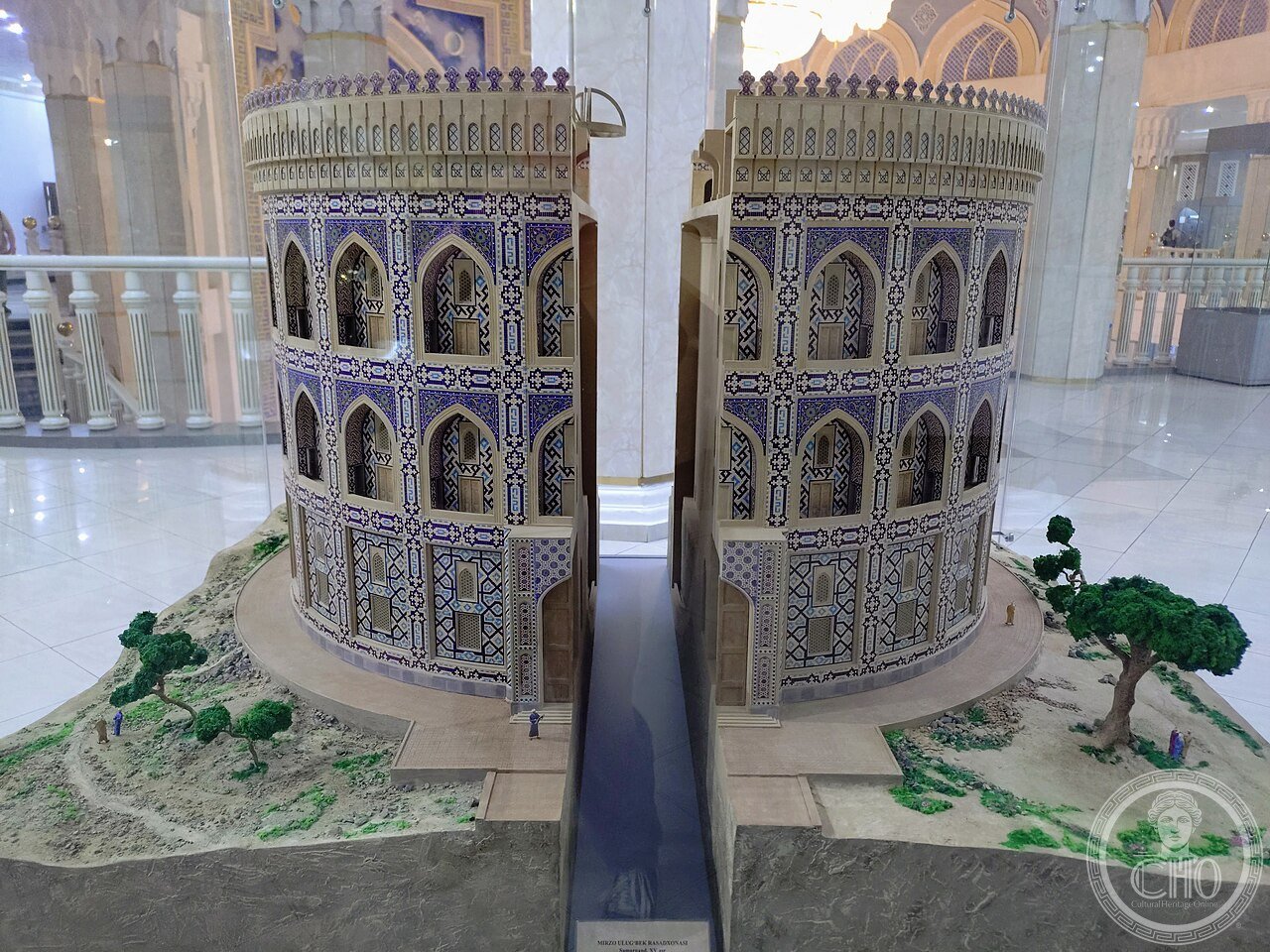
Ulugh Beg Observatory, Samarkand
The astronomer-king’s buried sextant – a 40-metre arc in the rock that fixed the stars to the minute, a century before Europe’s instruments matched it.
At a glance
- Type
- Observatory remains and museum
- Period
- c. 1420-1449
- Style
- Timurid scientific architecture
- Location
- Afrasiyab edge, Samarkand, Uzbekistan
- Coordinates
- 39.6753, 67.0050
- Founder
- Ulugh Beg, Timurid sultan-astronomer
Overview
Ulugh Beg – Timur’s grandson who preferred stars to conquest – sank a meridian sextant of forty metres’ radius into Samarkand’s rock around 1424: the great arc’s marble-faced trench, rediscovered in 1908, survives from the round observatory where his team fixed 1,018 stars and the year’s length within a minute – precision unequalled until Tycho Brahe a century and a half later.
History
The sultan’s Zij-i Sultani catalogue travelled west to Oxford’s presses; his religious opponents had him murdered in 1449 на his pilgrimage road, and the observatory was razed – science’s martyrdom Central Asia still mourns. Soviet archaeologist Vyatkin’s trench-find returned the instrument to light; the museum beside displays the catalogue’s pages and the prince’s court of mathematicians (al-Kashi, Qadi-zada).
Architecture and Design
The surviving arc’s twin marble parapets curve down eleven metres below grade – the underground portion of an instrument whose superstructure rose three storeys; sightline slots fixed solar transits to seconds. The drum’s foundation circles trace the building’s 46-metre diameter.
Cultural significance
The observatory crowns Islamic science’s late golden age and Uzbekistan’s identity as learning’s steppe capital – Registan’s Ulugh Beg madrasa, where he taught astronomy himself, completes the astronomer-king’s memorial.
Visiting today
Site and museum open daily on the Tashkent road’s rise; combine Afrasiyab’s museum and Shah-i-Zinda’s avenue nearby.
Getting there
Ten minutes by taxi from the Registan; city buses pass the Afrasiyab slope.
Sources and resources
Find it on the map
See this place and what’s around it →📷 Diventa un fotografo di Cultural Heritage Online
Condividi le tue foto dei luoghi: restano pubblicate con la tua firma come autore. Più vengono viste, più ti fai conoscere — e presto un concorso premierà le foto più apprezzate.
Accedi o registrati gratis per aggiungere una foto