

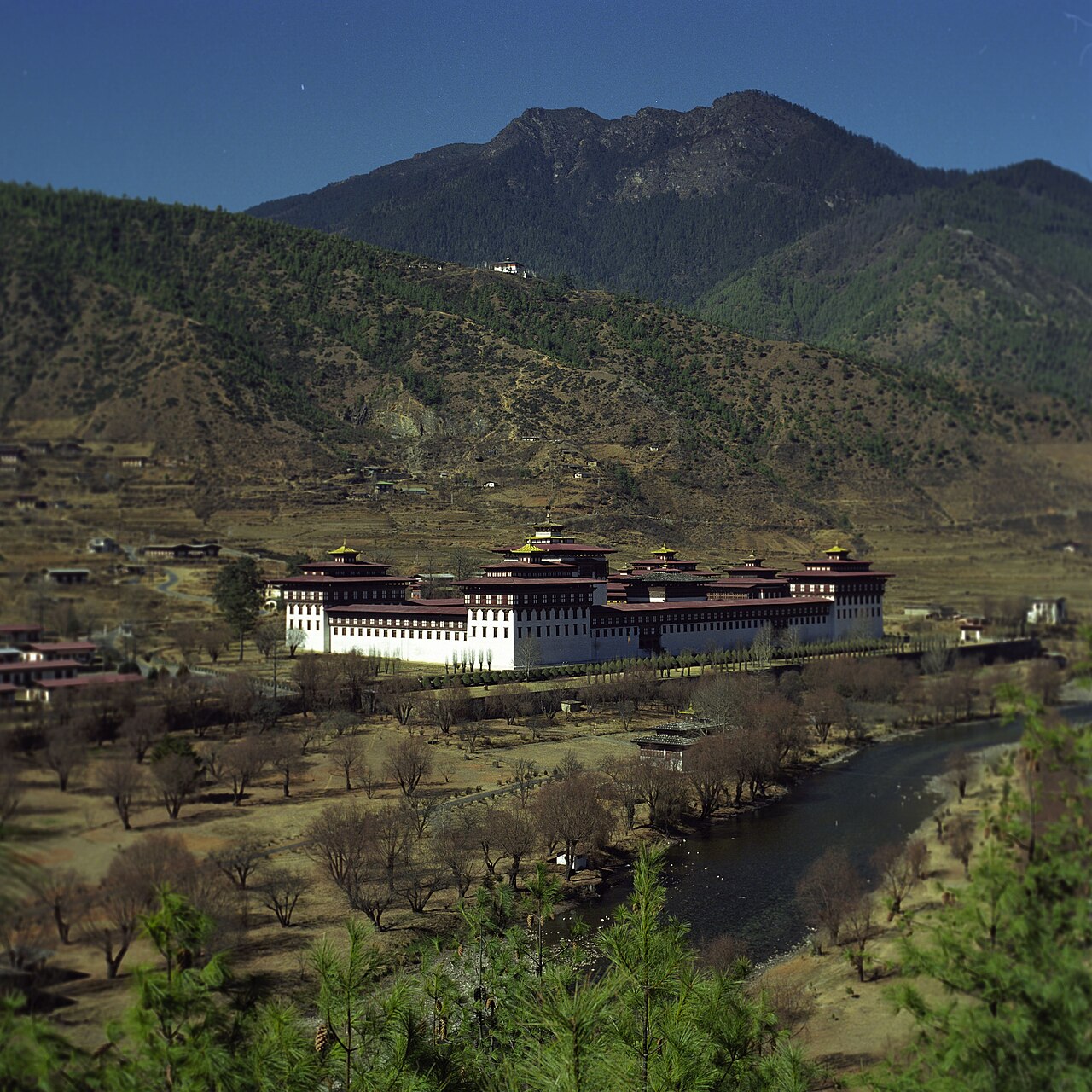
The fortress of the glorious religion – seat of Bhutan’s king and central monastic body, rebuilt without nails or drawings in the living dzong tradition.
At a glance
- Type
- Fortress-monastery and seat of government
- Period
- Origins 1216; rebuilt 1962-1968
- Style
- Traditional Bhutanese dzong architecture
- Location
- Thimphu, Bhutan
- Coordinates
- 27.4899, 89.6354
- Patron
- King Jigme Dorji Wangchuck
Overview
Tashichho Dzong – the Fortress of the Glorious Religion – stands on the west bank of the Wang Chhu river at the edge of Thimphu, a vast whitewashed quadrangle with red-and-gold roofs and corner towers that houses the throne room of the King of Bhutan, the offices of government, and the summer residence of the Je Khenpo, the chief abbot, with his central monastic body.
History
A dzong has stood at Thimphu since 1216; the present fortress descends from the 1641 stronghold of Zhabdrung Ngawang Namgyal, unifier of Bhutan. When King Jigme Dorji Wangchuck moved the permanent capital to Thimphu, he had the dzong enlarged and rebuilt between 1962 and 1968 in the traditional manner – without nails, without written plans, by master carpenters and the corvee labour of the valleys, continuing a building tradition unbroken for centuries.
Architecture and Design
Massive battered walls of whitewashed stone enclose courtyards separated by the central utse tower; the timber upper storeys, painted in Bhutan’s code of reds, golds, and floral panels, are joined entirely by joinery. The dzong typology – half monastery, half castle – is Bhutan’s singular contribution to world architecture, and Tashichho is its statliest working example.
Cultural significance
The dzong is the ceremonial heart of the kingdom: coronations and the great Thimphu Tshechu festival fill its courtyards each autumn with masked cham dances. As the joint seat of throne, government, and sangha it embodies Bhutan’s constitutional weave of monarchy and Buddhism.
Visiting today
Visitors are admitted after office hours on weekdays and during daylight on weekends, and throughout the Tshechu festival; dress modestly. The Buddha Dordenma statue and the National Memorial Chorten are companion sights in Thimphu.
Getting there
The dzong is ten minutes by taxi from central Thimphu; Bhutan is reached via Paro airport, an hour’s drive, with travel arranged through licensed operators under the kingdom’s tourism policy.
Sources and resources
Find it on the map
See this place and what’s around it →Record researched and written by Luigi De Marchi for Cultural Heritage Online, 2026.
📷 Become a Cultural Heritage Online photographer
Share your photos of places: they stay published under your name as the author. The more they're seen, the more you get noticed — and soon a contest will reward the most appreciated photos.
Log in or sign up free to add a photoIs this page about you?
This page is read by travellers and heritage enthusiasts who find it on Google. Tell us how you are connected to this place and we will take it from there.