
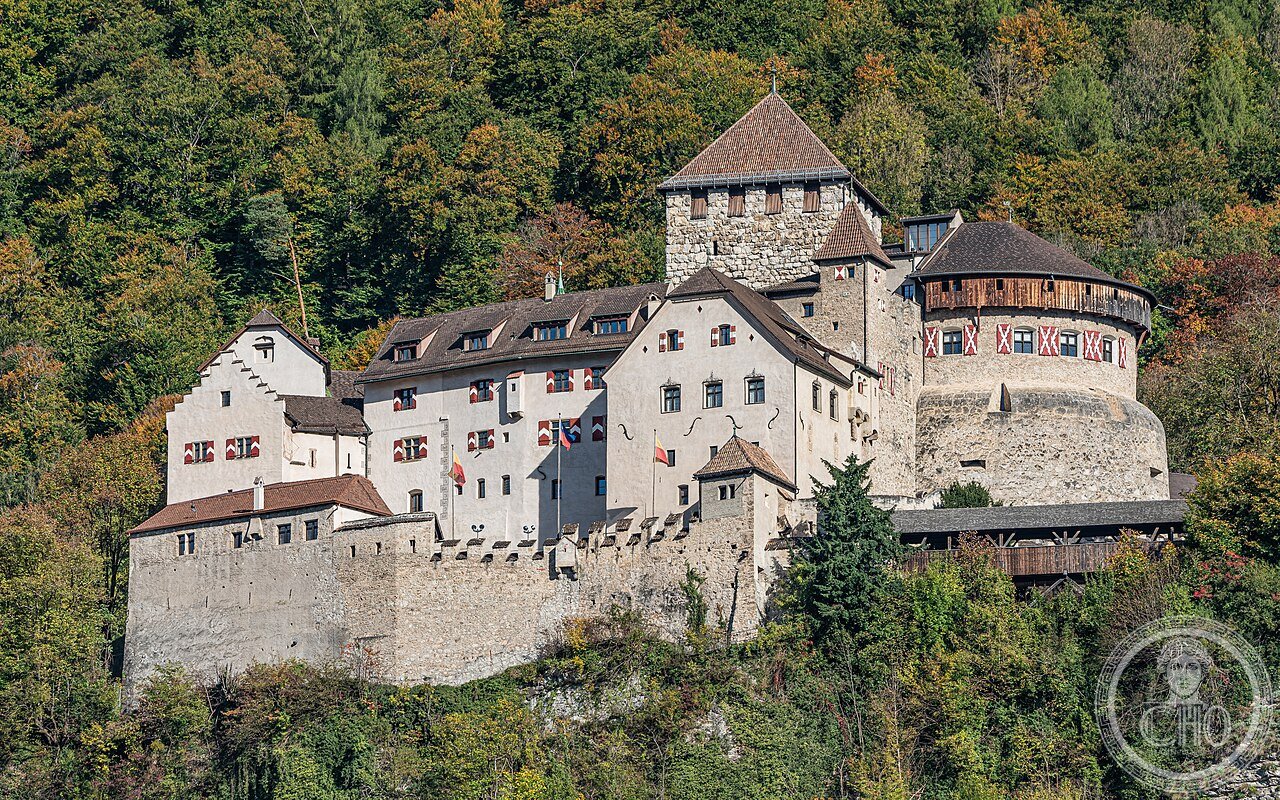
The medieval hilltop residence of the Prince of Liechtenstein, perched above Vaduz with sweeping views over the Rhine valley.
At a glance
- Style
- Medieval / Renaissance
- Founded
- 12th century (current structure largely rebuilt 1900s)
- Function
- Royal residence (private)
- Coordinates
- 47.1439, 9.5213
- Country
- Liechtenstein
Overview
Vaduz Castle is the official residence of the Prince of Liechtenstein and the most recognisable symbol of the world’s only German-speaking monarchy to have survived intact. The complex crowns a rocky spur above the capital Vaduz at 570 m above sea level, commanding panoramic views of the Rhine valley and the surrounding Alps. Liechtenstein itself is a constitutional monarchy of 37,000 inhabitants — the sixth-smallest country in the world and the only doubly landlocked nation in Europe, sharing borders with Switzerland to the west and Austria to the east. The castle is the permanent home of the reigning prince and remains closed to the public, but its silhouette defines the skyline of every view of Vaduz.
History
A fortification on this site is documented from the 12th century. The castle changed hands numerous times through the medieval period before passing to the House of Liechtenstein in 1712, when Prince Johann Adam I purchased the county of Vaduz, giving the dynasty a seat in the Holy Roman Empire. Following partial destruction during the Swabian War of 1499, the structure was restored and extended across several centuries. Major renovation campaigns in the late 19th and early 20th century gave the castle its present neo-Gothic and Renaissance character. Liechtenstein became a fully sovereign state in 1806 after the dissolution of the Holy Roman Empire, and the castle has served as the principal princely residence since 1938.
Architecture
The castle is a compact ensemble of towers, residential wings, and defensive walls built on a natural limestone promontory. The round keep, the oldest surviving element, dates to the 12th or 13th century. A square residential tower and connecting buildings were added over subsequent centuries. The 19th-century restoration introduced pointed gable roofs and neo-Gothic decorative elements, while the interior was refitted in the historicist style fashionable at the time. The exterior walls of pale stone contrast sharply against the forested hillside, making the castle visible from most of the Rhine plain below.
Cultural significance
Vaduz Castle is both the seat of government of the House of Liechtenstein and the physical embodiment of one of Europe’s most unusual political survivals — a principality that outlasted every other entity of the Holy Roman Empire. It features on Liechtenstein’s postage stamps, coins, and official tourism imagery. The Liechtenstein princely collections, one of the world’s largest private art holdings (Rubens, van Dyck, Raphael), are partly on display at the Kunstmuseum Liechtenstein in Vaduz and at the Garden Palace in Vienna, giving the castle cultural weight far beyond its modest national setting.
Visiting today
The castle is a private royal residence and is not open to the public. Visitors can admire it from the marked footpath that winds up the hillside from central Vaduz — a 20-minute walk from the city centre. The path offers several viewpoints directly beneath the castle walls. The surrounding wine estates and the Liechtenstein National Museum in Vaduz provide context for a half-day visit to the area.
Getting there
Liechtenstein has no airport or rail station. The nearest international airports are Zurich (90 min) and Friedrichshafen (60 min). From Buchs SG or Sargans (both served by Swiss Federal Railways), PostAuto buses cross into Vaduz in under 30 minutes. From Vaduz city centre, the castle footpath begins near the main post office. By car: A13 motorway (Switzerland) to exit Buchs or Sevelen, then cross the Rhine bridge into Vaduz.
Sources
Find it on the map
See this place and what’s around it →📷 Become a Cultural Heritage Online photographer
Share your photos of places: they stay published under your name as the author. The more they're seen, the more you get noticed — and soon a contest will reward the most appreciated photos.
Log in or sign up free to add a photoIs this page about you?
This page is read by travellers and heritage enthusiasts who find it on Google. Tell us how you are connected to this place and we will take it from there.