
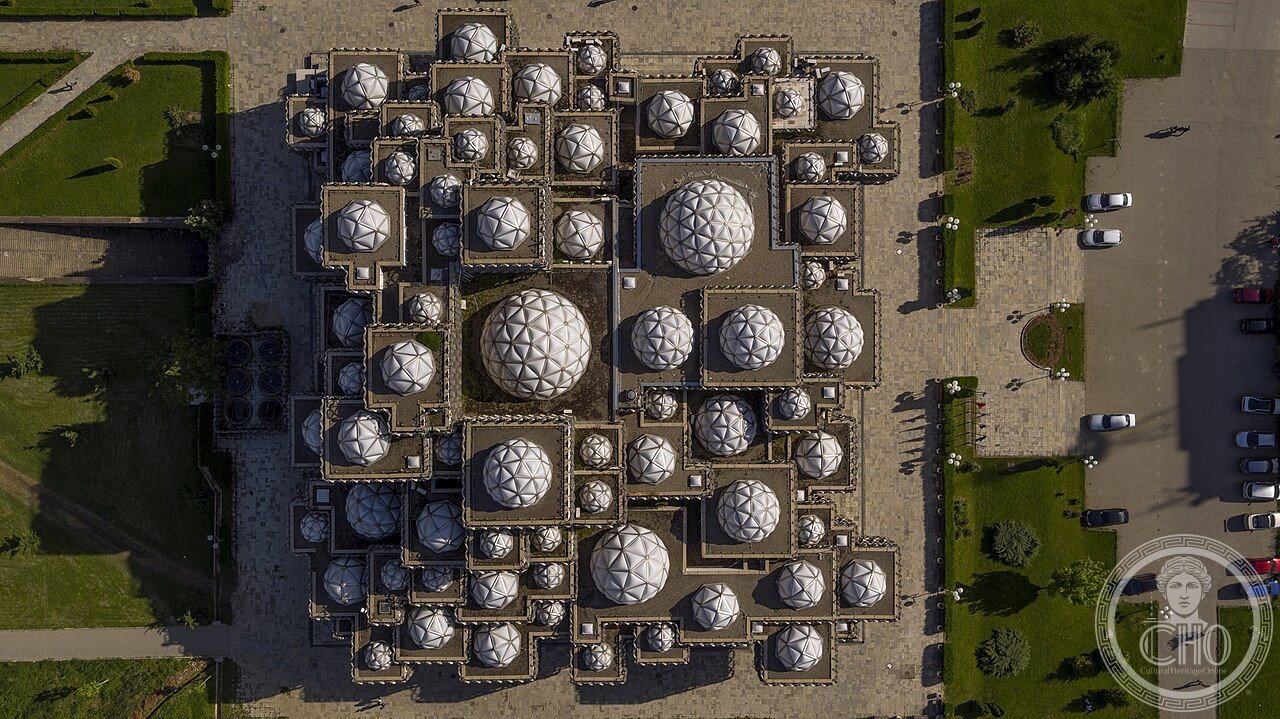
The most celebrated and debated building in the Western Balkans: a monumental reinforced-concrete library clad in 99 intersecting white steel dome meshes, deliberately synthesizing Byzantine and Ottoman architectural memory into a single post-modern structure that became the symbol of Kosovo identity.
At a glance
- Type
- National library
- Period
- 1974-1982
- Style
- Brutalist / Post-Modern syncretism
- Location
- Agim Ramadani Street, Pristina, Kosovo
- Coordinates
- 42.6600, 21.1605
- Architect
- Andrija Mutnjakovic (Croatia)
Overview
The National Library of Kosovo (Biblioteka Kombetare e Kosoves) in Pristina is one of the most architecturally distinctive public buildings in Europe and the most important cultural institution in Kosovo. Designed by Croatian architect Andrija Mutnjakovic and completed in 1982 under Yugoslav socialist rule, the building is clad in 99 intersecting white steel dome meshes that drape over its reinforced-concrete mass like a lattice of linked umbrellas. It holds over 1.7 million volumes and serves as the primary public research library for Kosovo inhabitants. The building was famously included in multiple lists of the world ugliest buildings in the 2000s; it has since been substantially reappraised as a significant work of post-modern architectural synthesis and a unique expression of Kosovo layered cultural identity.
History
The library was commissioned in the early 1970s as part of Yugoslavia investment in Kosovo cultural infrastructure during a period of relative autonomy for the province. Mutnjakovic won the competition with a design intended to represent Kosovo multi-religious heritage – a deliberate architectural act in a territory shared between Albanian Muslims, Serbian Orthodox Christians, and other communities. Construction ran from 1974 to 1982. The building opened under Yugoslav rule but experienced a turbulent subsequent history: the 1998-1999 Kosovo War, NATO intervention, UN administration under UNMIK from 1999 to 2008, and Kosovo 2008 declaration of independence (recognized by over 100 states but disputed by Serbia and others) each left their mark on the institution. Through these upheavals the library functioned as a repository of Albanian-language culture and identity.
Architecture and Design
Mutnjakovic design is a deliberate act of architectural synthesis. The 99 domes – a number sacred in Islam, referencing the 99 names of God – cover the building reinforced concrete structure in a mesh of white painted steel that filters light and creates a distinctive visual texture. The number simultaneously references Ottoman mosque architecture and Byzantine church architecture, fusing the two traditions that have defined Kosovo built environment for centuries. The overall massing is horizontal and monumental in the Brutalist tradition, with the dome meshes providing an ornamental layer that softens the raw concrete aesthetic. The interior is organized around a central atrium with reading rooms, stacks, and administrative spaces on multiple levels. Natural light enters through the dome meshes and clerestory openings, creating a luminous reading environment despite the massive exterior.
Cultural significance
The National Library of Kosovo carries an unusual weight of meaning for such a recent building. As a Yugoslav-era structure designed by a Croatian architect to serve a predominantly Albanian population in a Serbian-administered province, it embodies the contradictions of late socialist Yugoslavia. As a building that survived war, international administration, and independence to become the symbol of the new Kosovo state, it demonstrates how architecture can accumulate significance beyond its original intent. The synthesis of Islamic and Orthodox dome forms has been read as a utopian statement of inter-religious coexistence. The building appears on Kosovo postage stamps and has become the de facto emblem of Pristina architectural identity internationally.
Visiting today
The National Library is open to the public during standard library hours, generally Monday through Saturday with hours varying by season. Entry to the building and reading rooms is free; temporary exhibitions are occasionally held in the main atrium. The exterior is best viewed from Agim Ramadani Street, which allows a full view of the dome mesh facade. The nearby University of Pristina campus and the Kosovo Museum are within easy walking distance. Architectural photography is popular and unobstructed from public space. Guided tours of Pristina frequently include the library as the most internationally recognized building in the city.
Getting there
The National Library is located near the University of Pristina campus, approximately 1.5 km south of Mother Teresa Square (Sheshi Nene Tereza), Pristina main central plaza. The city center is compact and walkable; the library is reachable on foot from most central hotels in 20-25 minutes. Pristina does not currently have a metro or tram system; local buses and taxis serve the area. Pristina International Airport Adem Jashari is approximately 18 km southwest of the city center; taxis and shuttle buses connect the airport to Pristina in 25-40 minutes.
Sources and resources
Find it on the map
See this place and what’s around it →📷 Become a Cultural Heritage Online photographer
Share your photos of places: they stay published under your name as the author. The more they're seen, the more you get noticed — and soon a contest will reward the most appreciated photos.
Log in or sign up free to add a photoDo you manage this place?
This page is read by travellers and heritage enthusiasts who find it on Google. Keep it accurate — and make it work for you. Free for non-profit heritage institutions.