
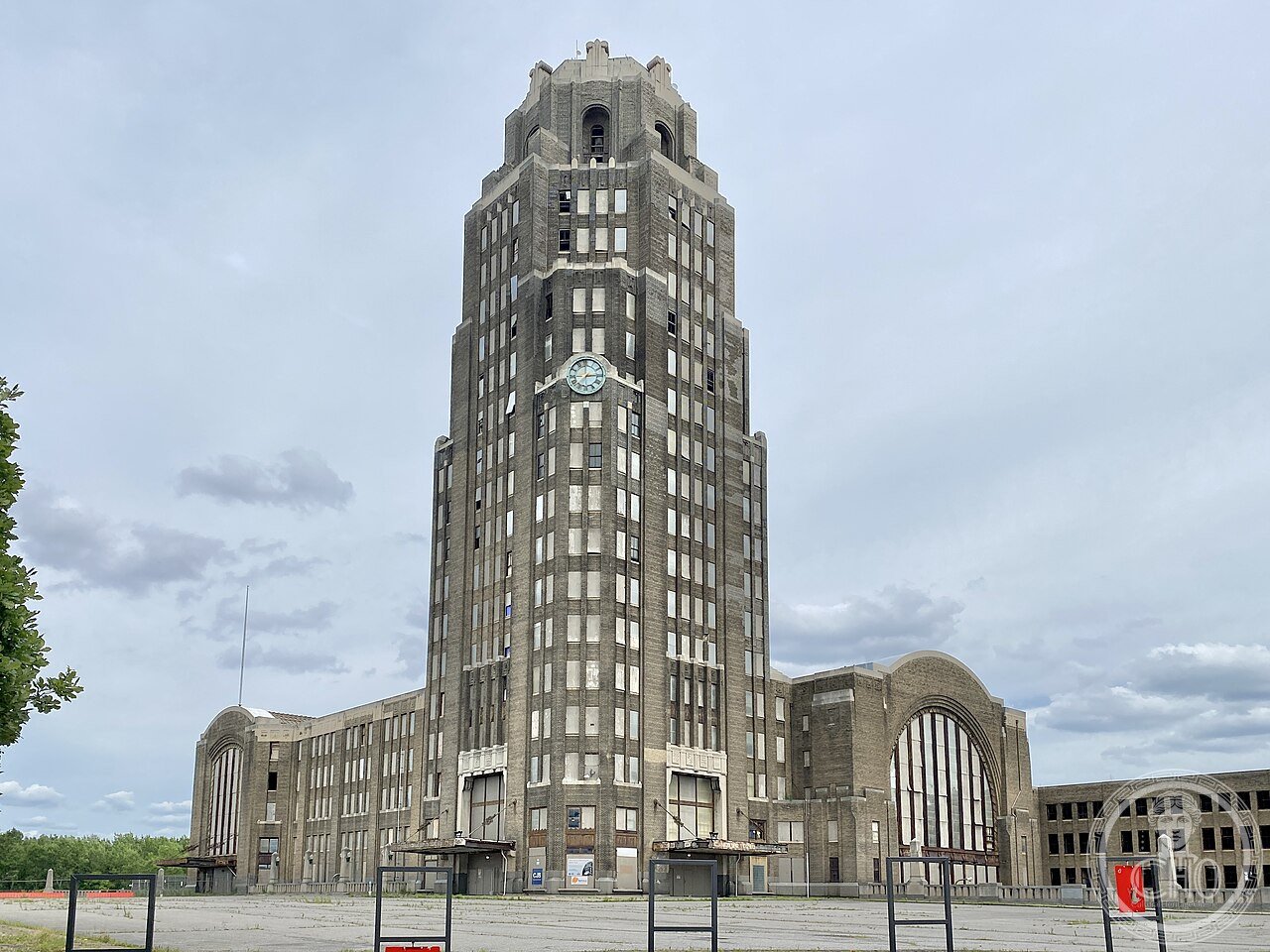
Rising from the flat industrial streets of the Broadway-Fillmore neighbourhood, Buffalo Central Terminal stands as one of the most dramatic — and most mourned — railway stations in America. Its 17-storey Art Deco tower, clad in terracotta and brick, soars above a 17-platform concourse that once processed thousands of passengers daily. Designed by architects Fellheimer & Wagner and opened in 1929 at the apex of American rail travel, the terminal was an act of civic optimism on a grand scale. But the postwar collapse of passenger rail, followed by the slow emptying of Buffalo itself, turned this cathedral of transport into the city's most potent symbol of post-industrial decline. Stripped of marble, brass, and ornament by scrappers, left to pigeons and urban explorers for decades, it has nevertheless survived — and since 2018 has been under active community-led restoration, becoming a symbol not of failure, but of stubbornness and renewal.
At a glance
- Type
- Railway station (historic)
- Period
- 1929 (closed 1984; restoration from 2018)
- Style
- Art Deco / Beaux-Arts
- Location
- 495 Paderewski Drive, Buffalo, New York, USA
- Coordinates
- 42.8872° N, 78.8228° W
- Architect(s)
- Fellheimer & Wagner
Overview
Buffalo Central Terminal is a 17-storey Art Deco tower attached to a massive concourse building that served as the main passenger rail hub for Buffalo and western New York for more than five decades. Opened in June 1929, the complex was one of the largest and most technologically advanced stations of its era, handling up to 200 trains per day at its peak during World War II. The tower housed offices, a hotel, and support functions; the concourse below contained waiting rooms, shops, and direct access to 17 tracks. After closure in 1984 it stood abandoned for over three decades, becoming a landmark of urban decline before community preservation efforts began reversing that story.
History
The New York Central Railroad commissioned Fellheimer & Wagner — specialists in railway architecture — to replace the old Exchange Street station with a facility worthy of Buffalo's industrial ambitions. The terminal opened on 22 June 1929, just months before the Wall Street Crash, but survived the Depression as a vital wartime hub. The decline of passenger rail in the postwar decades steadily reduced traffic; the last scheduled train departed on 28 October 1984. In the following years, the building was stripped of valuable materials and fell prey to vandalism and structural decay. A turning point came in 1997 when a group of local volunteers formed the Central Terminal Restoration Corporation. After years of advocacy, fundraising, and incremental repair, large-scale restoration began in 2018, with the concourse reopened for events and the tower undergoing structural stabilisation.
Architecture & Design
The design is a masterwork of late Art Deco in its most American, verticalist expression. The tower is clad in polychrome brick and terracotta with geometric ornamental bands; the base transitions into the concourse building via a series of arched bays. Inside, the main waiting room featured a vaulted ceiling, terrazzo floors, and elaborate tile work in ochre and cream. Fellheimer & Wagner were responsible for station design across multiple American cities; here they achieved their most imposing composition. The juxtaposition of industrial scale with decorative finesse — sunburst ornaments, stylised pilasters, bold corbels — gives the terminal a presence that makes its abandonment all the more painful as a cultural loss.
Cultural significance
No building in America more completely embodies the arc of industrial-era rise and postwar decline than Buffalo Central Terminal. Its image — the tower visible for miles, weeds growing through concourse tiles — became shorthand for the Rust Belt in journalism, photography, and documentary film. At the same time, the community restoration effort has become a model for grassroots historic preservation in cities where financial resources are limited but civic will is strong. The terminal is listed on the National Register of Historic Places and is considered one of the most significant endangered historic structures in the United States.
Visiting today
The Central Terminal Restoration Corporation organises regular public open days, tours, and cultural events in the restored concourse. The building is not continuously open; check the CTRC website for scheduled events and tour dates. Photography enthusiasts and architecture lovers will find the interior and exterior equally rewarding. The surrounding Broadway-Fillmore neighbourhood is easily navigable by car. Allow at least two hours for a thorough visit during open days.
Getting there
The terminal is located at 495 Paderewski Drive in the Broadway-Fillmore district, approximately 3 km east of downtown Buffalo. By car: take the Broadway exit from I-90 eastbound; street parking is available on Paderewski Drive during events. NFTA Metro Bus routes 4 and 14 stop on Broadway within a 10-minute walk. From Buffalo Niagara International Airport: approximately 20 minutes by car.
Sources & resources
Find it on the map
See this place and what’s around it →Record researched and written by Luigi De Marchi for Cultural Heritage Online, 2026.
📷 Become a Cultural Heritage Online photographer
Share your photos of places: they stay published under your name as the author. The more they're seen, the more you get noticed — and soon a contest will reward the most appreciated photos.
Log in or sign up free to add a photoIs this page about you?
This page is read by travellers and heritage enthusiasts who find it on Google. Tell us how you are connected to this place and we will take it from there.