
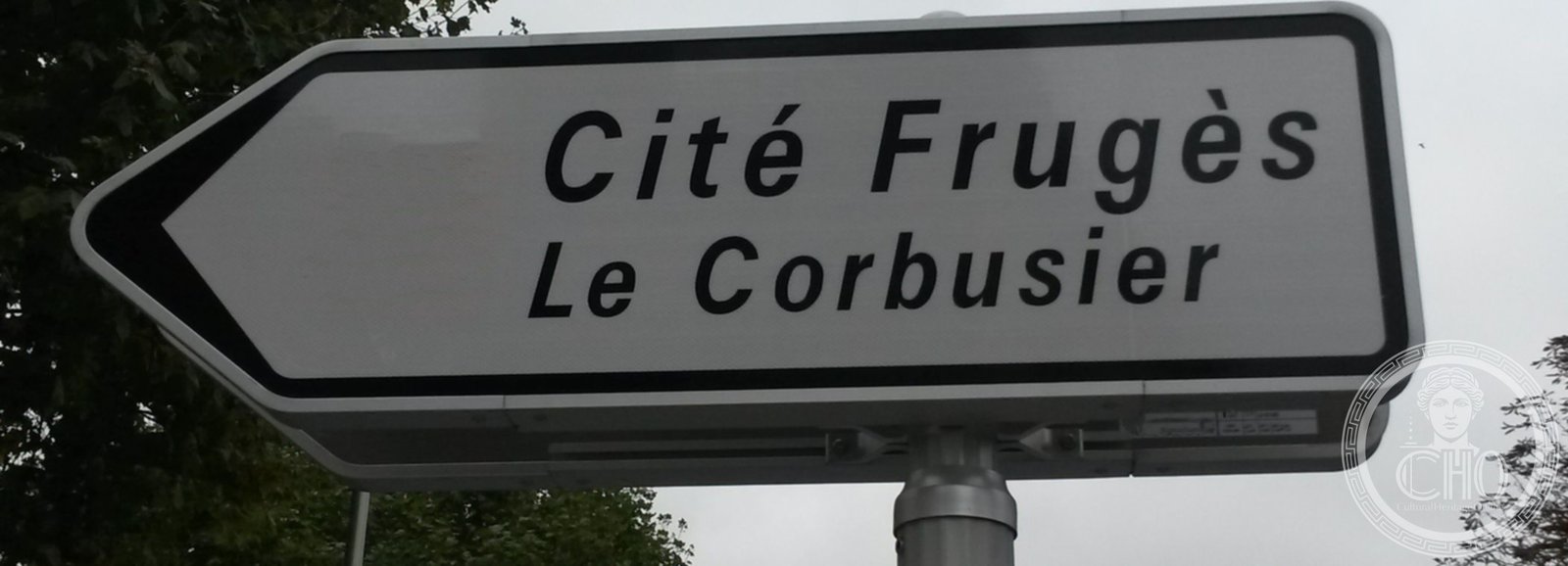
The Cité Frugès de Pessac is one of the most important social housing experiments of the twentieth century and the first full realisation of Le Corbusier’s revolutionary ideas about mass-produced, standardised housing. Commissioned by the enlightened industrialist Henri Frugès in 1924 and completed by 1926, the development of 53 houses in the Pessac suburb of Bordeaux was intended as a laboratory for the principles Le Corbusier had articulated in his 1923 manifesto Vers une Architecture — free plans, pilotis, ribbon windows, roof terraces, and interchangeable modular components. Le Corbusier and Pierre Jeanneret designed five house types that could be combined and stacked in different configurations, producing a townscape of extraordinary formal variety from a minimal palette. Today the Cité Frugès is a UNESCO World Heritage Site, inscribed in 2016 as part of the transnational series The Architectural Work of Le Corbusier — an Outstanding Contribution to the Modern Movement, and it remains inhabited, with many houses still in their original form.
At a glance
- Type
- Workers’ housing development (53 units)
- Period
- Designed 1924; completed 1926
- Style
- Purist / Le Corbusier Functionalism
- Location
- Pessac, near Bordeaux, Gironde, France
- Coordinates
- 44.7990° N, 0.6477° W
- Architect(s)
- Le Corbusier (Charles-Édouard Jeanneret); Pierre Jeanneret
Overview
The Cité Frugès — officially Les Quartiers Modernes Frugès — is a housing development in Pessac, a suburban commune southwest of Bordeaux. Commissioned by Henri Frugès, owner of a sugar refinery who sought to provide hygienic, modern housing for his workers while supporting experimental architecture, the project gave Le Corbusier his first opportunity to apply Purist housing theory at neighbourhood scale. The site comprises multiple streets laid out according to Le Corbusier’s planning principles, with 53 houses distributed across five typological variants. The UNESCO World Heritage inscription of 2016 placed it within a series of seventeen sites across seven countries representing Le Corbusier’s built work.
History
Henri Frugès had been following Le Corbusier’s writing and met the architect in 1924, giving him an unprecedented commission: design a workers’ village from scratch with no constraints and an open budget. Le Corbusier and Jeanneret developed five standardised house types — the Arcade, Isolated, Gratte-Ciel, Quinconce, and Zig-Zag — which could be combined to create the impression of variety. The houses were originally painted in bold primary colours (blue, red, green, yellow, white), which Le Corbusier considered integral to the architecture. Construction was completed by 1926, but the project was never fully realised: Frugès ran into financial difficulties and only 53 of the planned 130 units were built. The initial residents found the flat roofs prone to leaking and the open plans disorienting; many made modifications over the decades. By the 1980s, concern over the integrity of this major historic site prompted studies and conservation efforts, culminating in the UNESCO inscription.
Architecture & Design
The Cité Frugès is the built embodiment of the Five Points of Architecture that Le Corbusier would later codify: pilotis lifting the building from the ground, a free plan unconstrained by load-bearing walls, a free facade, ribbon windows running the width of the house, and roof terraces. The houses are constructed of reinforced concrete using a standardised structural frame — one of the earliest applications of industrial production methods to domestic architecture in France. The Gratte-Ciel type, a narrow two-storey tower, is particularly striking: stacked vertically with ribbon windows, it anticipates the high-density urban housing that Le Corbusier would develop in later projects. The original colour scheme — a rainbow of Purist tones — has been partially restored on several houses after decades of overpainting in conventional shades.
Cultural significance
The Cité Frugès is foundational to the history of modern architecture and social housing. It demonstrated for the first time that the machine-age ideals of standardisation and industrial production could be applied to housing at neighbourhood scale — a proof of concept that shaped social housing policy across Europe for the following half-century. Its UNESCO inscription affirms its status as one of Le Corbusier’s key contributions to the Modern Movement. It also raises enduring questions about the relationship between the architect’s vision and the lived needs of inhabitants, making it a continuing subject of study in architecture schools worldwide.
Visiting today
The Cité Frugès is a living neighbourhood and its streets are publicly accessible on foot at any time. The exterior of the houses can be photographed freely from the street. The Maison Le Corbusier (the restored Gratte-Ciel unit at rue Le Corbusier 4) serves as a small museum and information centre open to visitors; guided tours are available in French and English. Entry to the museum is charged. Check the municipality of Pessac for current opening times and booking information.
Getting there
Pessac is a 15-minute journey from Bordeaux Saint-Jean station by TER regional train (Pessac station). The Cité Frugès is approximately 1.5 km from Pessac station; local bus line 16 stops near the site, or the walk takes around 20 minutes. By car from Bordeaux city centre, the journey is approximately 20 minutes via the A630 ring road. Paid parking is available near the site. Bordeaux–Mérignac airport is 10 km away.
Sources & resources
Find it on the map
See this place and what’s around it →Record researched and written by Luigi De Marchi for Cultural Heritage Online, 2026.
📷 Become a Cultural Heritage Online photographer
Share your photos of places: they stay published under your name as the author. The more they're seen, the more you get noticed — and soon a contest will reward the most appreciated photos.
Log in or sign up free to add a photo