
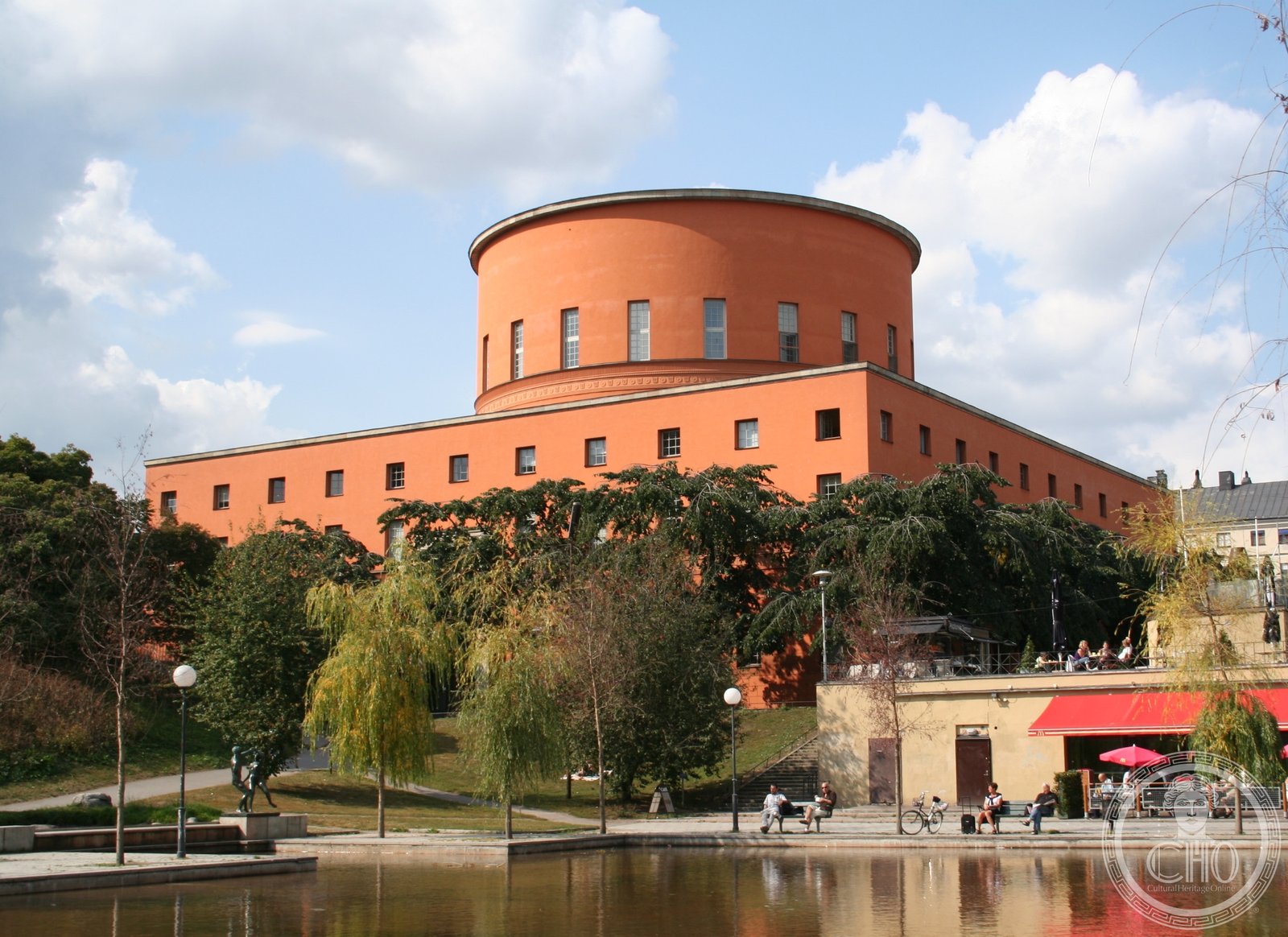
Rising above the rooftops of Vasastan, the Stockholm Public Library announces itself through pure geometry: a tall cylindrical drum erupting from a square cubic base, its ochre-rendered walls stripped of ornament, its authority derived entirely from proportion and mass. Designed by Erik Gunnar Asplund and opened on 31 March 1928, it stands as the pivotal work of his career — the moment where the lingering warmth of Nordic Classicism gives way to something harder, more absolute, yet still deeply humane. The circular reading room inside, its shelves rising the full height of the drum in concentric rings of knowledge, has no parallel in library architecture anywhere in the world. Sweden’s first institution to implement open-shelf access, it transformed the relationship between reader and book. More than a building, it is a manifesto in rendered brick and limestone, one of the most quietly radical spaces of the twentieth century.
At a glance
- Type
- Public library
- Period
- 1924–1928 (west wing 1932)
- Style
- Swedish Grace / Nordic Classicism transitioning to Modernism
- Location
- Sveavägen 73, Vasastan, Stockholm, Sweden
- Coordinates
- 59.3434° N, 18.0543° E
- Architect(s)
- Erik Gunnar Asplund
Overview
The Stockholm Public Library occupies a commanding position on Sveavägen, its cylindrical rotunda visible from afar as a landmark of intellectual life. Asplund conceived the building as a civic monument that would serve the democratic ideals of an emerging welfare state — knowledge freely available to all, housed in a space of genuine architectural ambition. The exterior reads as a tension between two languages: the cubic base recalls the rational geometry of French Neoclassicism, while the drum above it reaches toward something altogether more abstract. Custom furniture, fittings, and lamp fixtures designed specifically for the building complete an interior of rare coherence. Holding over 1.5 million books across forty branches in the Stockholm system, this flagship remains the heart of one of Europe’s most celebrated public library networks.
History
Planning for a major public library for Stockholm began in earnest in 1918, driven by the city’s rapidly expanding population and the progressive belief that public education was a civic responsibility. Asplund presented a scheme in 1922 and construction commenced in 1924. The main building opened on 31 March 1928, though financial constraints delayed completion of the west wing until 1932. The building was the first in Sweden to introduce open-shelf borrowing, ending the tradition of requesting books from unseen stacks — a seemingly simple change that fundamentally altered the culture of reading. Decades of heavy use eventually necessitated a major renovation, and the library closed in 2024 with reopening expected in 2028. Throughout its history it has attracted the admiration of architects worldwide, generating extensive preservation advocacy and scholarly analysis.
Architecture & Design
Asplund’s masterstroke is the rotunda: a cylindrical drum that rises dramatically above the square base, generating a silhouette of pure abstract force. Earlier designs had proposed a dome — a concession to conventional civic grandeur — but Asplund abandoned it in favour of the open cylinder, which floods the interior reading room with natural light from above. Inside, bookshelves line the full circumference of the drum from floor to ceiling, creating a vertiginous, immersive environment where architecture and collection become inseparable. The colour palette is warm but spare — ochre renders, limestone trim, dark timber joinery — and every object from reading lamps to catalogue cabinets was custom-designed. The elimination of historicist ornament, the reduction of classical motifs to their geometric essence, marks this as the hinge point of Asplund’s evolution toward the radical Functionalism of his later Woodland Crematorium.
Cultural significance
The Stockholm Public Library is widely regarded as one of the defining buildings of twentieth-century Scandinavian architecture and a touchstone of international Modernism. It demonstrated that civic architecture could be simultaneously monumental and democratic — grand without being intimidating, stripped of aristocratic ornament yet invested with genuine dignity. As Sweden’s first open-shelf public library it embodied Enlightenment ideals translated into social policy. Asplund’s influence on subsequent generations of Nordic architects — from Aalto to Utzon — passed substantially through this building. Today it is studied in architecture schools worldwide as the exemplary case of how geometry alone, handled with mastery, can produce spaces of profound emotional power.
Visiting today
The library is currently closed for a major renovation programme that began in 2024, with reopening anticipated in 2028. Visitors can view the exterior at any time — the cylindrical drum on Sveavägen remains one of Stockholm’s most photographed landmarks. For current project updates and programme information, consult the Stockholm Public Library website. The surrounding Vasastan neighbourhood offers a rich concentration of early twentieth-century architecture worth exploring on foot while the building is under restoration.
Getting there
The library stands at Sveavägen 73 in Vasastan. The nearest metro station is Odenplan (T-bana lines 17, 18, 19), a two-minute walk to the south. Several bus lines stop on Sveavägen directly outside. From Stockholm Central Station the building is reachable in under fifteen minutes on foot via Drottninggatan, or in five minutes by metro with one change at T-Centralen.
Sources & resources
Find it on the map
See this place and what’s around it →Record researched and written by Luigi De Marchi for Cultural Heritage Online, 2026.
📷 Become a Cultural Heritage Online photographer
Share your photos of places: they stay published under your name as the author. The more they're seen, the more you get noticed — and soon a contest will reward the most appreciated photos.
Log in or sign up free to add a photoIs this page about you?
This page is read by travellers and heritage enthusiasts who find it on Google. Tell us how you are connected to this place and we will take it from there.