
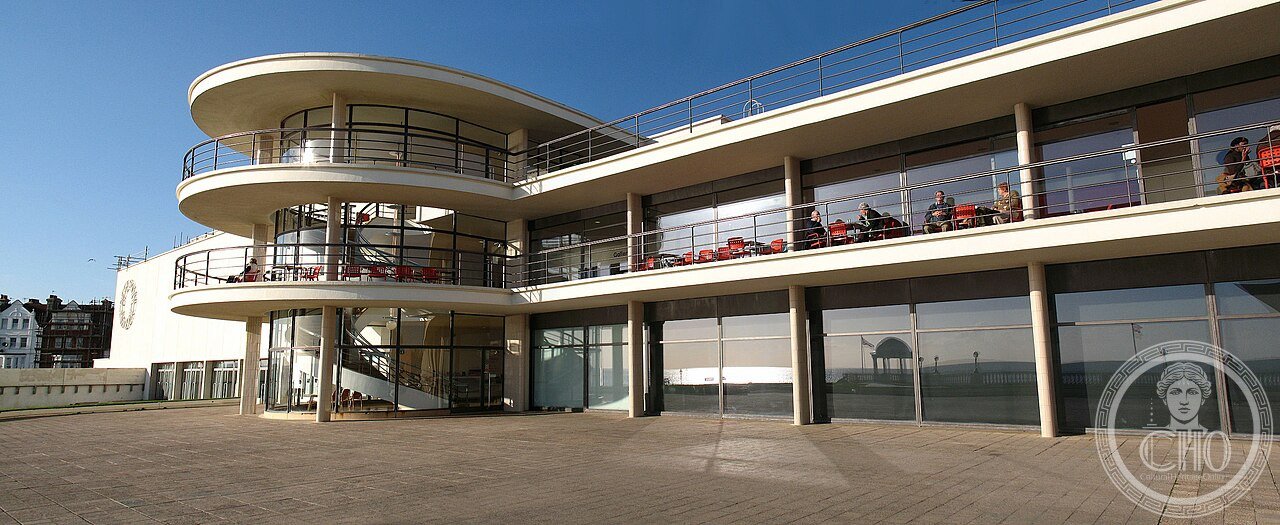
Rising above the shingle beach of Bexhill-on-Sea on the East Sussex coast, the De La Warr Pavilion is one of the defining works of British Modernism — and a building that arrived, in 1935, like a provocation. Commissioned by Herbrand Sackville, the 9th Earl De La Warr, and won through open architectural competition by the emigré partnership of Erich Mendelsohn and Serge Chermayeff, the pavilion introduced to Britain the language of the International Style: sweeping curves, a welded steel frame, continuous bands of metal-framed glazing, and cantilevered terraces that face the English Channel as though scanning the horizon. Its famous spiral staircase — encased in a glass drum and rising through three floors — became an instant icon, reproduced endlessly on postcards and in architecture textbooks. Grade I listed since 1986, the building underwent meticulous restoration between 2004 and 2005 and reopened as a contemporary arts centre that commissions new work, hosts live performance, and serves as the cultural heart of the Sussex coast.
At a glance
- Type
- Cultural centre and gallery
- Period
- 1935
- Style
- International Style / Modernist
- Location
- Marina, Bexhill-on-Sea, East Sussex, England, UK
- Coordinates
- 50.8375° N, 0.4716° E
- Architect(s)
- Erich Mendelsohn and Serge Chermayeff
Overview
The De La Warr Pavilion was conceived as a public leisure and arts venue for the people of Bexhill, funded by the progressive Earl De La Warr who served as the town’s mayor. Mendelsohn and Chermayeff beat 230 entries in the 1934 competition with a design that pioneered welded steel frame construction in Britain, with structural engineering by Felix Samuely. The building opened on 12 December 1935, inaugurated by the Duke and Duchess of York — later King George VI and Queen Elizabeth.
History
Construction began in January 1935 on a seafront site adjacent to the Metropole hotel. During the Second World War the military requisitioned the pavilion; the comedian Spike Milligan served a posting there, an episode he later described vividly in his wartime memoirs. German bombing destroyed the neighbouring Metropole, causing minor foundation damage to the pavilion. In subsequent decades inappropriate modifications and years of under-investment eroded the building’s fabric. A Heritage Lottery Fund and Arts Council grant enabled a £7 million restoration by architects Troughton McAslan, completed in October 2005. In 2022 Storm Eunice destroyed a more recent bandstand addition on the seafront terrace.
Architecture & Design
Mendelsohn and Chermayeff’s design is animated by the tension between horizontality and verticality. Long ribbon windows and cantilevered sun terraces emphasise the horizontal sweep of the seafront, while the glass drum enclosing the spiral staircase punctuates the composition vertically. The welded (rather than riveted) steel frame — a structural innovation for Britain at the time — allowed unusually large and uninterrupted window openings. Interior spaces flow openly between auditorium, restaurant, and gallery, organised around the double-height entrance foyer that still retains much of its original fabric.
Cultural significance
The pavilion represents a pivotal moment in British cultural history: the arrival of European Modernism in a seaside town, championed by an aristocrat with socialist sympathies and realised by two architects fleeing the rise of fascism in Germany. It stands as evidence that progressive architecture could serve a broad public rather than a wealthy elite. Its Grade I listing places it among the most important twentieth-century buildings in England, and its ongoing life as a working arts venue — commissioning artists, presenting music and theatre — has made it a model for how heritage buildings can remain genuinely contemporary.
Visiting today
The De La Warr Pavilion is open daily with free entry to the galleries and café. Exhibition programmes change regularly, with a strong focus on contemporary and site-specific commissions. The rooftop restaurant offers views across the English Channel. Events — concerts, film screenings, talks — fill the year-round programme. The building is fully accessible.
Getting there
Bexhill-on-Sea is served by direct trains from London Bridge, London Charing Cross, and Eastbourne (approximately 90 minutes from London). The pavilion is a five-minute walk from Bexhill station along the seafront. By car, the A259 connects Bexhill to Eastbourne and Hastings; on-street parking is available on Marina.
Sources & resources
Find it on the map
See this place and what’s around it →Record researched and written by Luigi De Marchi for Cultural Heritage Online, 2026.
📷 Become a Cultural Heritage Online photographer
Share your photos of places: they stay published under your name as the author. The more they're seen, the more you get noticed — and soon a contest will reward the most appreciated photos.
Log in or sign up free to add a photoIs this page about you?
This page is read by travellers and heritage enthusiasts who find it on Google. Tell us how you are connected to this place and we will take it from there.