
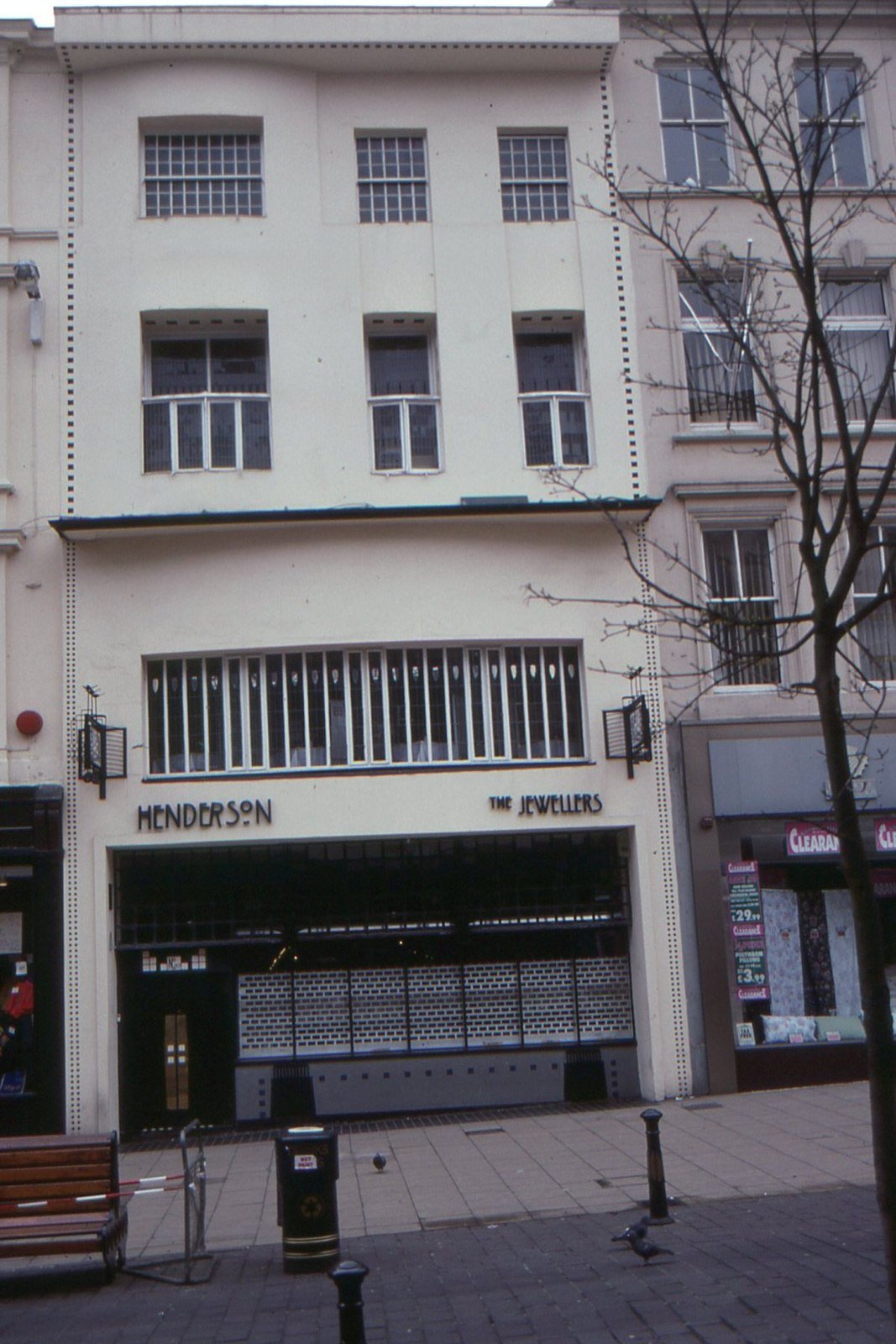

The only Mackintosh tearoom to survive in its original location — an intimate Glasgow landmark where Art Nouveau ornament, Japanese spatial thinking and the Gaelic meaning of a street name converge in a single interior.
At a glance
In 1903 Charles Rennie Mackintosh (1868–1928) designed every detail of the Willow Tea Rooms for entrepreneur and tearoom owner Kate Cranston: the facade, the furniture, the leaded-glass panels and the mirrored frieze of the first-floor Room de Luxe. Sauchiehall Street takes its name from the Gaelic sauchan (willow) and haugh (meadow), a etymology Mackintosh wove into the decoration throughout. Of the four Glasgow tearooms he created with Cranston, this is the sole one that stands today in its original building, restored and reopened under the care of the Willow Tea Rooms Trust after a major conservation project completed in 2018.
Key facts
- Name: The Willow Tea Rooms (also Willow Tearooms)
- Address: 217 Sauchiehall Street, Glasgow G2 3EX, Scotland
- GPS: 55.8652° N, 4.2611° W — Google Maps
- Architect: Charles Rennie Mackintosh (1868–1928), interior design and fitments
- Client: Catherine (Kate) Cranston (1849–1934)
- Opened: 1903
- Listing: Category A Listed Building (Historic Environment Scotland)
- Current management: Willow Tea Rooms Trust
- Style: Glasgow Style / Arts and Crafts / Art Nouveau
History
Kate Cranston ran a chain of temperance tearooms in late-Victorian and Edwardian Glasgow that were deliberately designed as respectable, female-friendly public spaces — a social innovation in an era when women had few options for meeting outside the home. She commissioned Mackintosh for a series of interiors beginning in the 1890s: Buchanan Street (1896), Argyle Street (1897) and Ingram Street (1900) preceded the Sauchiehall Street building, which was the only project where Mackintosh had full control of the exterior facade as well as every interior element.
The building opened in 1903. The name was not arbitrary: Sauchiehall derives from the Gaelic words for willow and meadow, and Mackintosh made the willow motif the unifying thread across furniture carvings, stencilled panels and the sinuous leaded-glass work of the Room de Luxe on the first floor. Cranston sold her tearooms in 1919, and the Sauchiehall Street building passed through several commercial uses over the following decades, including a period as a billiard hall and later a jewellery shop. By the early 2000s the upper floors were in serious disrepair.
The Willow Tea Rooms Trust was established to undertake a full heritage restoration. The project, supported by the Heritage Lottery Fund and Historic Environment Scotland, ran from approximately 2014 to 2018 and included structural consolidation of the upper floors and conservation of surviving original fixtures. The restored tearoom and visitor attraction reopened in 2018, making it the centrepiece of Glasgow’s 2018 Year of Young People cultural programme and the wider Charles Rennie Mackintosh 150th anniversary commemorations.
What you see
The Sauchiehall Street facade is relatively restrained: the three upper floors read as a white rendered surface articulated by narrow vertical windows, with Mackintosh’s characteristic elongated proportions and the original signage reinstated after the 2018 restoration. Inside, the ground floor accommodates a tearoom open to all visitors. The Room de Luxe on the first floor is the architectural centrepiece. Mackintosh designed the high-backed chairs with their characteristic ladder-back geometry, upholstered in purple and silver — colours that reinforced the willow palette. The mirrored frieze multiplies the leaded-glass panels in the door, which incorporate stylised willow branches in pale green and silver-grey glass. The overall spatial effect is compressed and jewel-like: a room that feels both intimate and ceremonially precise, closer to a Japanese tea pavilion than to an Edwardian parlour.
The restoration returned several items of original furniture to the building. The leaded-glass door panel to the Room de Luxe is among the best-preserved examples of Mackintosh decorative glass in situ. Display cases in the gallery level present drawings, photographs and archival material documenting the original commission and the sequence of Cranston’s four Glasgow tearooms. Mackintosh’s pattern language — the elongated rose, the flowing willow line, the interplay of rectilinear structure with organic ornament — is readable throughout every layer of the building, from door handles to ceiling details.
Charles Rennie Mackintosh and Kate Cranston
Mackintosh (born Glasgow 1868, died London 1928) was the most prominent figure in the Glasgow Style, a regional variant of Art Nouveau that synthesised Arts and Crafts principles, Celtic ornament and strong Japanese spatial influence. His international reputation rests primarily on the Glasgow School of Art (1896–1909) and the Hill House in Helensburgh (1902–04), but it was the Cranston tearooms that gave him sustained commercial patronage in his home city.
Kate Cranston (1849–1934) was a remarkable patron. Her tearooms were not simply restaurants but social experiments: they welcomed women alone or in groups at a time when public dining was predominantly male-coded. By commissioning progressive designers — Mackintosh from 1896 onward, and also George Walton for some earlier interiors — she made Glasgow’s tearooms internationally noted as examples of integrated interior design. The Willow Tea Rooms of 1903 represents the fullest expression of this collaboration, because it was the first project where Cranston gave Mackintosh exterior control from the outset.
The Willow Tea Rooms Trust
The Willow Tea Rooms Trust is the charitable body that owns and operates the restored building at 217 Sauchiehall Street. It was established specifically to save the building from ongoing dereliction of the upper floors and to return it to public use as a functioning tearoom and heritage visitor attraction. The restoration project, completed in 2018, was funded through a combination of Heritage Lottery Fund grants, Historic Environment Scotland support, and a public fundraising campaign tied to the Charles Rennie Mackintosh 150th anniversary. The Trust now operates the ground-floor tearoom commercially, using income to maintain the building and sustain the visitor programme. A separate commercial operation under the Willow Tea Rooms brand exists on Buchanan Street in Glasgow, but that later venue is not managed by the Trust and does not occupy a Mackintosh-designed building.
Visiting
- Tearoom: Open to all visitors; the ground-floor café serves teas, coffees and light meals in the restored Mackintosh setting
- Room de Luxe: Accessible as part of the heritage visit; check the Trust’s website for current opening hours and admission details as these may vary seasonally
- Guided tours: Heritage tours covering the history of the building, the restoration and the Cranston–Mackintosh collaboration are available; booking recommended
- Photography: Generally permitted for personal use in public areas
- Accessibility: The restored building includes lift access to upper floors; verify current access arrangements with the Trust before visiting
- Time needed: Allow 45–90 minutes for a tearoom visit combined with the heritage gallery
Getting there
The Willow Tea Rooms stand at 217 Sauchiehall Street, Glasgow G2 3EX, approximately ten minutes’ walk from Glasgow Central Station via Hope Street and Sauchiehall Street. The nearest underground station is Cowcaddens on the Clockwork Orange (Glasgow Subway), a two-minute walk east along Sauchiehall Street. St Enoch subway station is approximately fifteen minutes’ walk to the south. Multiple bus routes serve Sauchiehall Street. There is no dedicated parking immediately adjacent; the Buchanan Galleries multi-storey car park on Killermont Street is the closest major parking facility.
Nearby heritage
- Glasgow School of Art (Mackintosh Building) — approximately 300 m south on Renfrew Street; Mackintosh’s most celebrated commission, currently under restoration following fires in 2014 and 2018
- Queen’s Cross Church (now CRM Society headquarters) — approximately 2.5 km north-west via Great Western Road; the only Mackintosh-designed church to be built, housing the Charles Rennie Mackintosh Society archive
- Kelvingrove Art Gallery and Museum — approximately 2.5 km west; holds significant Mackintosh collections including drawings and decorative objects from the Cranston tearooms
- The Lighthouse (Scotland’s Centre for Design and Architecture) — approximately 600 m south-east on Mitchell Street; occupies a building Mackintosh converted from a Herald newspaper office in 1895, with a dedicated Mackintosh interpretation centre
Sources
- Wikipedia, Willow Tearooms — overview, historical sequence, restoration
- Wikipedia, Charles Rennie Mackintosh — biography and career context
- Wikipedia, Catherine Cranston — patron biography, social history of Glasgow tearooms
- Willow Tea Rooms Trust — willowtearooms.co.uk — current operations and visiting information
- Historic Environment Scotland — Category A Listing record for 217 Sauchiehall Street, Glasgow
Find it on the map
See this place and what’s around it →Record researched and written by Luigi De Marchi for Cultural Heritage Online, 2026.
📷 Become a Cultural Heritage Online photographer
Share your photos of places: they stay published under your name as the author. The more they're seen, the more you get noticed — and soon a contest will reward the most appreciated photos.
Log in or sign up free to add a photoIs this page about you?
This page is read by travellers and heritage enthusiasts who find it on Google. Tell us how you are connected to this place and we will take it from there.