
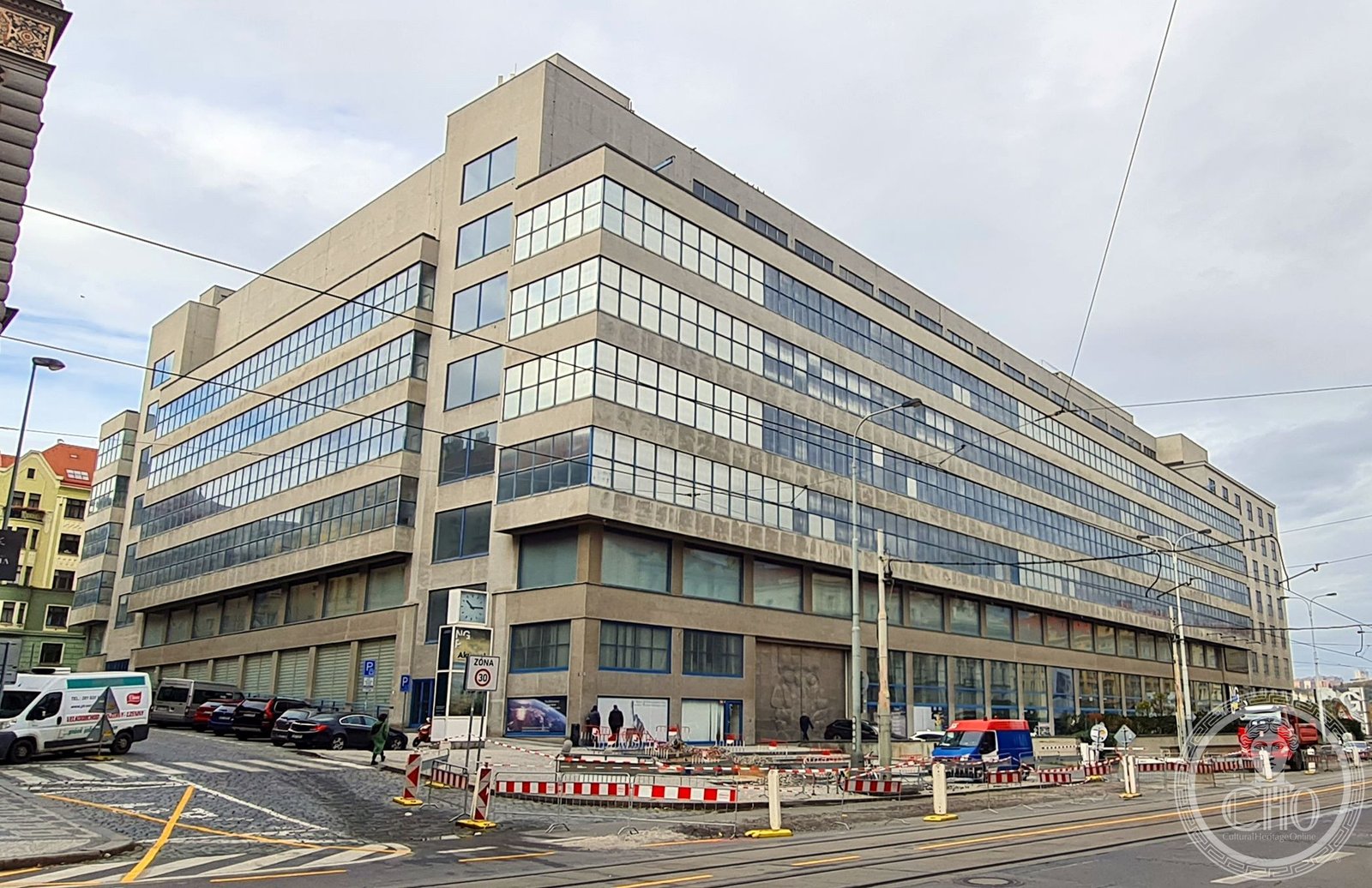
The Trade Fair Palace—Veletržní palác in Czech—stands in Prague's Holešovice district as one of the great monuments of European Functionalist architecture. Designed by architects Josef Fuchs and Oldřich Tyl and completed in 1928, it was the first functionalist building in Prague and, at the time of its opening, the largest functionalist building in the world. Originally constructed to house international trade fairs, the palace was severely damaged by fire in 1974 and subsequently transferred to the National Gallery Prague. After a lengthy restoration it reopened in 1995 as the National Gallery's largest exhibition site, now housing its remarkable collection of twentieth-century and contemporary art. The building is a benchmark of Czech Functionalism, a movement that shared with Art Déco the values of geometric rigour and modern construction but pushed further toward pure rationalist abstraction.
At a glance
- Type
- Museum (former trade fair hall)
- Period
- 1925–1928
- Style
- Czech Functionalism
- Location
- Dukelských hrdinů 530/47, Prague 7–Holešovice, Czech Republic
- Coordinates
- 50.101° N, 14.433° E
- Architect(s)
- Josef Fuchs; Oldřich Tyl
Overview
The Trade Fair Palace occupies a full city block in Holešovice, a former industrial quarter of Prague on the left bank of the Vltava. Its seven-storey reinforced-concrete frame, wrapped in a grid of windows and white plaster, exemplifies the rationalist ideals of interwar Czech Functionalism: clarity of structure, rejection of ornament, and expression of function through form. The building's monumental scale—13,500 square metres of floor area—was without precedent for a functionalist structure anywhere in the world at the time of its inauguration on 28 September 1928.
History
After Czechoslovakia gained independence in 1918, the new state sought an international-standard trade exhibition venue. A competition launched in 1924 invited six Czech architects; Josef Fuchs and Oldřich Tyl's collaborative design was selected. Construction began in spring 1925 on the site of a former steelworks, and the palace was completed and opened in September 1928, inaugurated with the first public showing of Alfons Mucha's Slav Epic. After serving as a trade and commercial hub for decades, a catastrophic six-day fire broke out in 1974. Ownership passed to the National Gallery Prague, which undertook a major restoration leading to the building's reopening in 1995 as an art museum.
Architecture & Design
The Trade Fair Palace is an exemplar of Czech Functionalism, a movement that developed in parallel with Art Déco but diverged toward austere rationalism rather than ornamental refinement. Where Art Déco celebrated geometric decoration and luxurious materials, Czech Functionalism pursued structural honesty and the elimination of superfluous form. The façade's repetitive grid of windows and load-bearing piers, the open interior courts and the expansive floor plates anticipated modernist design principles that would only become mainstream after the Second World War. The building's influence on European architecture was immediate and widely acknowledged.
Cultural significance
As the first and largest functionalist building in Prague at the time of its completion, the Trade Fair Palace represents a decisive moment in Central European architectural history. It demonstrated that a major public building could abandon historical ornament entirely without sacrificing civic dignity. Since its transformation into the National Gallery Prague's flagship venue, it has become one of the most important modern art museums in Central Europe, housing key works from the early twentieth century to the present and attracting hundreds of thousands of visitors annually.
Visiting today
The Trade Fair Palace is open to the public as part of the National Gallery Prague network (Tues–Sun). It houses the gallery's permanent collection of twentieth-century and contemporary Czech and international art, including works by Picasso, Monet, Klimt and major Czech modernists. Temporary exhibitions occupy additional floors. Admission tickets are available on site and online; National Gallery network passes allow entry to multiple sites.
Getting there
The Trade Fair Palace is easily reached from Prague city centre by tram (lines 12, 17 or 24) alighting at Výstaviště or Holešovice tram stops. The Nadráží Holešovice metro station (Line C, red line) is approximately ten minutes on foot. From Prague Václav Havel Airport, take the airport bus or express to the city centre and connect by tram.
Sources & resources
Find it on the map
See this place and what’s around it →Record researched and written by Luigi De Marchi for Cultural Heritage Online, 2026.
📷 Become a Cultural Heritage Online photographer
Share your photos of places: they stay published under your name as the author. The more they're seen, the more you get noticed — and soon a contest will reward the most appreciated photos.
Log in or sign up free to add a photoIs this page about you?
This page is read by travellers and heritage enthusiasts who find it on Google. Tell us how you are connected to this place and we will take it from there.