
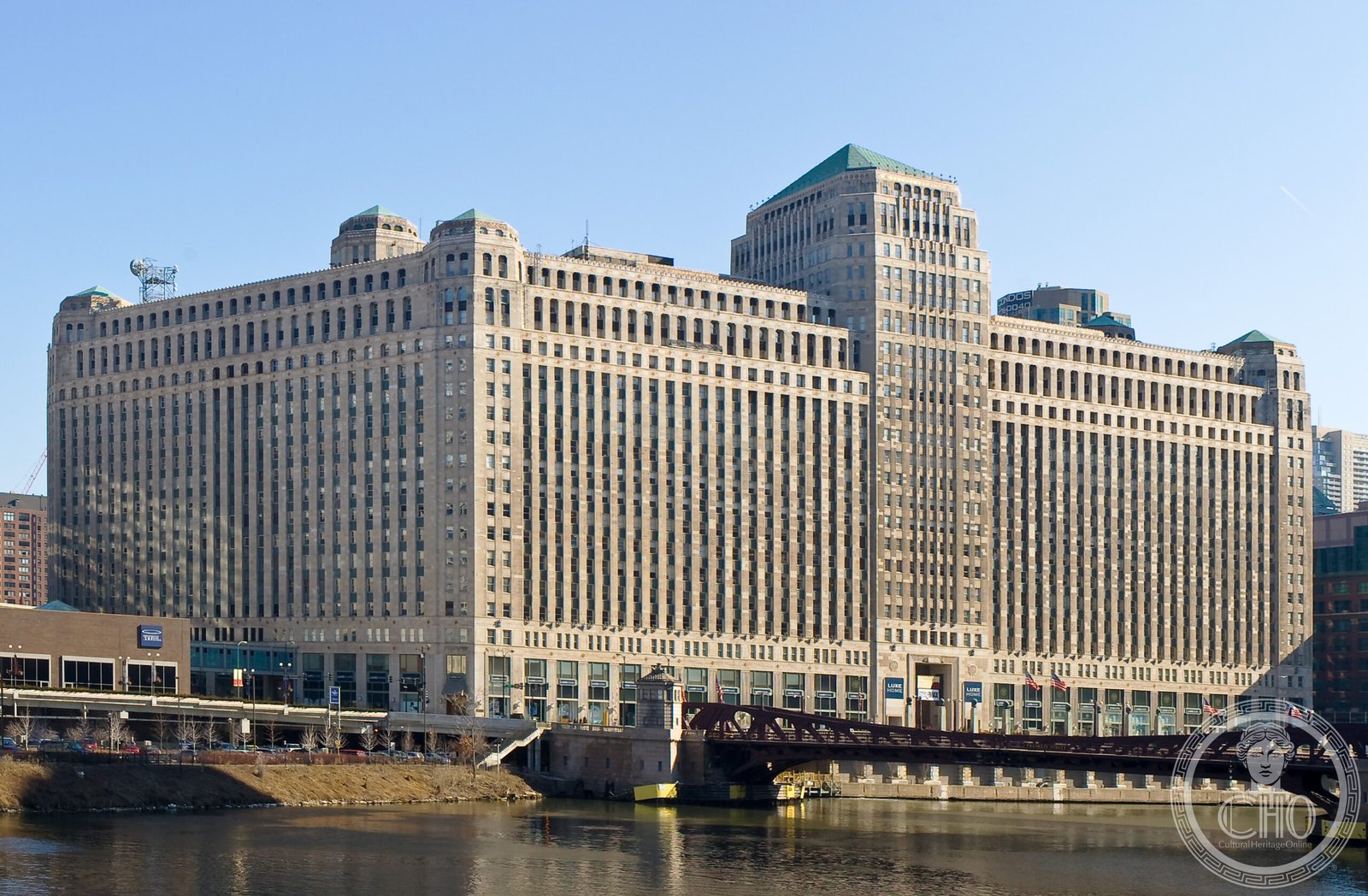
Rising eighteen stories above the north bank of the Chicago River, the Merchandise Mart stands as one of the most commanding commercial landmarks in the United States. Completed in 1930 to designs by Graham, Anderson, Probst and White, this Art Déco colossus originally held the title of the world’s largest building by floor space, encompassing four million square feet across its massive footprint. Built for Marshall Field & Company to consolidate wholesale trade operations, it redefined the scale of commercial architecture and helped anchor Chicago’s Near North Side as a hub of design and commerce. Today it remains one of the city’s most recognisable skyline elements, hosting the global contract furnishings industry and drawing visitors with its remarkable history, lobby details, and the luminous “Art on theMART” projection programme.
At a glance
- Type
- Commercial building / cultural centre
- Period
- 1928–1930
- Style
- Art Déco
- Location
- 222 Merchandise Mart Plaza, Chicago, Illinois, USA
- Coordinates
- 41.8884° N, 87.6355° W
- Architect(s)
- Graham, Anderson, Probst and White (Alfred P. Shaw, chief architect)
Overview
The Merchandise Mart occupies an entire city block along the Chicago River, its eighteen-storey base crowned by a twenty-five-storey central tower reaching 340 feet. With 6.2 million square feet of floor space following a 1977 expansion, it long functioned as the city’s wholesale trade nerve centre. Today the building operates as a mixed-use commercial complex known as theMART, concentrating contract furniture showrooms, technology firms, television studios, retail outlets, and event spaces under one roof. The NeoCon trade show, held annually in the building, attracts more than fifty thousand design professionals from around the world and is considered the leading forum for commercial interior design in North America.
History
Construction began on 16 August 1928, driven by Marshall Field & Company’s ambition to bring thirteen scattered wholesale warehouses under a single roof. The building opened on 5 May 1930, briefly holding the record as the world’s largest structure by floor area — a distinction it kept until the Pentagon was completed in 1943. In 1945 the Kennedy family purchased the building, retaining ownership until 1998 when Vornado Realty Trust acquired it for 550 million dollars. The building once had its own postal code, ZIP 60654, reflecting its sheer scale and self-contained character. NBC operated the first television studios in Chicago here from 1930, and on 15 April 1956 — known locally as “C-Day” — it became the site of the first all-colour television broadcast in the United States.
Architecture & Design
The exterior presents the restrained, geometric authority characteristic of American Art Déco at its most self-confident. Ribbon piers of light-coloured limestone rise vertically through the façade, emphasising height and disciplined repetition. Chamfered corner towers soften the building’s bulk while adding a sculptural rhythm, and fifty-six terra cotta busts of American Indian chiefs punctuate the parapet in an unusual decorative programme. The double-height lobby is a showcase of the period’s decorative vocabulary: terrazzo floors, marble piers, and bronze trim combine with Jules Guérin’s frieze of seventeen murals depicting scenes of global commerce, commissioned to underscore the building’s role as a world trading hub.
Cultural significance
The Merchandise Mart holds an outsized place in Chicago’s cultural memory as a monument to the city’s commercial ambition. It shaped wholesale trade practices across North America for decades, and its Kennedy-era ownership embedded it in the mythology of one of the country’s most prominent political families. Its television broadcasting history links it to the birth of American mass media. More recently the building has become a canvas in the literal sense: since 2018 the “Art on theMART” programme projects large-scale digital artworks by international artists onto the river-facing façade each autumn, transforming one of the world’s largest architectural surfaces into a public gallery visible from both banks of the Chicago River.
Visiting today
The Shops at the Mart on the ground floor are open to the general public and include restaurants, service businesses, and a United States Post Office. Design showrooms on upper floors opened partially to the public in 2010, and guided architecture tours are available for groups with an interest in design history. The “Art on theMART” outdoor projection series runs on scheduled evenings from spring through autumn along the Chicago River façade; admission is free and viewing is best from the riverwalk on the south bank. The annual NeoCon trade fair (typically held in June) brings the building’s showrooms fully alive for registered design professionals.
Getting there
The building is directly served by the Chicago ‘L’ at Merchandise Mart station, on the Brown and Purple lines, which opened alongside the building in December 1930 and remains one of the most central stops on the elevated rail network. Multiple bus routes run along Wells Street and Franklin Street adjacent to the building. Pedestrians can approach via the Chicago Riverwalk from the south or through the Wells Street Bridge from the Loop. Street-level entrances on Merchandise Mart Plaza and the North Bank Drive offer direct access for visitors arriving by taxi, rideshare, or on foot from surrounding River North hotels.
Sources & resources
Find it on the map
See this place and what’s around it →Record researched and written by Luigi De Marchi for Cultural Heritage Online, 2026.
📷 Become a Cultural Heritage Online photographer
Share your photos of places: they stay published under your name as the author. The more they're seen, the more you get noticed — and soon a contest will reward the most appreciated photos.
Log in or sign up free to add a photoIs this page about you?
This page is read by travellers and heritage enthusiasts who find it on Google. Tell us how you are connected to this place and we will take it from there.