
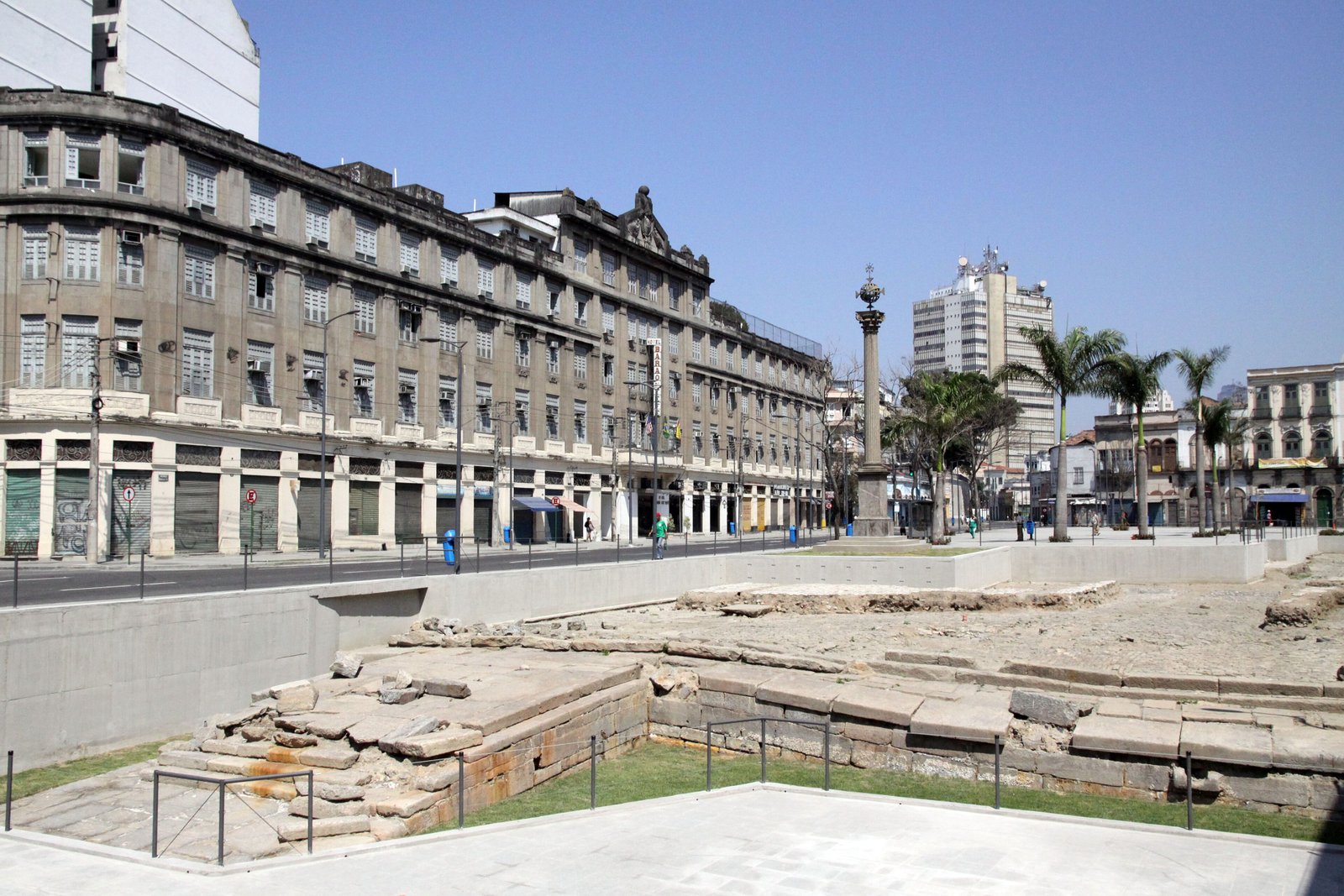
The most important material testament to the arrival of enslaved Africans in the Americas: an archaeological site in Rio de Janeiro preserving the remains of the wharf where an estimated 500,000 to one million enslaved people disembarked — more than at any other single site in the Western Hemisphere.
At a glance
The Valongo Wharf Archaeological Site sits in the Gamboa neighbourhood of Rio de Janeiro’s port district, rediscovered in 2011 during excavations for the Porto Maravilha urban renewal project. The site preserves the physical remains of the Valongo Wharf — the principal point of disembarkation for enslaved Africans arriving in the Americas between 1811 and 1831 — along with artefacts of extraordinary historical depth. UNESCO inscribed the site on the World Heritage List in 2017 under criteria (vi), recognising it as an outstanding example of an exchange of human values and as directly associated with events of universal significance.
Key facts
- UNESCO designation: World Heritage Site, 2017
- Location: Gamboa, port district, Rio de Janeiro, Brazil
- Active as slave landing: 1811–1831 CE
- Estimated disembarkations: 500,000 to 1 million enslaved Africans — more than at any other site in the Americas, and more than all North American ports combined
- Rediscovery: 2011, during Porto Maravilha urban renewal excavations
- UNESCO criterion: (vi) — directly associated with events of universal significance (the transatlantic slave trade)
- Key finds: African amulets, cowrie shells, clay pipes, ceramic fragments, beads, and the physical disembarkation structure
History
In 1808, the Portuguese royal family fled Napoleon’s invasion of the Iberian Peninsula and relocated to Rio de Janeiro, transforming the colonial city into the seat of empire. The slave trade had previously landed its human cargo near the royal palace — a proximity the court found unseemly. In 1811, the Valongo Wharf was constructed specifically to handle slave disembarkations, relocating the trade to the outskirts of the city centre while rendering it more efficient: the new structure provided a dedicated landing, holding, and commercial infrastructure for enslaved people arriving from West and Central Africa.
Between 1811 and the formal abolition of the transatlantic slave trade to Brazil in 1831, an estimated 500,000 to one million enslaved Africans passed through Valongo — the largest number to arrive at any single point in the Americas. They came primarily from present-day Mozambique, Angola, the Congo Basin, and West Africa. Those who survived the horrific Middle Passage were held in adjacent barracoons (slave pens) — crowded enclosures where they were assessed, “fattened,” and sold. Many did not survive this phase; an adjacent cemetery (the Cemitério dos Pretos Novos — “Cemetery of the New Blacks”) received those who died before or shortly after sale.
In 1843, with the trade officially suppressed, the wharf was covered over and transformed into the Cais da Imperatriz (Empress Wharf) to receive the new empress of Brazil, Teresa Cristina of the Two Sicilies. Subsequent decades of urban development further buried the site. It was not until 2011, when workers excavating the Saúde square for the Porto Maravilha project broke through the later paving, that the original 19th-century stone structure was revealed — largely intact beneath more than a metre of fill.
Excavations between 2011 and 2016 yielded thousands of artefacts that speak directly to the lives, beliefs, and origins of the enslaved people: cowrie shells used as currency in West Africa, clay pipes in forms specific to Central African traditions, glass and stone beads worn as personal ornaments, and iron tools. These objects, together with the physical structure of the wharf itself, constitute the most complete archaeological testimony of the transatlantic slave trade known to science.
What you see
The Valongo Wharf Archaeological Site is an open archaeological excavation in the Praça Jornal do Commercio. The visible remains consist primarily of the stone pavement and structural elements of the original 1811 wharf — large irregular stones laid in a distinctive pattern that served as the disembarkation surface. Around the stones, the archaeological context preserves layers of soil and fill that contain the artefacts recovered during excavation.
The site is bordered by information panels and interpretation materials in Portuguese and English. Adjacent to the main wharf remains, a section of the later Empress Wharf paving is visible, illustrating the deliberate burial and erasure of the slave trade’s physical traces. Nearby, the Cemitério dos Pretos Novos (Institute of Research and Memory Pretos Novos) is a companion site where the skeletal remains of enslaved people who died at the wharf were recovered — one of the most significant and affecting places of memory of the African diaspora in the Americas.
The surrounding Gamboa neighbourhood retains a strong Afro-Brazilian cultural identity. The Museu de Arte do Rio and the Porto Maravilha cultural revitalisation zone provide broader context for the city’s engagement with this history.
Practical information
- Location: Praça Jornal do Commercio, Gamboa, Rio de Janeiro — in the revitalised Porto Maravilha zone
- Access: VLT (light rail) to Harmonia stop; or walk from the port area; approximately 15 minutes on foot from the city centre
- Entry: The outdoor archaeological site is freely accessible; interpretation centre hours vary — check locally
- Companion site: Instituto de Pesquisa e Memória Pretos Novos (Cemitério dos Pretos Novos) — a short walk away, with guided visits
- Photography: Permitted at the site
- Guided tours: Available through the Porto Maravilha visitor services and local cultural organisations
Getting there
From central Rio de Janeiro, take the VLT Carioca light rail to the Harmonia stop (Gamboa). Alternatively, the site is approximately 1.5 km north of the Museu de Arte do Rio (MAR), walking along the revitalised port waterfront. The area is also served by municipal buses from the Centro. The Porto Maravilha zone is a walkable cultural district — the Valongo Wharf site is most powerfully visited in conjunction with the nearby Pretos Novos memorial and the MAR.
Nearby
- Cemitério dos Pretos Novos — the adjacent burial ground for enslaved people who died at Valongo; now a museum and memorial (Instituto Pretos Novos)
- Museu de Arte do Rio (MAR) — 1.5 km south; a major cultural institution in the revitalised port zone with exhibitions addressing Rio’s history and identity
- Museu do Amanhã — a landmark science museum on the Pier Mauá waterfront, approximately 1 km from the wharf
- Lapa and Santa Teresa — Rio’s historic bohemian neighbourhoods, accessible from the port zone, with 18th-century aqueduct (Arcos da Lapa) and vibrant cultural life
Sources
- UNESCO World Heritage Centre — Valongo Wharf Archaeological Site (whc.unesco.org)
- Wikipedia — Valongo Wharf
- Instituto de Pesquisa e Memória Pretos Novos — documentation of excavations and finds
- Pereira, J. (2013). Cais do Valongo: O Maior Porto Negreiro das Américas. Rio de Janeiro.
Find it on the map
See this place and what’s around it →📷 Become a Cultural Heritage Online photographer
Share your photos of places: they stay published under your name as the author. The more they're seen, the more you get noticed — and soon a contest will reward the most appreciated photos.
Log in or sign up free to add a photo