
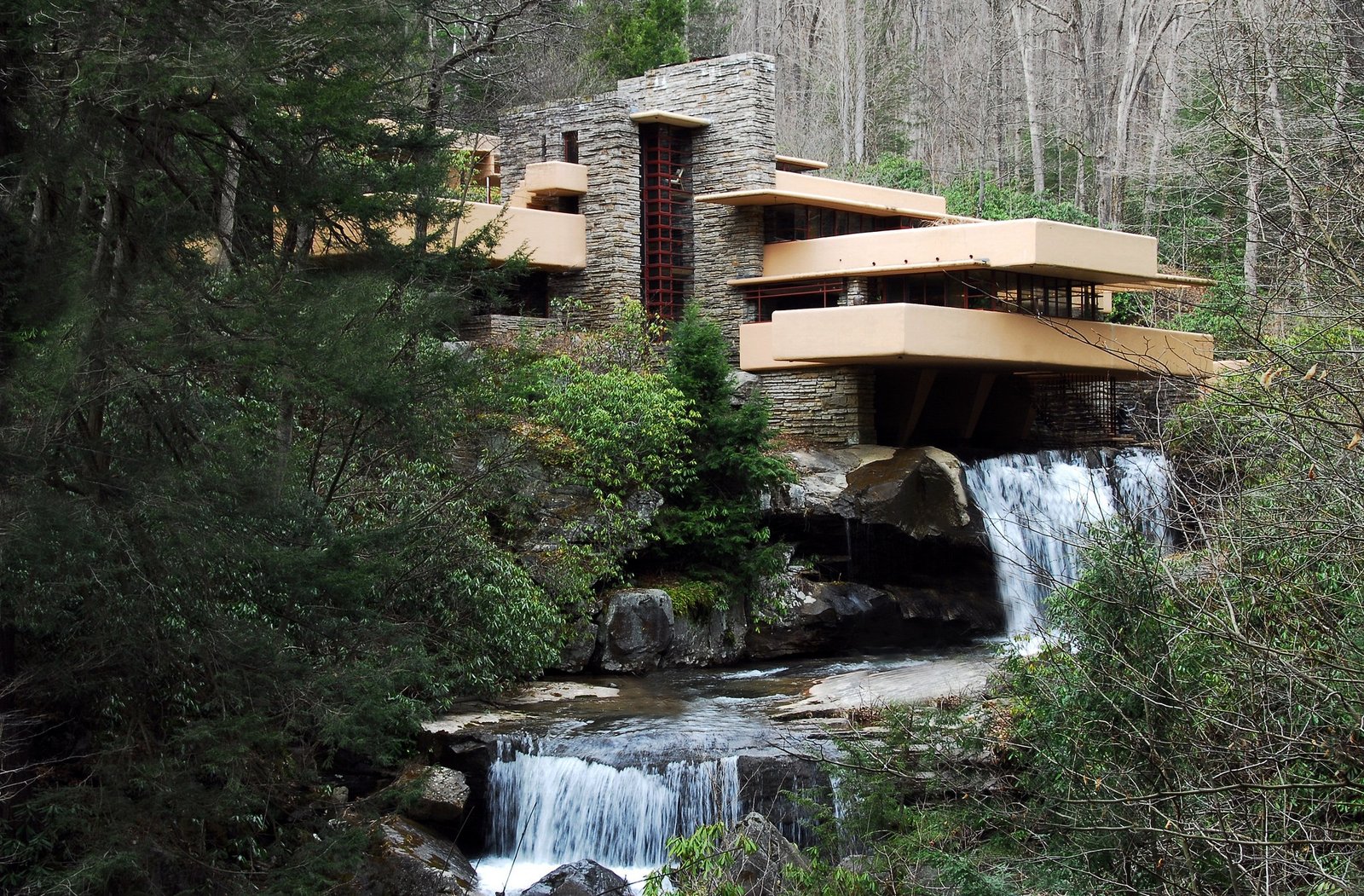
Eight buildings across six US states document seventy years of organic architecture — from the poured-concrete revolution of Unity Temple (1908) to the spiral concrete ramp of the Guggenheim (1959). Together they form the only UNESCO World Heritage Site dedicated to a single architect's body of work in the United States.
At a glance
Frank Lloyd Wright (1867–1959) spent seven decades dismantling the conventions of Western architecture. His philosophy of organic architecture held that buildings should grow from their sites like natural organisms, integrating structure, landscape, materials, and human use into a single coherent whole. The UNESCO inscription (2019) covers eight buildings: Unity Temple, Taliesin, Hollyhock House, Jacobs House I, Fallingwater, Taliesin West, SC Johnson Research Tower, and the Guggenheim Museum. The inscribed group must be understood as a collective statement rather than a single site.
Key facts
- UNESCO inscription: 2019, criterion i (creative masterpiece)
- Buildings inscribed: 8, across Illinois, Wisconsin, California, Pennsylvania, Arizona, and New York
- Architect: Frank Lloyd Wright (1867–1959)
- Career span of inscribed works: Unity Temple 1908 to Guggenheim 1959
- Fallingwater GPS anchor: 39.9023° N, 79.4680° W
- Fallingwater built: 1935, for the Kaufmann family as a weekend retreat
- Guggenheim Museum: Continuous concrete spiral ramp, Fifth Avenue, New York City
- Usonian prototype: Jacobs House I, Madison WI, 1937
History: from Prairie to Organic
Wright began in the Chicago offices of Louis Sullivan, absorbing Sullivan's rejection of historicist ornament. By 1900 he had developed the Prairie Style: low horizontal houses with wide overhanging eaves and open floor plans integrated with the Midwestern landscape. Unity Temple (Oak Park, 1908) was the turning point — the first major public building in the United States cast in exposed reinforced concrete.
The 1910 Wasmuth Portfolio, published in Berlin, spread his work across Europe, directly influencing Mies van der Rohe, Gropius, and the De Stijl movement. Taliesin (begun 1911) became his home, studio, and school in Wisconsin, rebuilt twice after fire.
In 1935 Edgar Kaufmann, a Pittsburgh department-store magnate, commissioned a weekend house on his Pennsylvania estate. Wright placed the house over the waterfall rather than facing it. Fallingwater's cantilevered terraces shocked convention and appeared on the cover of Time magazine, making Wright, then 68, a global celebrity. In the final decade, the Guggenheim Museum in New York replaced the conventional gallery sequence with a single unbroken spiral ramp. Wright died six months before its 1959 opening.
What you see: the eight inscribed works
Fallingwater (Mill Run, PA, 1935): Three horizontal concrete trays cantilever over Bear Run. The house descends from entry level into a living room where a glass-walled hatch opens over the stream. Local sandstone, walnut, and Cherokee-red steel blend with the forest. Operated by the Western Pennsylvania Conservancy; timed guided tours required.
Guggenheim Museum (New York, 1959): An inverted cream-white cone on Fifth Avenue. Visitors descend a quarter-mile spiral ramp from a single top-level elevator, the entire interior bathed in skylight from the central oculus.
Unity Temple (Oak Park, IL, 1908): Two linked geometric cubes in board-formed concrete — one for worship, one for community. Amber art glass and geometrically layered interior galleries. The first reinforced-concrete public building in America.
Taliesin (Spring Green, WI, 1911–1959): Limestone-and-wood buildings growing from the brow of a hill; the name means shining brow in Welsh. Home of the Taliesin Fellowship apprenticeship school.
Taliesin West (Scottsdale, AZ, 1937): Desert winter school built of rubblestone and redwood with canvas roof panels. Low walls open onto Sonoran Desert horizon.
Hollyhock House (Los Angeles, CA, 1921): Mayan-influenced concrete house for oil heiress Aline Barnsdall on Olive Hill. Abstract hollyhock motifs cast into the concrete and carved into the furniture.
Jacobs House I (Madison, WI, 1937): The first Usonian house — Wright's affordable single-storey L-plan prototype. Board-and-batten cedar, radiant floor heating, carport. Template for hundreds of subsequent commissions.
SC Johnson Research Tower (Racine, WI, 1950): A 14-storey taproot-structure laboratory with cantilevered floor plates and alternating glass-tube bands. No external load-bearing walls. Free tours available through SC Johnson.
Practical information
- Fallingwater: 1491 Mill Run Road, Mill Run, PA 15464. Open year-round (closed Tuesdays Nov–Mar). Timed guided tours required; book at fallingwater.org. Admission approx. $35–65.
- Guggenheim Museum: 1071 Fifth Ave, New York, NY 10128. Open Sun–Fri 11am–6pm, Sat 11am–8pm. Admission $30.
- Unity Temple: 875 Lake St, Oak Park, IL 60301. Self-guided and docent tours; flwright.org/unity-temple.
- Taliesin (Wisconsin): 5607 County Road C, Spring Green, WI 53588. Tours May–Oct; taliesinpreservation.org.
- Taliesin West: 12621 Frank Lloyd Wright Blvd, Scottsdale, AZ 85259. Year-round tours; franklloydwright.org.
- Hollyhock House: 4800 Hollywood Blvd, Los Angeles, CA 90027. Thu–Sun tours; City of LA.
- SC Johnson Research Tower: 1525 Howe St, Racine, WI 53403. Free tours; scjohnson.com/architecture.
Getting there
Fallingwater (GPS anchor 39.9023° N, 79.4680° W): 90 km southeast of Pittsburgh via PA-381 South, approx. 1h 30min drive. No public transport to the site; private vehicle or organised tour from Pittsburgh is essential. Pittsburgh International Airport (PIT) serves the region with domestic and select international flights. The eight inscribed buildings span six states; a full pilgrimage tour requires at least 10–14 days driving or can be combined with separate regional trips to Chicago, New York, or the American Southwest.
Nearby
Within the Laurel Highlands (Fallingwater area): Kentuck Knob (another Wright house 14 km away, tours available), Fort Necessity National Battlefield (French and Indian War, 1754), and Ohiopyle State Park (Youghiogheny River rafting and trails). Pittsburgh (90 km): Carnegie Museum of Art and Natural History, Andy Warhol Museum, and the Strip District food halls. For Wright completists: the Robie House in Chicago (1910, not UNESCO-inscribed) is essential context for the Prairie Style transition.
Sources
- UNESCO World Heritage List: The 20th-Century Architecture of Frank Lloyd Wright (2019), whc.unesco.org/en/list/1496
- Western Pennsylvania Conservancy, fallingwater.org
- Frank Lloyd Wright Foundation, franklloydwright.org
- Taliesin Preservation, taliesinpreservation.org
- SC Johnson Architecture, scjohnson.com/architecture
- Wikipedia: Fallingwater; Frank Lloyd Wright; Solomon R. Guggenheim Museum; Unity Temple Oak Park
Find it on the map
See this place and what’s around it →📷 Become a Cultural Heritage Online photographer
Share your photos of places: they stay published under your name as the author. The more they're seen, the more you get noticed — and soon a contest will reward the most appreciated photos.
Log in or sign up free to add a photo