
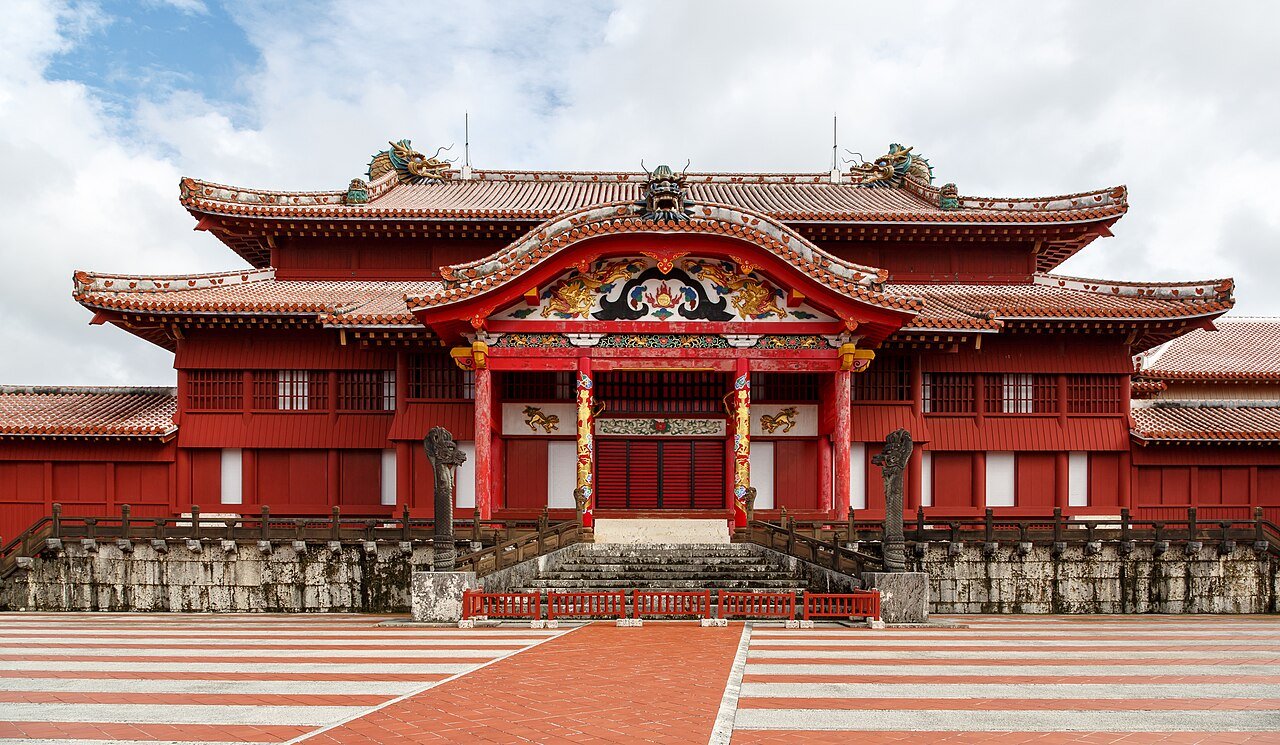
Nine sites across Okinawa Prefecture — castle complexes, sacred groves, and cultural landscapes — testifying to the extraordinary civilization of the Ryukyu Kingdom, an independent maritime trading state that synthesized Chinese, Japanese, and Southeast Asian cultures for over four centuries.
At a glance
The nine sites inscribed by UNESCO in 2000 as the Gusuku Sites and Related Properties of the Kingdom of Ryukyu represent the full spectrum of Ryukyuan civilization. A gusuku is a dry-stone castle complex, built on limestone hilltops using a distinctive local stone-laying technique called nunchiku-zumi — large irregular stones fitted without mortar — and featuring curved walls adapted to the hilly terrain. Alongside the castles, the inscription includes sacred sites (utaki), a royal mausoleum (Tamaudun), and a garden (Shikinaen), together documenting a culture of remarkable sophistication that flourished in the islands between Japan and China from the 12th to the 19th century.
The Ryukyu Kingdom (formally established 1429 CE) was one of Asia’s great maritime trading states: its ships carried goods between China, Japan, Korea, and South-East Asia, and its capital Shuri (today part of Naha) grew wealthy and cosmopolitan. In 1879 Japan annexed the Ryukyu Kingdom and incorporated it as Okinawa Prefecture. The gusuku and sacred sites survived, their stones and terraces preserving the memory of an independent civilization that no longer exists as a political entity.
Key facts
- UNESCO inscription: 2000 (criteria ii, iii, vi)
- Number of sites: Nine (five castle sites, two utaki sacred sites, one mausoleum, one garden)
- Period: 12th–19th century CE (Ryukyu Kingdom)
- Construction technique: Nunchiku-zumi (dry-stone, large irregular limestone blocks, no mortar)
- Location: Okinawa Prefecture, Japan (main island and nearby areas)
- Most famous site: Shuri Castle (Shurijo), Naha — royal palace of the Ryukyu kings
- Coordinates: 26.2167 N, 127.7167 E (Shuri Castle)
History
The Ryukyu archipelago was inhabited from prehistoric times, but the distinctive gusuku tradition emerged around the 12th century CE, when local chieftains (anji) began constructing hilltop stone fortresses. By the 14th century several competing kingdoms had consolidated in the main island of Okinawa. In 1429 King Sho Hashi unified the islands under the First Ryukyu Kingdom, with Shuri as his capital and Shuri Castle as his palace.
The Ryukyu Kingdom quickly became a hub of East Asian maritime trade. Ryukyuan ships sailed under the banner of “a nation of propriety and music,” carrying Chinese silk and porcelain to Japan, Japanese swords and folding fans to South-East Asia, and returning with tropical goods. This trade generated enormous wealth: Shuri Castle was expanded and elaborated over generations into a splendid complex of lacquered halls and ceremonial courtyards strongly influenced by Chinese palace architecture, yet distinctively Ryukyuan in its layout and materials.
In 1609 the Satsuma Domain of Japan invaded and made Ryukyu a vassal state, while the kingdom nominally continued as a Chinese tributary for another two and a half centuries — a diplomatic double game that served both parties. The kingdom was formally abolished in 1879 when Japan incorporated it as Okinawa Prefecture. In the Battle of Okinawa (1945) Shuri Castle was almost entirely destroyed; reconstruction was completed in 1992. In October 2019 a fire of electrical origin destroyed the main hall and several other buildings again; reconstruction is once more underway.
What you see — the nine sites
Shuri Castle (Shurijo), Naha: The centrepiece of the inscription and the symbolic heart of Ryukyuan civilization. The main hall (Seiden) is a distinctive red-lacquered two-storey building combining Chinese architectural vocabulary with Ryukyuan proportions. The castle is reached through a series of stone gates, each more impressive than the last; Kankaimon (the outer gate) and Shureimon (the Gate of Courtesy) are iconic images of Okinawa.
Nakagusuku Castle: A spectacular ruin on a central Okinawa hilltop, with sweeping views over the Pacific. The walls here are among the tallest surviving gusuku fortifications, and the ashlar stonework is exceptionally fine.
Zakimi Castle: Widely considered to have the most beautiful and perfectly executed stone walls of all the Ryukyuan gusuku — the curved bastions and arched gateway are sinuous and precise.
Katsuren Castle: Perched on a promontory with panoramic ocean views; associated with the powerful anji Amawari (15th century).
Urasoe Castle: An older site that predates the Ryukyu Kingdom; the mausoleum of early kings (Urasoe Youdore) is here.
Sefa-utaki: The most sacred site in Ryukyuan religion — not a castle but a natural limestone grove of massive triangular boulders and a ceremonial passage. The high priestess of Ryukyu (kikoe-ogimi) conducted royal rites here; it remains an active sacred site today.
Tamaudun: The royal mausoleum of the Second Sho Dynasty (from 1501 CE), with distinctive Ryukyuan stone architecture.
Sonohyan-utaki Stone Gate: A carved limestone gateway that served as the royal sacred site within the Shuri Castle complex.
Shikinaen Garden: A 19th-century royal garden in the Chinese style, with a pond, pavilions, and bridges — a graceful late addition to the Ryukyuan royal heritage.
Practical information
- Shuri Castle opening hours: Generally 08:30–17:30 (summer until 19:00); closed on some Wednesdays in January–July
- Shuri Castle admission: Adults approx. JPY 400 (main area free while reconstruction continues for some buildings)
- Nakagusuku Castle: Open daily; admission approx. JPY 400
- Sefa-utaki: Open daily; admission approx. JPY 300; silent behaviour required — this is an active sacred site
- Combined pass: Some sites offer a joint ticket; check okinawa-world-heritage.com for current combinations
Getting there
All nine sites are in Okinawa Prefecture, Japan. Naha Airport (OKA) is the main gateway, served by flights from Tokyo (approx. 2.5 hrs), Osaka (approx. 1.5 hrs), and several international routes. Shuri Castle is reachable from Naha Airport on the Yui Rail monorail (to Shuri or Kenchomae station, then 15–20 min walk). For the other sites (Nakagusuku, Zakimi, Katsuren), a rental car or organised tour is the most practical option, as public transport connections are limited.
Nearby
Okinawa’s heritage extends beyond the gusuku. The Okinawa Churaumi Aquarium (in the northwest of the main island) is one of the largest in the world. The island’s beaches and coral reefs are among the finest in Japan. Naha’s Kokusai-dori (International Street) is a lively hub of Ryukyuan crafts, including bingata (stencil-dyeing), lacquerware (ryukyu-shikki), and Awamori spirits. The Okinawa Prefectural Museum provides the essential introduction to Ryukyuan history and material culture before visiting the castle sites.
Sources
- UNESCO World Heritage List: Gusuku Sites and Related Properties of the Kingdom of Ryukyu (2000)
- Wikipedia: Gusuku Sites and Related Properties of the Kingdom of Ryukyu
- Okinawa World Heritage official site: okinawa-world-heritage.com
Find it on the map
See this place and what’s around it →📷 Become a Cultural Heritage Online photographer
Share your photos of places: they stay published under your name as the author. The more they're seen, the more you get noticed — and soon a contest will reward the most appreciated photos.
Log in or sign up free to add a photo