
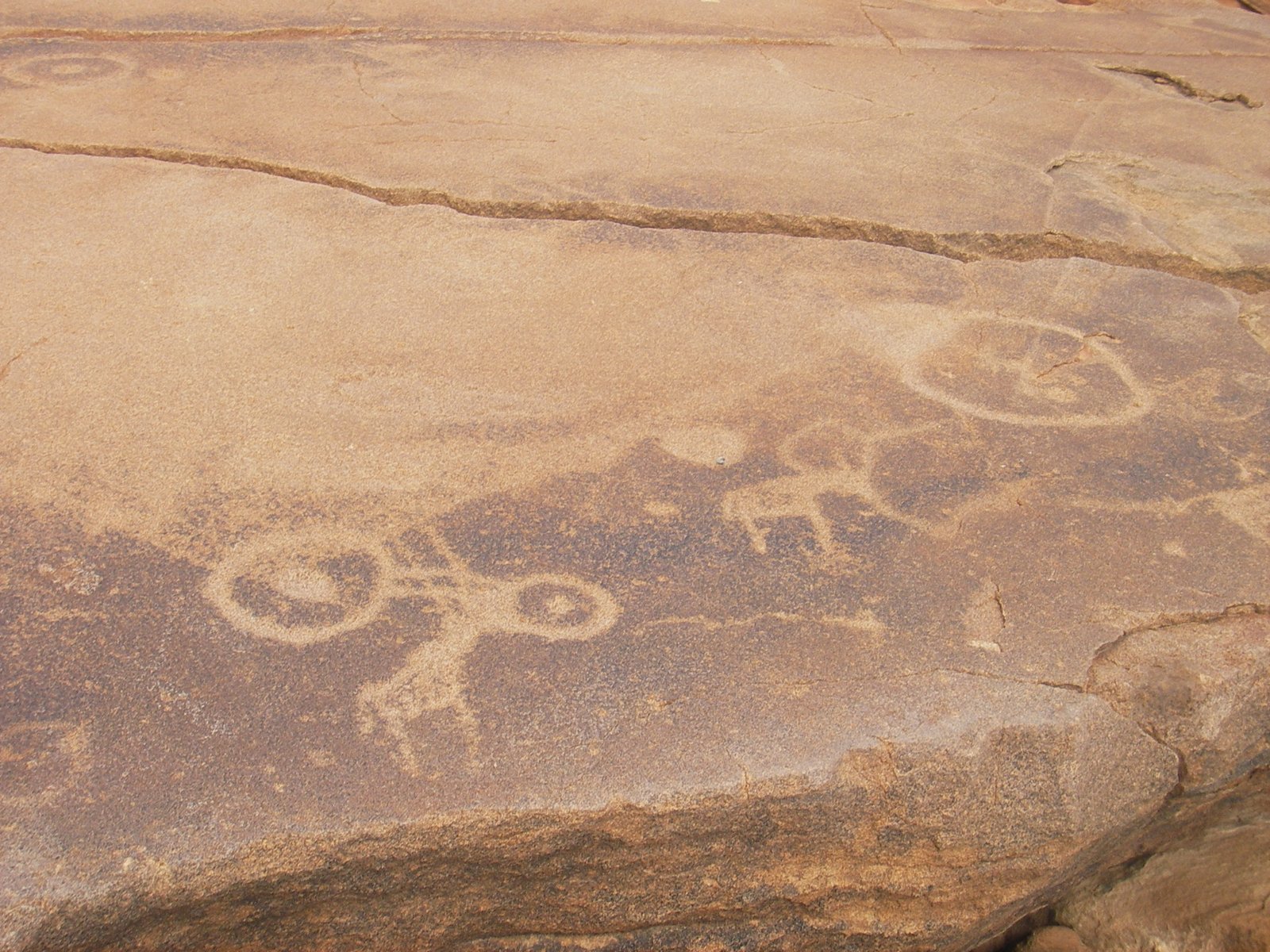
One of Africa’s richest concentrations of rock art — more than 2,000 petroglyphs pecked into sandstone by San hunter-gatherers across 6,000 years — Twyfelfontein preserves an unbroken record of ritual life at a desert water source, inscribed as a UNESCO World Heritage Site in 2007.
At a glance
Twyfelfontein sits in the arid Kunene Region of north-western Namibia, in a dry river valley where a seasonal spring drew nomadic San groups for millennia. The name means doubtful spring in Afrikaans — the water source was never guaranteed. Around this uncertain spring, generations of San artists pecked thousands of images into the exposed sandstone slabs and outcrops, accumulating the densest gallery of petroglyphs on the continent south of the Sahara. UNESCO inscribed the site in 2007 as an outstanding example of rock art that documents the spiritual and cultural life of a hunter-gatherer society over an extraordinary span of time.
Key facts
- UNESCO designation: World Heritage Site, 2007
- Location: Kunene Region, north-western Namibia, approximately 30 km from the town of Khorixas
- Rock art count: At least 2,000 individual engravings (petroglyphs) identified
- Time span: c. 5500 BCE to approximately 2,000 years ago
- Creators: San people (Bushmen), hunter-gatherer tradition
- Technique: Pecking and incising into desert varnish-covered sandstone
- Most famous image: The lion with five toes — a lion with individually depicted human-like toes on each paw
- Related site: Burnt Mountain — adjacent site with rare San rock paintings in red and white ochre
- Coordinates: 20°35′36″S, 14°22′09″E
History
The engravings at Twyfelfontein were produced by the San people — the region’s original inhabitants — across a vast timespan beginning around 5500 BCE. The San were semi-nomadic hunter-gatherers whose territories covered much of southern Africa. The Kunene valley was part of a wider network of seasonal movement, and the spring at Twyfelfontein made it a reliable meeting point for different bands coming together for exchange, ceremony, and collective memory-making.
The oldest engravings are deeply weathered and represent abstract geometric forms as well as animals; younger layers show increasingly naturalistic animal images. The accumulation over millennia suggests the site was actively maintained as a sacred place — not merely used once, but returned to repeatedly across generations. Ethnographic analogy with San communities elsewhere in southern Africa suggests that such sites functioned as places where shamans entered trance states and recorded their spiritual visions on stone: the animals depicted are not hunting trophies but figures encountered in altered states of consciousness, used to transfer power or communicate with ancestral spirits.
European contact came relatively late in the Kunene — the Afrikaans name doubtful spring dates to the colonial period, when a Boer settler named the spring for its unreliable flow. The San presence at the site effectively ended with the expansion of pastoralist peoples and European settlement in the 19th and early 20th centuries. Scientific documentation of the rock art began in earnest in the 1950s and intensified after Namibian independence in 1990.
What you see
The engravings are distributed across a series of large flat sandstone slabs and low outcrops in the valley. The stone surface is covered in a dark desert varnish — iron and manganese oxides — and the petroglyphs were made by pecking through this varnish to expose the lighter stone beneath. Subjects include lion, elephant, rhinoceros, giraffe, oryx, zebra, ostrich, seal, penguin (remarkable for an inland site — suggesting contact or knowledge of the coast), and human footprints. Footprints appear frequently and are understood as representations of spirit tracks.
The lion with five toes panel is the most celebrated: a large lion shown in profile with each paw rendering five individual toes — anatomically impossible for a lion, but consistent with how a shaman might experience transformation into an animal during trance. This image has become the visual icon of Twyfelfontein and of Namibian rock art more broadly.
A smaller adjacent site, Burnt Mountain, preserves rare San paintings — images in red and white ochre, a painting tradition less common than engraving in Namibia. Burnt Mountain’s colourful geology (shale oxidised by contact with a dolerite intrusion) provides a vivid contrast with the sandstone valley.
Cultural significance
Twyfelfontein is among the most important testimonies to San spiritual life in existence. The San’s cosmological system — rooted in the concept of the potency or n/om, a life-force that shamans could harness in trance — is directly reflected in the imagery: animals that serve as vehicles of power, human-animal hybrids representing shamanic transformation, and geometric entoptic patterns that appear in trance states. The rock art is not merely decorative; it is a form of sacred record, accumulating over thousands of years at a site understood to be spiritually charged.
The site also represents an early and sustained form of landscape literacy — the capacity to identify, remember, and inscribe meaning onto specific natural features across generations without a written tradition. In this sense, Twyfelfontein is as much a library as it is a gallery.
Practical information
- Access: Twyfelfontein is within the Twyfelfontein–Uibasen Conservancy; the main site is accessed via a short guided walk from the visitor centre. Access is by guided tour only — unaccompanied visitors are not permitted on the engraving platforms to protect the fragile stone surfaces.
- Opening hours: Generally 08:00–17:00 daily; confirm locally as hours may vary seasonally
- Entry fee: National park entry fee applies, plus a conservancy fee; fees support local community conservation
- Guided tours: Obligatory and typically included in the entry fee; guides are trained community members who provide context on the rock art and its interpretation
- Photography: Permitted; no flash photography on sensitive panels
- Nearby accommodation: The Twyfelfontein Country Lodge and Aba-Huab Camp are located within a few kilometres of the site
Getting there
Twyfelfontein is approximately 30 km from Khorixas on the C39 road, which is a gravel road requiring a standard vehicle in good condition (4WD recommended in wet conditions). The nearest town of significant size is Outjo, roughly 175 km south-east. Most visitors approach from Swakopmund via the Skeleton Coast, a journey of approximately 4–5 hours. There is no public transport; self-drive or guided tour from Swakopmund or Windhoek are the standard options. The closest airstrip is at Palmwag, about 60 km to the north, served by charter flights from Windhoek.
Nearby
- Burnt Mountain: Adjacent site with San paintings in red and white ochre, included in the UNESCO property
- Organ Pipes: A 100-metre dolerite formation a few kilometres from Twyfelfontein — a geological curiosity named for its columnar basalt-like appearance
- Damaraland Wilderness: The wider Kunene Region contains abundant desert-adapted wildlife including desert elephant, black rhino, and lion
- Brandberg Mountain: Namibia’s highest peak, approximately 120 km south, contains the famous White Lady rock painting
- Palmwag Conservancy: A major wildlife conservancy to the north with desert rhino and elephant populations
Sources
- UNESCO World Heritage List — Twyfelfontein or /Ui-//aes: whc.unesco.org/en/list/1255
- Wikipedia — Twyfelfontein: en.wikipedia.org/wiki/Twyfelfontein
- Namibia Tourism Board — Rock Art Sites: namibiatourism.com.na
- Lewis-Williams, J.D. — The Mind in the Cave (2002): foundational text on San rock art interpretation
Find it on the map
See this place and what’s around it →📷 Become a Cultural Heritage Online photographer
Share your photos of places: they stay published under your name as the author. The more they're seen, the more you get noticed — and soon a contest will reward the most appreciated photos.
Log in or sign up free to add a photo