
The meatpacking complex on the Uruguay River that fed the world’s armies for a century — birthplace of the bouillon cube, the corned beef tin, and one of the earliest industrial-scale food production lines on the planet.
At a glance
The Fray Bentos Industrial Landscape encompasses the Anglo (formerly Liebig’s Extract of Meat Company) meatpacking plant on the eastern bank of the Uruguay River in Río Negro Department, Uruguay. Founded in 1863 by German chemist Justus von Liebig, the 40-hectare complex was for over a century the largest and most technologically advanced meat-processing facility in the world. Inscribed as a UNESCO World Heritage Site in 2015, it survives almost entirely intact: slaughter floors, refrigeration plant, boiler room, can-making workshops, workers’ housing, and the director’s villa all remain in place, creating an extraordinary record of industrial capitalism, global food supply chains, and working-class life from the mid-19th to the mid-20th century.
Key facts
- UNESCO inscription: 2015 (Cultural — criteria ii, iv)
- Active period: 1863–1979 CE
- Peak capacity: 2,000 cattle processed per day; 4,000 workers employed
- Founder: Justus von Liebig (German chemist, inventor of Liebig’s Extract of Meat)
- Key products: Liebig’s Extract (bouillon paste), canned corned beef (WWI & WWII rations), frozen beef
- Site area: 40 hectares on the Uruguay River bank
- Location: Fray Bentos, Río Negro Department, Uruguay (33°08′S 58°18′W)
- Current use: Museo de la Revolución Industrial (Museum of the Industrial Revolution)
History
The story begins with a chemistry experiment. In 1840, German scientist Justus von Liebig developed a concentrated meat extract — a dark paste produced by reducing beef stock — that he believed could solve European protein deficiency. The challenge was raw material: Europe’s cattle were too valuable for slaughter. Uruguay, by contrast, had vast estancias with millions of head of cattle slaughtered each year for their hides alone, their carcasses left to rot on the pampas.
In 1863, Belgian engineer George Christian Giebert established the Liebig’s Extract of Meat Company factory at Fray Bentos, a small port on the Uruguay River selected for its direct cattle supply, river access for export, and reliable firewood. The first shipment of extract reached Europe in 1865 and was an immediate commercial success. Within a decade, Liebig’s Extract had transformed European cooking: it became the base of bouillon, gravy, and stock — the ancestor of Oxo, Maggi, and every modern stock cube.
By the 1880s, advances in refrigeration technology allowed the factory to ship frozen beef to Europe, and by 1900 it was producing canned corned beef on an industrial scale. The plant — renamed the Anglo Meatpacking Company in 1924 after British investors took control — became essential to Allied war efforts: it supplied canned beef rations to British, French, and Russian armies in WWI, and to Allied forces in WWII. The iconic “Fray Bentos” brand name (printed on the tins) became synonymous with canned corned beef across the English-speaking world.
At its peak in the 1920s, the factory processed 2,000 cattle per day in a continuous 45-minute chain — killing, bleeding, skinning, eviscerating, and separating into extract, frozen cuts, canned product, hides, tallow, bone meal, and blood fertilizer with virtually zero waste. Four thousand workers, the majority of the town’s population, lived in company housing adjacent to the plant. The factory closed in 1979 when changing economics and new production methods made it unviable. Rather than demolish it, Uruguay preserved the entire complex as a heritage site.
What you see
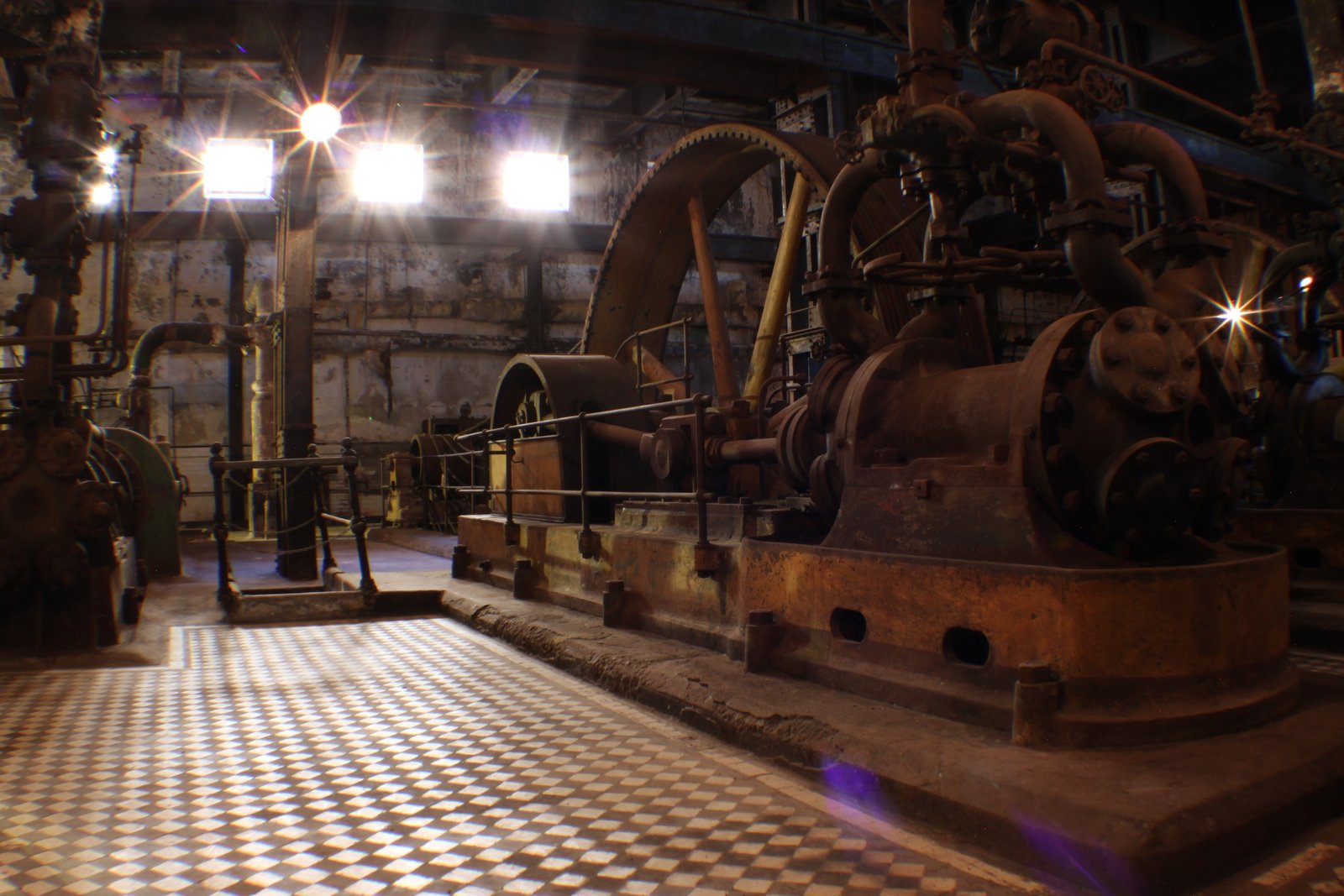
Unlike most industrial heritage sites where machinery has been stripped or buildings repurposed beyond recognition, Fray Bentos survives with exceptional integrity. The tour begins in the vast slaughter floors — high-ceilinged halls with overhead rail systems still suspended from the roof beams, where cattle carcasses once traveled from killing floor to chilling room in a continuous chain. The floors retain their original tile drainage systems and the distinct spatial hierarchy of industrial processing.
The refrigeration plant is one of the most impressive spaces: it contains early 20th-century ammonia compression equipment on a monumental scale, the largest industrial refrigeration installation in South America when it was built. The boiler room houses a row of massive Lancashire boilers that once generated the steam powering the entire complex. The can-making workshop — where the famous Fray Bentos tins were pressed, filled, sealed, and labeled — retains its production equipment in place.
Outside the production buildings, the workers’ village survives intact: rows of modest company housing (still occupied by local families), a social club, a school, and the director’s villa (a gracious early 20th-century residence that speaks to the social hierarchy of the industrial company town). The contrast between worker housing and management villa is itself a document of industrial-era class relations. The entire riverbank setting — with the Uruguay River visible behind the complex and the Argentine bank opposite — explains the site’s logic: cattle arrived from the interior, product departed via river to Montevideo and transatlantic ships.
Practical information
- Museum: Museo de la Revolución Industrial, open Tuesday–Sunday, hours vary by season; check locally
- Admission: Charged; concessions available for students and seniors
- Guided tours: Highly recommended; guides explain industrial processes that are not self-evident from the machinery alone
- Photography: Permitted throughout
- Duration: Allow 2–3 hours for the full complex including workers’ village
- Language: Spanish; some English-speaking guides available on request
- Accessibility: Partial; some buildings have uneven floors and stairs
Getting there
Fray Bentos is located 300 km northwest of Montevideo on the Uruguay River. By road from Montevideo: approximately 3.5 hours via Ruta 2 west to Mercedes, then north to Fray Bentos. Direct bus services (COPAY, Cot) operate from Montevideo’s Tres Cruces terminal to Fray Bentos (4–5 hours). From Buenos Aires: cross to Uruguay via Colonia del Sacramento ferry (Buquebus) then continue west by bus, or use the Puente Internacional General San Martín bridge between Puerto Unzué (Argentina) and Fray Bentos (Uruguay). The museum is at the northern edge of Fray Bentos town, signposted from the main road.
Nearby
- Fray Bentos city center — well-preserved early 20th-century urban fabric with Art Deco and Italian-influenced architecture reflecting the company town era; the central plaza retains its original kiosco and pergola
- Río Negro Department — wine-producing region with several estancias open for visits
- Parque Nacional Esteros de Farrapos — wetlands reserve 30 km north on the Uruguay River, significant for birdlife
- Colonia del Sacramento (UNESCO WHS) — 200 km southeast, the best-preserved Portuguese colonial town in the River Plate region
Sources
- UNESCO World Heritage Committee, Fray Bentos Industrial Landscape: Outstanding Universal Value, 2015 inscription document
- Frigorífico Anglo del Uruguay / Museo de la Revolución Industrial, official site materials
- Wilkins, Mira. The Maturing of Multinational Enterprise. Harvard University Press, 1974 (on Liebig’s Extract Company global operations)
- Wikipedia contributors, “Frigorífico Anglo del Uruguay,” Wikipedia, The Free Encyclopedia
Find it on the map
See this place and what’s around it →📷 Become a Cultural Heritage Online photographer
Share your photos of places: they stay published under your name as the author. The more they're seen, the more you get noticed — and soon a contest will reward the most appreciated photos.
Log in or sign up free to add a photo