

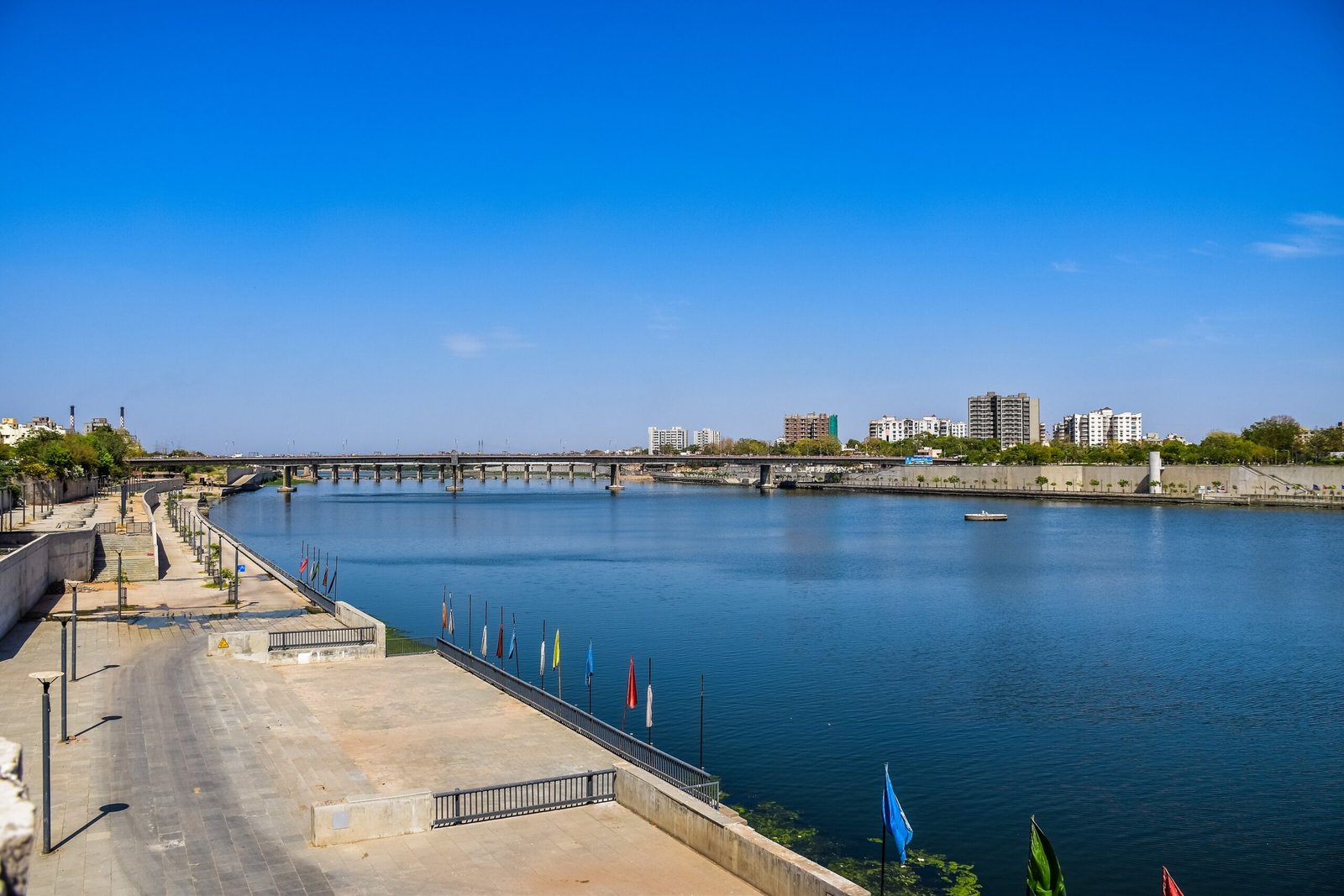
India’s first UNESCO World Heritage City — 600 years of Hindu, Jain, and Islamic architecture woven into a living urban fabric of narrow lanes, shared courtyards, and intricately carved stone, on the banks of the Sabarmati River.
At a glance
Ahmedabad, Gujarat’s largest city, was inscribed as a UNESCO World Heritage Site in 2017 — the first city in India to receive this designation for its entire historic urban ensemble. Founded in 1411 CE by Sultan Ahmad Shah I of the Gujarat Sultanate, it was for five centuries one of the most prosperous cities on the subcontinent: a major centre of textile production, long-distance trade, and craftsmanship that connected the Indian Ocean economy with Central Asia and the Ottoman world. The walled historic core (the Bhadra area) preserves an extraordinary layering of architectural traditions — syncretic Indo-Islamic mosques, Jain and Hindu temples, Mughal-period havelis, and colonial bungalows — within an organic urban fabric that has been continuously inhabited for over 600 years.
Key facts
- UNESCO inscription: 2017 (Cultural — criteria ii, v) — India’s first World Heritage City
- Founded: 1411 CE by Sultan Ahmad Shah I of the Gujarat Sultanate
- Location: Eastern bank of the Sabarmati River, Gujarat, India
- Distinctive feature: The pol system — a traditional neighbourhood unit of shared-wall houses accessed through a single gate, persisting for 500+ years
- Notable monument: Sidi Saiyyed Mosque (1573) — stone jali window carved into an intricate tree-of-life pattern, an icon of Indian craftsmanship
- Gandhi connection: Mahatma Gandhi established his Sabarmati Ashram here in 1917
History
Ahmedabad was founded on 26 February 1411 CE when Sultan Ahmad Shah I of the Gujarat Sultanate laid the first stone on the eastern bank of the Sabarmati, near the existing village of Ashaval. According to legend, he chose the site after seeing a rabbit chase a dog — an omen of courage. He named the city after himself: Ahmadabad (city of Ahmad). Within a generation it had displaced Patan as the capital of Gujarat and was drawing merchants from across the Indian Ocean world.
Under the Mughals (1572 onward), Ahmedabad became one of the empire’s most important commercial cities. Akbar visited in 1573; his general Khan-i-Azam oversaw the construction of the Sidi Saiyyed Mosque. The city’s textile industry — producing fine muslins, brocades, and the bandhani tie-dye fabric — made it indispensable to the Mughal economy and later to the East India Companies of Portugal, England, and the Netherlands, all of which maintained factories here.
British rule (after 1818) introduced colonial bungalows and institutions into the historic fabric without demolishing the medieval city. In the 20th century, Ahmedabad became a centre of the Indian independence movement: Mahatma Gandhi established his Sabarmati Ashram on the western bank in 1917 and launched the Salt March to Dandi (240 km south) from here in 1930. The city later became a major industrial centre — “the Manchester of India” for its cotton mills — though the mills largely closed in the 1980s and 1990s.
What you see
The most distinctive feature of Ahmedabad’s historic quarters is the pol system: self-contained residential neighbourhoods of closely packed houses sharing party walls, each accessed through a single wooden gate that closes at night, with shared water wells, community shrines (deris), and notice boards. There are over 600 pols in the historic city, each historically associated with a particular caste, trade, or religious community. The wooden facades of pol houses are some of the finest examples of domestic carved-wood architecture in India.
The Jama Masjid (Friday Mosque, 1424) is the largest mosque in the historic city — a 260-pillar colonnaded hall in which Hindu and Jain architectural vocabulary (the carved columns, the corbelled arches) was redeployed by Muslim craftsmen in a syncretic style unique to the Gujarat Sultanate. The Sidi Saiyyed Mosque (1573) is smaller but universally celebrated for its two stone jali (lattice) windows carved into a palm-tree and intertwining vine pattern — a masterpiece of Indian stone-carving that became the symbol of Ahmedabad and the inspiration for the Indian Institute of Management logo.
The Bhadra Citadel (1411) was Ahmad Shah’s original palace-fortress; today its gates and bastions are embedded in the dense urban fabric. The Hatheesingh Jain Temple (1850), just outside the Delhi Gate, is a large white marble complex with intricate carving. Scattered through the pols are hundreds of smaller Hindu and Jain shrines, step-wells (vav), and havelis with carved stone or wooden facades.
Practical information
- Access: The historic city (Bhadra area) is best explored on foot; auto-rickshaws and cycle-rickshaws navigate the wider lanes
- Heritage walks: The Ahmedabad Municipal Corporation runs a free daily heritage walk starting from Swaminarayan Temple at 8:00 AM
- Sidi Saiyyed Mosque: Entry free; early morning light best for photographing the jali windows
- Sabarmati Ashram: Open daily, 8:30 AM – 6:30 PM; free entry; Gandhi museum on site
- Best time: October–February (temperatures 15–30°C; monsoon July–September brings humidity and flooding)
- Stay: Heritage hotels within or adjacent to the pol neighbourhoods offer immersive experiences
Getting there
Ahmedabad is well-connected by air, rail, and road. Sardar Vallabhbhai Patel International Airport (AMD) receives direct flights from major Indian cities and from Dubai, Abu Dhabi, London, and New York. The Ahmedabad Railway Station (Kalupur) is on the main Western Railway trunk line, with express trains to Mumbai (7 hours), Delhi (8–12 hours), and Jaipur (8 hours). The historic city centre is approximately 8 km from the airport and 2 km from the railway station.
Nearby
- Rani ki Vav, Patan — UNESCO-listed step-well of extraordinary sculptural complexity, 120 km north (UNESCO 2014)
- Champaner-Pavagadh — UNESCO-listed medieval city and hill fort, 150 km south-east (UNESCO 2004)
- Modhera Sun Temple — 11th-century Solanki temple with solar alignment, 100 km north
- Lothal — Indus Valley Civilisation port city with the world’s oldest known dock, 85 km south-west
Sources
- UNESCO World Heritage — Historic City of Ahmedabad, whc.unesco.org/en/list/1551
- Gillion, K.L. (1968). Ahmedabad: A Study in Indian Urban History. University of California Press.
- Hasan, P. (2007). Sultans and Mosques: The Early Muslim Architecture of Bangladesh. I.B. Tauris (Gujarat Sultanate chapter).
- Ahmedabad Municipal Corporation — Heritage Cell, ahmedabadheritage.com
Find it on the map
See this place and what’s around it →📷 Become a Cultural Heritage Online photographer
Share your photos of places: they stay published under your name as the author. The more they're seen, the more you get noticed — and soon a contest will reward the most appreciated photos.
Log in or sign up free to add a photo