

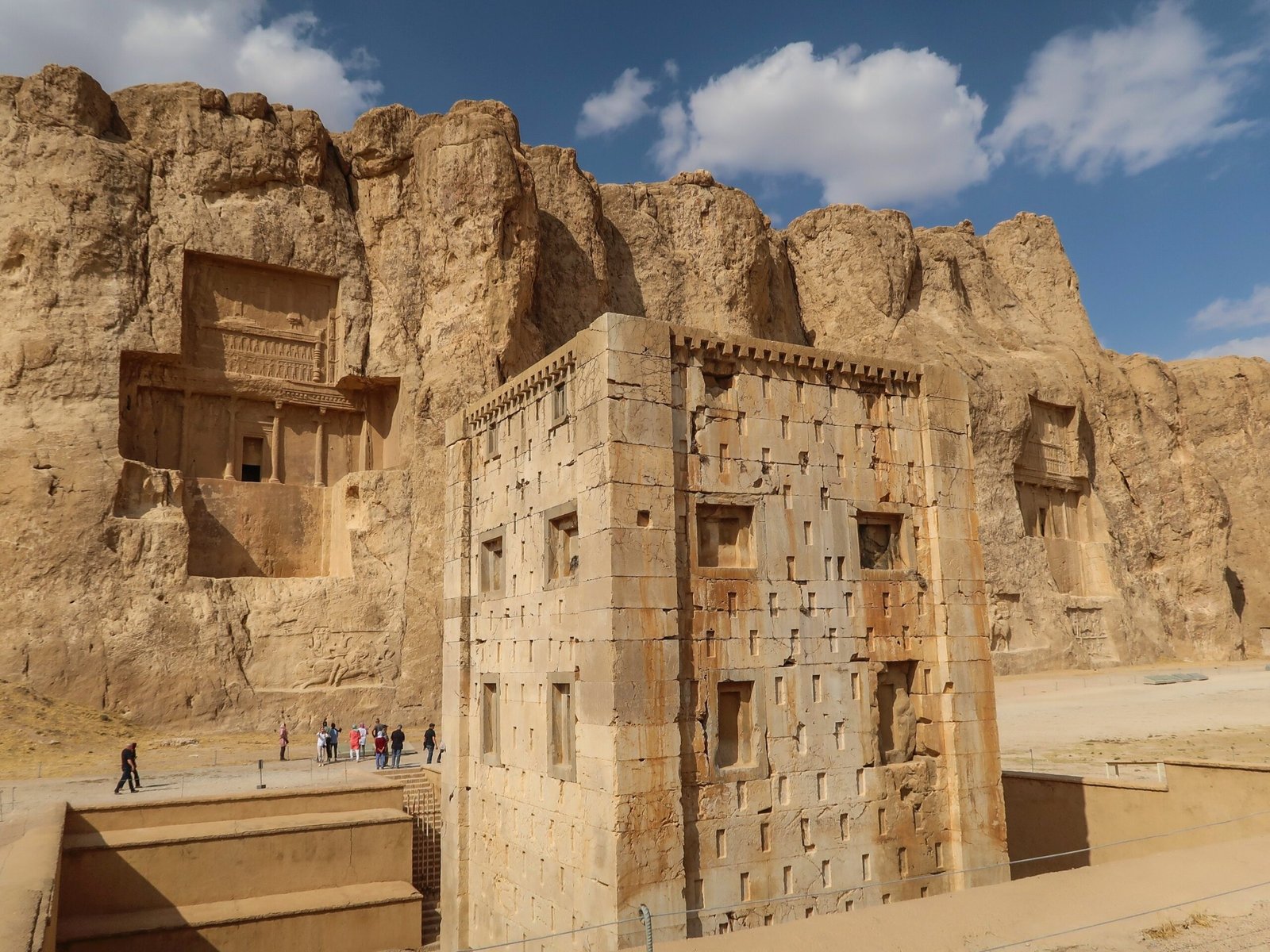
Eight monumental sites across the heartland of the last Persian empire — cliff-face reliefs, circular cities, and the oldest iwan arches in Persian architecture — inscribed as a UNESCO World Heritage Site in 2018.
At a glance
The Sassanid Archaeological Landscape of Fars Region is a serial UNESCO World Heritage Site comprising eight properties in the Marvdasht plain and the Firuzabad and Sarvestan districts of Fars Province, southern Iran. Together they document the full arc of the Sassanid Empire (224–651 CE) — from Ardashir I’s dynastic founding to the last decades before the Arab-Islamic conquest. The Sassanids were a superpower that fought Rome and Byzantium to a standstill for four centuries; their art, architecture, and statecraft were the dominant cultural force from Egypt to Central Asia, and their aesthetic vocabulary passed directly into Byzantine and early Islamic civilisation.
Key facts
- UNESCO inscription: 2018 (Cultural — criteria i, ii, iii, iv)
- Period: 224–651 CE (Sassanid Empire)
- Number of sites: 8 component properties
- Location: Marvdasht plain + Firuzabad + Sarvestan, Fars Province, Iran
- Key monument: Naqsh-e Rostam — largest surviving sequence of Sassanid royal reliefs
- Architectural innovation: Qal’eh Dokhtar (210 CE) — earliest surviving Sassanid palace and first iwan arch in Persian architecture
History
The Sassanid dynasty was founded when Ardashir I defeated and killed the last Parthian king Artabanus IV at the Battle of Hormozdgan in 224 CE. Ardashir, a local ruler from Istakhr in Fars Province (the ancient Persian homeland), consciously modelled his new empire on the Achaemenids — reviving Zoroastrianism as the state religion, reoccupying Persepolis as a symbolic necropolis, and carving monumental reliefs in the same cliff faces used by Achaemenid kings seven centuries earlier.
The Sassanid Empire lasted 427 years, reaching its greatest territorial extent under Khosrow I (531–579 CE) and Khosrow II (590–628 CE). Khosrow II briefly captured Jerusalem, Egypt, and parts of Anatolia from Byzantium — the largest Persian expansion since Achaemenid times. The empire was fatally weakened by a generation of war with Byzantium under Heraclius and collapsed before the Arab-Islamic armies of the 630s and 640s. The last Sassanid king, Yazdegerd III, was murdered in 651 CE.
The sites of Fars Province were the cradle of the dynasty. Ardashir I built his palace Qal’eh Dokhtar at Firuzabad around 210 CE — before his final victory over the Parthians — and immediately afterwards founded a new circular planned city, Ardashir-Khwarrah. His son Shapur I carved the great investiture reliefs at Naqsh-e Rostam and Naqsh-e Rajab, establishing the iconographic programme that subsequent Sassanid kings would follow for three centuries.
What you see
Naqsh-e Rostam is the most dramatic of the eight sites: a sheer cliff face 12 km north of Persepolis into which four Achaemenid kings carved cruciform rock tombs. Below the tombs, the Sassanid kings carved seven enormous investiture reliefs — panels up to 10 metres high showing the king on horseback receiving the royal ring of authority from Ahura Mazda. The most famous, by Shapur I (260 CE), shows the Roman Emperor Valerian kneeling in submission after the Battle of Edessa — the only surviving monumental record of a Roman emperor’s defeat and capture.
Qal’eh Dokhtar (Firuzabad, 210 CE) is the earliest surviving Sassanid palace — a three-iwaned structure on a rocky bluff above the Firuzabad gorge. The iwan (a vaulted hall open on one side) appears here for the first time as a monumental architectural element; it would become the dominant feature of Islamic architecture across the entire Middle East. Sarvestan Palace (c. 400–420 CE) is the most architecturally sophisticated of the Sassanid palaces, with domed pavilions and carved stucco decoration.
Persepolis Terrace (Achaemenid ceremonial capital, founded c. 518 BCE) was maintained by the Sassanids as a dynastic necropolis, embedding their identity within the Achaemenid legacy. Naqsh-e Rajab, 3 km north of Persepolis, preserves four Sassanid reliefs including an investiture scene of Ardashir I and a rare representation of the high priest Kartir.
Practical information
- Hub city: Shiraz (60 km south-west of Persepolis and Naqsh-e Rostam)
- Firuzabad sites: 110 km south of Shiraz; best visited by private car or organised tour
- Sarvestan Palace: 90 km east of Shiraz; requires a dedicated half-day
- Best time to visit: October–April (summers in Fars Province exceed 40°C)
- Entry: Separate admission for Naqsh-e Rostam and Persepolis; check current rates
- Photography: Permitted at all outdoor sites
Getting there
The hub for visiting all eight sites is Shiraz, capital of Fars Province, served by direct flights from Tehran, Dubai, and Istanbul. From Shiraz, Persepolis and Naqsh-e Rostam are most easily visited by taxi or tour (60–70 km north-east). The Firuzabad group requires a car journey of approximately 110 km south on a mountain road. All sites can be covered in 3–4 days using Shiraz as a base.
Nearby
- Persepolis — Achaemenid ceremonial capital, 60 km north-east of Shiraz (UNESCO 1979)
- Pasargadae — Tomb of Cyrus the Great, 130 km north of Shiraz (UNESCO 2004)
- Bishapur — Sassanid city of Shapur I with Roman-influenced mosaics, 80 km north-west of Shiraz
- Shiraz Historic Centre — Vakil Mosque, Shah Cheragh shrine, Arg of Karim Khan citadel
Sources
- UNESCO World Heritage — Sassanid Archaeological Landscape of Fars Region, whc.unesco.org/en/list/1568
- Daryaee, T. (2009). Sasanian Persia: The Rise and Fall of an Empire. I.B. Tauris.
- Wiesehöfer, J. (2001). Ancient Persia: From 550 BC to 650 AD. I.B. Tauris.
- Encyclopaedia Iranica — Naqsh-e Rostam entry.
Find it on the map
See this place and what’s around it →📷 Become a Cultural Heritage Online photographer
Share your photos of places: they stay published under your name as the author. The more they're seen, the more you get noticed — and soon a contest will reward the most appreciated photos.
Log in or sign up free to add a photo