
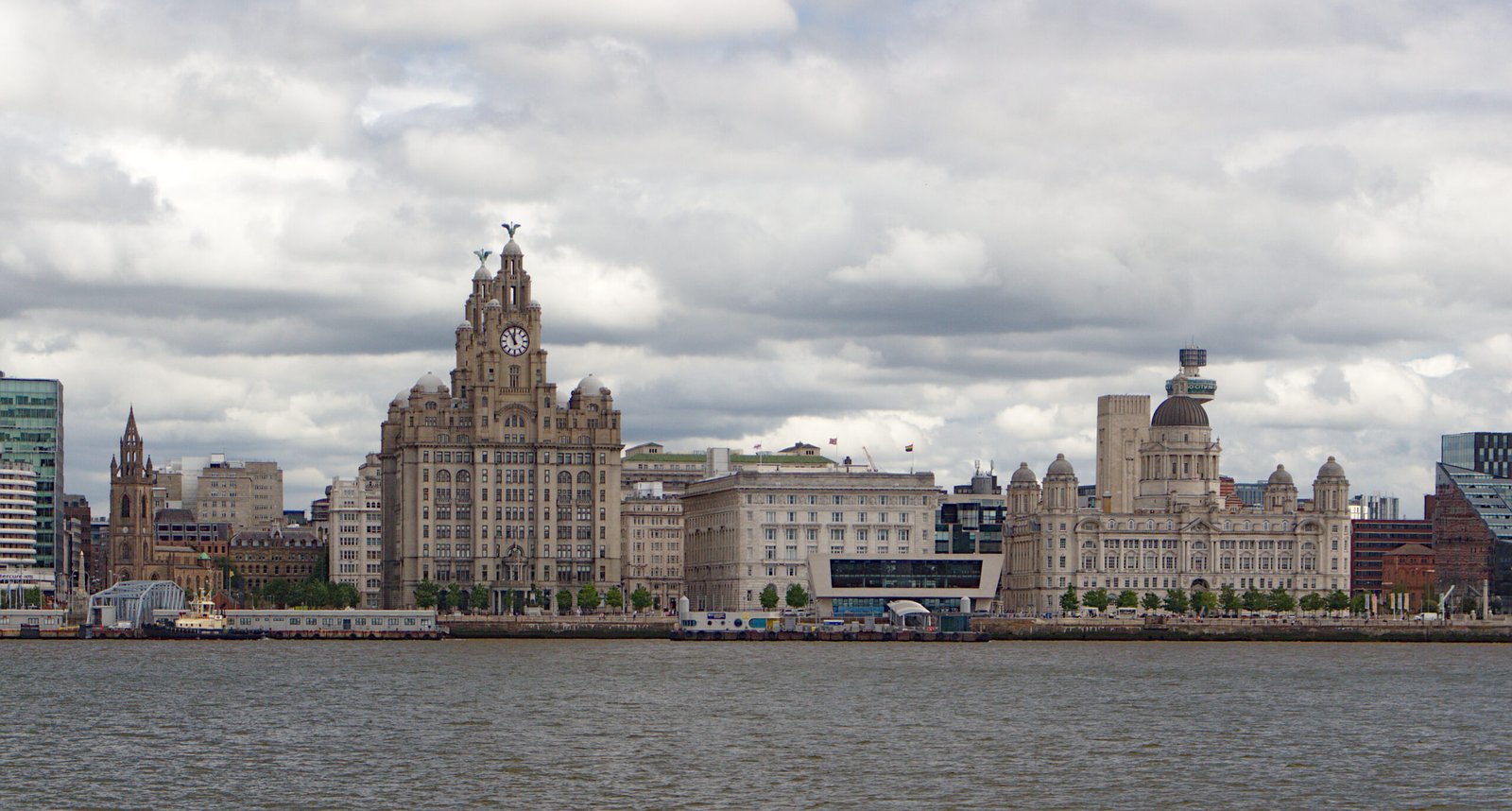
Once the gateway through which 40% of the world’s trade passed, Liverpool’s historic waterfront — with the iconic Three Graces, the engineering marvel of Albert Dock, and the memory of millions of emigrants and enslaved people — tells the story of the British Empire’s commercial reach. The site was inscribed on the UNESCO World Heritage List in 2004 and controversially delisted in 2021.
At a glance
Liverpool’s maritime heritage is inscribed across six distinct areas of the historic city: the Pier Head (dominated by the Three Graces), the Albert Dock, the Stanley Dock conservation area, the Ropewalks, the commercial centre, and the William Brown Street cultural quarter. Together they document the rise of a port city that became, during the 19th century, one of the most powerful commercial centres in the world — and one of the most morally compromised, as a principal port in the transatlantic slave trade. The UNESCO designation in 2004 recognised the exceptional completeness and authenticity of Liverpool’s surviving 18th and 19th-century maritime infrastructure. The delisting in 2021 — only the third site ever removed from the World Heritage List — was a consequence of approved large-scale development in the historic docklands. Liverpool’s heritage significance is unchanged by the administrative decision; its buildings, docks, and stories remain among the most compelling in Britain.
Key facts
- UNESCO WHS: Inscribed 2004; delisted July 2021 (Liverpool Waters development deemed to cause irreversible loss of heritage attributes — only the third site ever removed from the List)
- WHS area at inscription: Six zones covering the historic waterfront, commercial centre, and cultural quarter
- Albert Dock: 1846 — world’s first enclosed, non-combustible warehouse complex; first hydraulically operated dock; Grade I listed
- Royal Liver Building: 1911, Grade I listed; home to the Liver Birds — the symbol of Liverpool
- Cunard Building: 1916, Grade I listed
- Port of Liverpool Building: 1907, Grade I listed
- Peak trade: c. 1880–1914 — Liverpool handled approximately 40% of the world’s total trade
- Emigration port: Over 9 million emigrants departed Liverpool for the Americas, 1830–1930
History
Liverpool’s transformation from a small fishing settlement to a global commercial metropolis unfolded over roughly two centuries, driven by geography, engineering, and the darkest chapter of modern history. The city occupies the eastern shore of the Mersey estuary at the point where the river is narrow enough to be bridged but wide enough to accommodate deep-draught ocean-going ships. From the 1650s onwards, Liverpool’s merchants recognised this advantage and began investing in docks.
The opening of the Old Dock in 1715 — the world’s first commercial wet dock, now buried beneath Liverpool city centre — marked the beginning of systematic port development. But the capital that funded this development came substantially from the transatlantic slave trade. Between approximately 1700 and 1807, Liverpool merchants organised roughly 5,000 slaving voyages, transporting an estimated 1.4 million enslaved Africans to the Americas. By the 1790s, Liverpool had overtaken Bristol and London to become the world’s largest slaving port. The profits from this trade funded the construction of the Georgian townhouses, warehouses, and public buildings that give the city much of its surviving architectural character.
The abolition of the slave trade in 1807 did not diminish Liverpool’s commercial momentum: the port pivoted to cotton importation from the American South (itself produced by enslaved labour), to emigration traffic, and to the general merchandise trade of the expanding British Empire. The Albert Dock, designed by Jesse Hartley and Philip Hardwick and opened in 1846, represented a fundamental advance in dock engineering: for the first time, an entire dock complex — quays, warehouses, and transit sheds — was built entirely of iron and brick, with no timber. The result was fireproof, hydraulically powered (the world’s first such dock), and vastly more efficient than any predecessor.
The Three Graces at the Pier Head — the Port of Liverpool Building (1907), the Cunard Building (1916), and the Royal Liver Building (1911) — were built at the height of Liverpool’s global commercial dominance. The Royal Liver Building, with its two clock towers each topped by a mythical Liver Bird, became one of the most recognisable skylines in the world. Cunard liners, carrying emigrants and first-class passengers to New York, sailed from the berths directly below these buildings. Between 1845 and 1852 alone, 1.3 million Irish Famine refugees departed from Liverpool for North America.
Liverpool’s decline began after the First World War, accelerated by the shift to containerisation in the 1960s (which required deep-water container terminals the Mersey could not accommodate), and became catastrophic with deindustrialisation in the 1970s and 1980s. The Albert Dock, derelict by the early 1980s, was rescued and converted into a cultural and retail complex — including the Tate Liverpool and the Merseyside Maritime Museum — and reopened in 1988. The UNESCO inscription in 2004 recognised both the quality of the surviving fabric and the city’s remarkable cultural revival.
The 2021 delisting resulted from UNESCO’s conclusion that the approved Liverpool Waters mixed-use development scheme — a major regeneration of the north docks area — would cause irreversible loss of attributes of Outstanding Universal Value to the historic buffer zone. The decision was and remains deeply contested: Liverpool City Council and many heritage professionals argued that sympathetic development was necessary for the regeneration of derelict docklands, and that UNESCO’s criteria were being applied inflexibly. The delisting placed Liverpool alongside Dresden Elbe Valley (delisted 2009) and Oman’s Arabian Oryx Sanctuary (delisted 2007) as the only three sites ever removed from the World Heritage List.
What you see
The Pier Head remains the defining image of Liverpool. The three Edwardian Baroque and Beaux-Arts towers of the Royal Liver, Cunard, and Port of Liverpool buildings are best seen from the Mersey Ferry or from the opposite bank at Birkenhead. The Royal Liver Building’s Liver Birds — two mythical cormorant-like creatures, each 5.5 metres high — have watched over the city since 1911 and are the unchallenged symbol of Liverpool.
The Albert Dock survives in exceptional condition. Jesse Hartley’s five-storey, cast-iron-colonnaded warehouses enclose a rectangular basin of water, their red brick and black iron reflecting in the dock. The complex contains Tate Liverpool, the Merseyside Maritime Museum (including the International Slavery Museum), and the Beatles Story exhibition. It is the most visited multi-attraction complex outside London.
The William Brown Street cultural quarter preserves a remarkable sequence of 19th-century neo-classical public buildings: the Walker Art Gallery (with one of the finest pre-Raphaelite collections in the world), the World Museum Liverpool, the Central Library, and St George’s Hall — perhaps the finest neo-classical building in Britain, used by Dickens and Liszt and described by Pevsner as one of the greatest buildings of the world.
The Ropewalks district, centred on Bold Street and Seel Street, preserves the Georgian and early Victorian warehouse fabric of the port city’s commercial hinterland, now a creative and cultural district.
UNESCO delisting — context and significance
The 2021 delisting is an administrative decision by an international body; it does not alter Liverpool’s historical importance, the quality of its surviving architecture, or its status as one of the most significant port cities in world history. The site’s heritage values — the slave trade history, the emigration narratives, the engineering innovations of Albert Dock, the architectural quality of the Three Graces and St George’s Hall — are recognised by Historic England (all key structures are Grade I listed) and are not diminished by UNESCO’s decision.
For visitors and researchers, the delisting is primarily significant as a precedent in heritage conservation: it demonstrates that UNESCO is prepared to enforce its criteria even against a major developed-world city with significant political support. Whether the decision was correct — whether the Liverpool Waters development genuinely threatened Outstanding Universal Value, or whether UNESCO applied its criteria in a way that prioritised conservation over living-city regeneration — remains a serious and unresolved debate in the heritage field.
Practical information
- Albert Dock: Albert Dock, Liverpool L3 4BB. Open access to dock area and public spaces daily. Individual attractions have separate admission charges and hours.
- Tate Liverpool: Free permanent collection; charges for temporary exhibitions. Tue–Sun 10:00–17:50.
- International Slavery Museum: Free. Daily 10:00–17:00. Part of Merseyside Maritime Museum.
- St George’s Hall: St George’s Place, Liverpool L1 1JJ. Open daily; free entry to Great Hall foyer. Guided tours available.
- Walker Art Gallery: William Brown Street, Liverpool L3 8EL. Free. Mon–Sun 10:00–17:00.
- Mersey Ferry: Runs regular crossings Liverpool Pier Head to Birkenhead and Seacombe — the best way to see the waterfront from the water.
Getting there
By train: Liverpool Lime Street is the main intercity station (direct services from London Euston approx. 2h 10min, Manchester Piccadilly 50 min). Merseyrail services connect to Liverpool Central and James Street (closest to the Albert Dock and Pier Head).
By car: Liverpool city centre is reached via the M62 (from Manchester and the east) or the M58/A580. Parking in multi-storey car parks near the Albert Dock and Liverpool ONE. Postcode for Pier Head: L3 1BY.
By ferry: Stena Line and P&O ferries operate services from Dublin and Belfast to Liverpool. The ferry terminal is adjacent to the Pier Head.
By air: Liverpool John Lennon Airport (LPL) serves European destinations; Manchester Airport (MAN, 50 km east) provides wider international connections.
Nearby
- Birkenhead (across the Mersey): Take the Mersey Ferry or the Mersey Tunnel for Hamilton Square — a preserved Regency townscape — and Birkenhead Priory, the oldest standing building in Merseyside.
- Port Sunlight (10 km south of Birkenhead): The model village built by Lever Brothers for their soap factory workers (1888 onwards) — a complete Arts and Crafts townscape with the Lady Lever Art Gallery.
- Speke Hall (12 km south of Liverpool): National Trust half-timbered manor house (1530–1616), an extraordinary survival near Liverpool Airport.
- Caernarfon Castle, Wales (100 km south-west): UNESCO WHS — Edward I’s concentric castle dominating the Menai Strait, part of the Castles and Town Walls of King Edward in Gwynedd.
Sources
- UNESCO World Heritage Centre — Liverpool — Maritime Mercantile City (whc.unesco.org, id 1150) — inscribed 2004, delisted 2021
- Historic England — Albert Dock, Grade I Listed Building, List Entry 1205046
- Historic England — Royal Liver Building, Grade I Listed Building, List Entry 1241497
- Belchem, John. Liverpool 800: Culture, Character and History. Liverpool University Press, 2006.
- Hughes, Quentin. Seaport: Architecture and Townscape in Liverpool. Lund Humphries, 1964.
- UNESCO Decision 44 COM 7A.47 (2021) — delisting decision text (whc.unesco.org).
Find it on the map
See this place and what’s around it →📷 Become a Cultural Heritage Online photographer
Share your photos of places: they stay published under your name as the author. The more they're seen, the more you get noticed — and soon a contest will reward the most appreciated photos.
Log in or sign up free to add a photo