
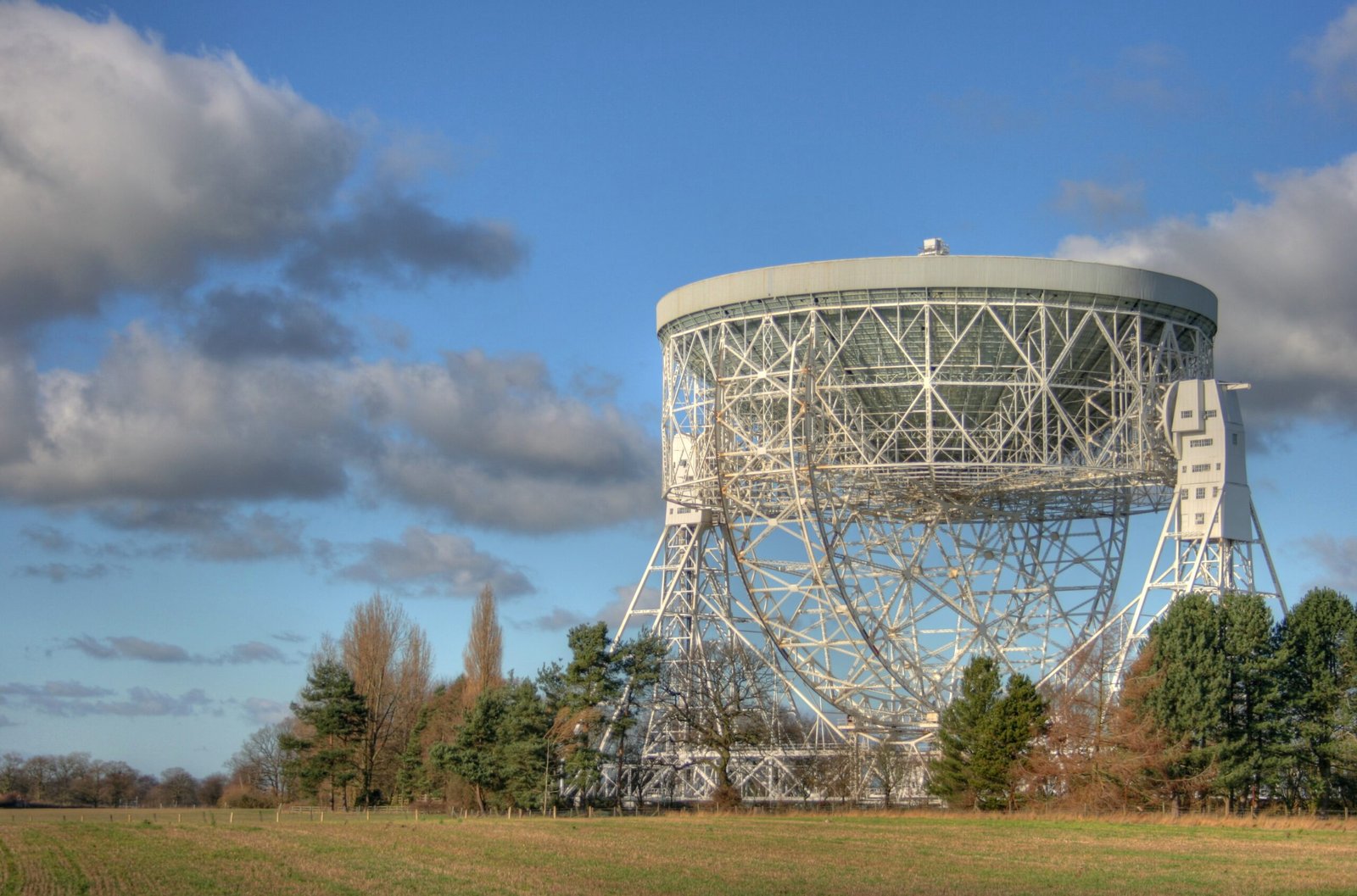
Home of the Lovell Telescope — the third-largest fully steerable radio telescope on Earth — Jodrell Bank is the pioneering British observatory that tracked Sputnik, guided the Apollo missions, and today anchors one of the world’s highest-resolution interferometric arrays.
At a glance
Jodrell Bank Observatory stands in a field outside Macclesfield, Cheshire, roughly 25 km south of Manchester. Its centrepiece is the Lovell Telescope: a bowl of 76.2 metres diameter and 3,200 tonnes of steel, completed in 1957 and still in daily use as a front-line research instrument. The site was added to the UNESCO World Heritage List in 2019 as an exceptional witness to the dawn of the radio astronomy age — a period when human beings first learned to listen to the universe rather than merely look at it. The observatory is operated by the University of Manchester and hosts the Discovery Centre, which receives around 140,000 visitors per year.
Key facts
- UNESCO WHS: 2019 (sole UK site inscribed that year)
- Telescope diameter: 76.2 m (250 ft) — world’s third-largest fully steerable dish
- Weight: 3,200 tonnes; the bowl alone weighs 1,500 tonnes
- First operational: August 1957; named after Sir Bernard Lovell 1987
- Grade I listed: one of the most significant engineering structures in Britain
- e-MERLIN array: hub of a 217 km baseline linking 7 radio telescopes across the UK
- Frequency range: 300 MHz to 25 GHz (multiple receivers)
- Operator: University of Manchester
History
The story of Jodrell Bank begins in 1945, when physicist Bernard Lovell drove a trailer-load of surplus Army radar equipment out of Manchester to an experimental farm belonging to the university. His goal was simple: escape the electrical interference of the city and detect cosmic ray air showers. Within months, he and a small team had discovered that meteor trails scatter radio waves — the first scientifically significant result from the site.
By 1950 Lovell had become convinced that a much larger, fully steerable dish was needed to explore the new frontier of radio astronomy. The engineering challenge was formidable: no one had ever built a steerable antenna of such size, and there was no established technology to draw on. The project — budgeted at £260,000 but eventually costing £700,000 — nearly bankrupted the university and Lovell himself faced personal liability for the overruns. It was saved, almost miraculously, by events 250 miles above the Earth.
On 4 October 1957, four days after the Soviet Union launched Sputnik 1, the Lovell Telescope was the only instrument in the Western world capable of tracking the carrier rocket. That single demonstration of capability transformed the telescope’s status overnight from costly white elephant to strategic national asset. The British government quietly wrote off the debt.
During the Space Race, Jodrell Bank tracked Pioneer 5 (1960), detected signals from Soviet Luna probes, and played a critical relay role for Apollo 8’s trans-lunar injection. In 1963 it co-detected the first quasar signals. Pulsar research, SETI experiments, mapping galactic hydrogen: the Lovell Telescope has contributed to virtually every major field of radio astronomy. The creation of the MERLIN array in the 1980s, upgraded to e-MERLIN with fibre-optic links in 2011, turned Jodrell Bank into the hub of an instrument with a baseline of 217 km — achieving resolutions comparable to or exceeding the Hubble Space Telescope at radio wavelengths.
What you see
The Lovell Telescope dominates every view across the Cheshire plain for many kilometres. Up close, its scale is almost incomprehensible: the dish is large enough to contain two Olympic swimming pools; the steel structure that supports and rotates it rises to 89 metres. The bowl is perforated steel mesh, optimised for the wavelengths it observes. Two rail tracks allow the entire structure to rotate 360° in azimuth; hydraulic jacks tilt the dish in elevation from just above horizontal to pointing straight up at the zenith.
On site, the Mark II telescope (elliptical dish, 38 × 25 m, 1964) operates in tandem with the Lovell for interferometric work. The Control Building, substantially original from the 1950s, contains the historic operations room where Sputnik was tracked. The Discovery Centre (opened 2011, expanded 2018) provides interactive exhibits on radio astronomy, the Big Bang, and the life of Bernard Lovell. An arboretum planted around the observatory grounds softens what might otherwise be an industrial landscape into something unexpectedly serene.
Why it matters
Jodrell Bank’s UNESCO inscription recognises it as an outstanding example of a technological ensemble that illustrates a significant stage in human history — specifically the emergence of radio astronomy and the construction of the first generation of large, steerable radio telescopes. The Lovell Telescope is not a relic: it is still an active research instrument generating peer-reviewed publications every year. This combination of heritage significance and ongoing scientific productivity is rare among World Heritage Sites.
The observatory also carries a deeper cultural importance. At the height of the Cold War, Jodrell Bank — a civilian scientific institution operating on a shoestring budget in a Cheshire field — tracked both sides’ spacecraft and shared its data openly, demonstrating that science transcends politics.
Practical information
- Address: Jodrell Bank Observatory, Macclesfield, Cheshire SK11 9DL, United Kingdom
- Opening hours: Daily 10:00–17:00 (Discovery Centre); check official website for seasonal variations
- Admission: Adults approx. £17; children approx. £11; family tickets available
- Guided tours: Available at scheduled times; telescope base accessible on public tours
- Website: jodrellbank.net
- Phone: +44 (0)1477 571766
Getting there
By car: Jodrell Bank is on the A535, approximately 17 km south of Macclesfield. Postcode: SK11 9DL. Free parking on site.
By train and bus: The nearest station is Goostrey (direct trains from Manchester Piccadilly, approx. 45 min), then a 2.4 km walk. A seasonal shuttle bus operates on selected dates — confirm on the website before travel.
Nearby
- Quarry Bank Mill, Styal (22 km north): National Trust water-powered cotton mill (1784), a direct contemporary of Arkwright’s Derwent Valley system.
- Tatton Park (14 km north): National Trust estate with mansion, working farm, and parkland.
- Alderley Edge (8 km north): Sandstone escarpment with prehistoric copper mines and sweeping views across the Cheshire plain.
- Macclesfield Silk Museum (17 km north): Tells the story of Cheshire’s pre-industrial textile heritage.
Sources
- UNESCO World Heritage Centre — Jodrell Bank Observatory (whc.unesco.org, id 1594)
- University of Manchester — official Jodrell Bank Observatory website (jodrellbank.net)
- Lovell, Bernard. The Story of Jodrell Bank. Oxford University Press, 1968.
- Historic England — Listed Building, Grade I, List Entry 1215737.
Find it on the map
See this place and what’s around it →📷 Become a Cultural Heritage Online photographer
Share your photos of places: they stay published under your name as the author. The more they're seen, the more you get noticed — and soon a contest will reward the most appreciated photos.
Log in or sign up free to add a photoIs this page about you?
This page is read by travellers and heritage enthusiasts who find it on Google. Tell us how you are connected to this place and we will take it from there.