
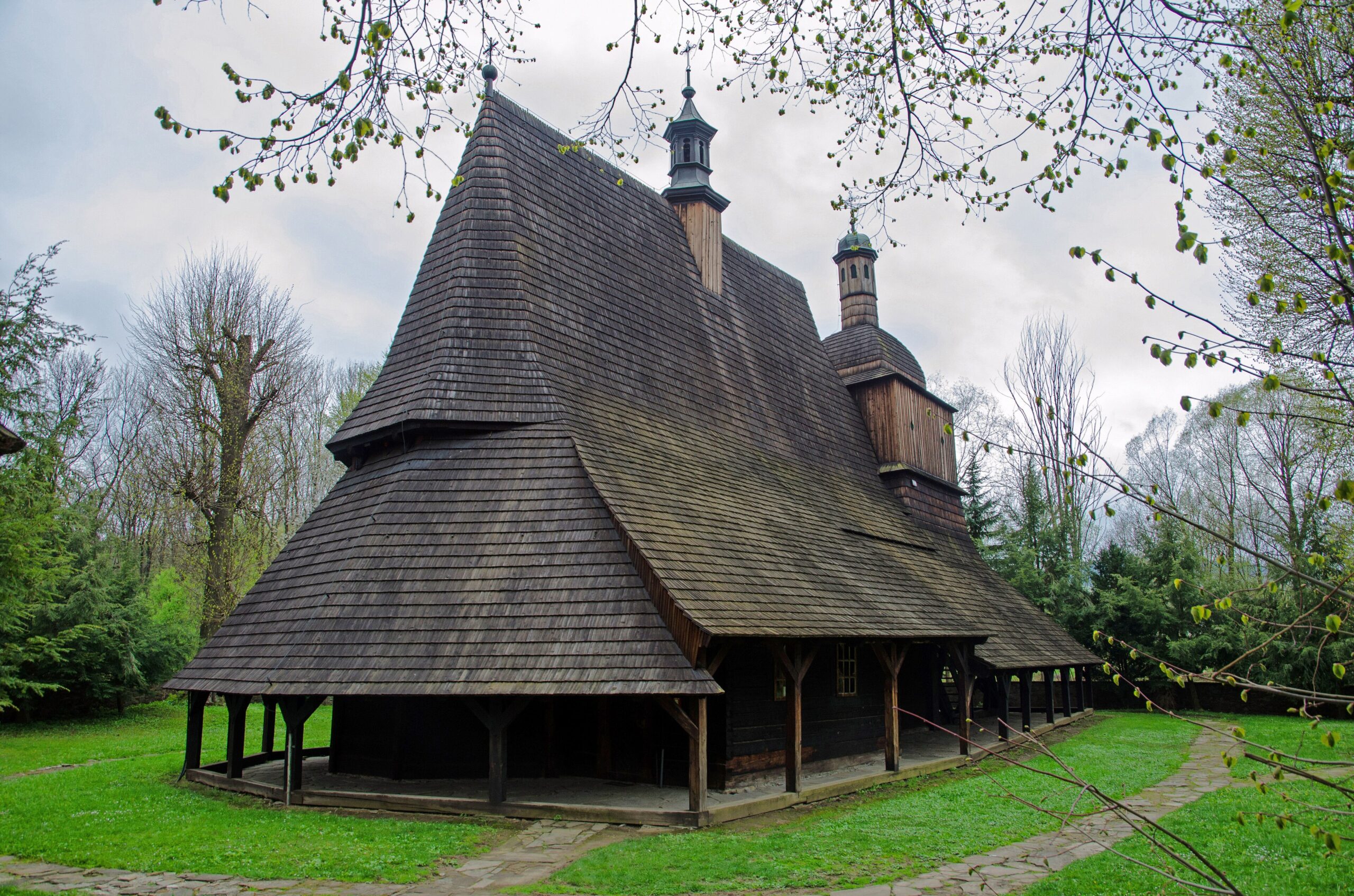
Six Gothic and Renaissance churches built entirely of timber in the foothills of the Carpathians, without nails, whose polychrome-painted interiors rank among the most complete surviving examples of late-medieval sacred decoration anywhere in Europe.
At a glance
Inscribed as a UNESCO World Heritage Site in 2003, the six churches at Binarowa, Blizne, Debno Podhalanski, Haczow, Lipnica Murowana, and Sekowa form a coherent ensemble of rural Catholic architecture executed entirely in horizontal log (blockbau) construction. Dating from the 15th and 16th centuries, they have been in continuous liturgical use ever since. Their structural timber frames, joined at the corners without metal fasteners, remain largely original, a testament to the durability of Carpathian silver fir and larch. The interiors are wrapped in polychrome murals covering walls, ceilings, and vaulted timber bays in vivid reds, greens, and golds.
Key facts
- UNESCO inscription: 2003, serial property (6 components)
- Date of construction: 15th-16th century CE
- Construction technique: Blockbau (horizontal log, corner-locked, no nails)
- Style: Gothic and Renaissance, Carpathian vernacular
- Largest church: Haczow — the largest Gothic wooden church in Europe
- Most decorated interior: Debno Podhalanski — complete 15th-century polychrome covering every surface
- Region: Malopolska (Lesser Poland) Voivodeship, southern Poland
- Status: All six churches are active parishes
History
The churches were built when the Malopolska region, at the heart of the Kingdom of Poland under the Jagiellonian dynasty, was prosperous enough to invest in fine ecclesiastical buildings yet remote enough to maintain timber as the preferred material over stone. The Gothic church at Haczow dates to c. 1388–1459; the Renaissance Sekowa church was completed in 1520. All were built by local carpenters using techniques passed down across generations in the Carpathian timber-building tradition.
The interiors were decorated over the 15th and 16th centuries in successive campaigns of polychrome painting. Debno Podhalanski represents the most ambitious programme: every wall, ceiling beam, and vaulted panel is covered in geometric, heraldic, and figurative scenes, producing one of the most complete late-medieval interior decoration schemes surviving in Europe. The churches also contain original carved altars, Gothic sculpture, and liturgical furnishings.
Despite wars, fires, and the turbulence of the 20th century, all six churches survived largely intact, aided by their remoteness in small Carpathian foothill villages and the devotion of local communities. They were added to the Polish Monuments Register before receiving the UNESCO designation, which confirmed their outstanding universal value as representatives of a distinctive regional ecclesiastical tradition bridging Gothic and Renaissance building cultures in timber.
What you see
Each church follows a similar spatial logic: a western bell tower, a single nave, and an apse, all constructed of horizontal logs locked at the corners without nails. The exterior silhouette is characterised by shingle roofs sweeping low over the walls, wooden arcaded porches, and small windows. The profile is horizontal and organic, embedded in the landscape rather than rising above it.
Inside, the full impact of the polychrome tradition becomes apparent. At Debno Podhalanski, the entire interior is painted with interlocking geometric patterns, stylised floral motifs, heraldic symbols, and figurative panels depicting saints and biblical scenes, all in earthy reds, ochres, greens, and blacks. At Haczow, the sheer scale of the nave is arresting. At Lipnica Murowana and Binarowa, carved Gothic altarpieces and original furnishings survive alongside painted interiors.
Each church is set in a churchyard enclosed by a wooden fence, surrounded by quiet Carpathian village landscapes that heighten the sense of timelessness.
Visiting today
All six churches are active Catholic parishes open to visitors, typically via a resident key-keeper in the village, or during Mass times. The best single stop for the full polychrome experience is Debno Podhalanski, near Nowy Targ. Haczow, near Brzozow, offers the most dramatic Gothic spatial experience. Sekowa and Binarowa are close together and can be visited in a single day. The surrounding Carpathian foothill landscape makes a self-drive circuit through the six villages an exceptionally rewarding itinerary.
Practical information
- Entry: Free (donations welcomed); contact local parish for key-keeper access
- Opening hours: Variable by church; most open daily during daylight hours or during Mass
- Best base: Nowy Targ (for Debno), Gorlice (for Sekowa and Binarowa), Rzeszow (for Blizne and Haczow)
- Guided tours: Available on request via local tourist offices in Nowy Sacz and Rzeszow
- Photography: Generally permitted; flash may be restricted
- Accessibility: Limited; historic interiors have uneven floors and low thresholds
Getting there
The six churches are dispersed across the Malopolska and Subcarpathian regions of southern Poland, 80–130 km from Krakow. A car is essential; no direct public transport links the churches. Binarowa and Sekowa are accessible from Gorlice; Debno Podhalanski lies near Nowy Targ; Haczow and Blizne are east of Rzeszow. International airports: Krakow John Paul II (KRK) and Rzeszow-Jasionka (RZE).
Nearby
- Wooden Tserkvas of the Carpathian Region (UNESCO 2013) — Ukrainian and Slovak Orthodox timber churches in the same mountain arc
- Tatra National Park — Poland highest mountain range, 50–80 km south of Debno, with alpine scenery and Podhale highland architecture
- Wieliczka Salt Mine (UNESCO 1978) — extraordinary underground cathedral carved from salt, 30 km from Krakow
- Krakow Historic Centre (UNESCO 1978) — royal capital of medieval Poland, 80–130 km north of the church circuit
- Bieszczady Mountains — remote wilderness national park east of Haczow, known for wolf and bison populations
Sources
- UNESCO World Heritage List — Wooden Churches of Southern Lesser Poland (2003). whc.unesco.org/en/list/1053
- Wikipedia — Wooden churches of Southern Lesser Poland. en.wikipedia.org
- Polish National Heritage Board (NID). nid.pl
Find it on the map
See this place and what’s around it →📷 Become a Cultural Heritage Online photographer
Share your photos of places: they stay published under your name as the author. The more they're seen, the more you get noticed — and soon a contest will reward the most appreciated photos.
Log in or sign up free to add a photo