
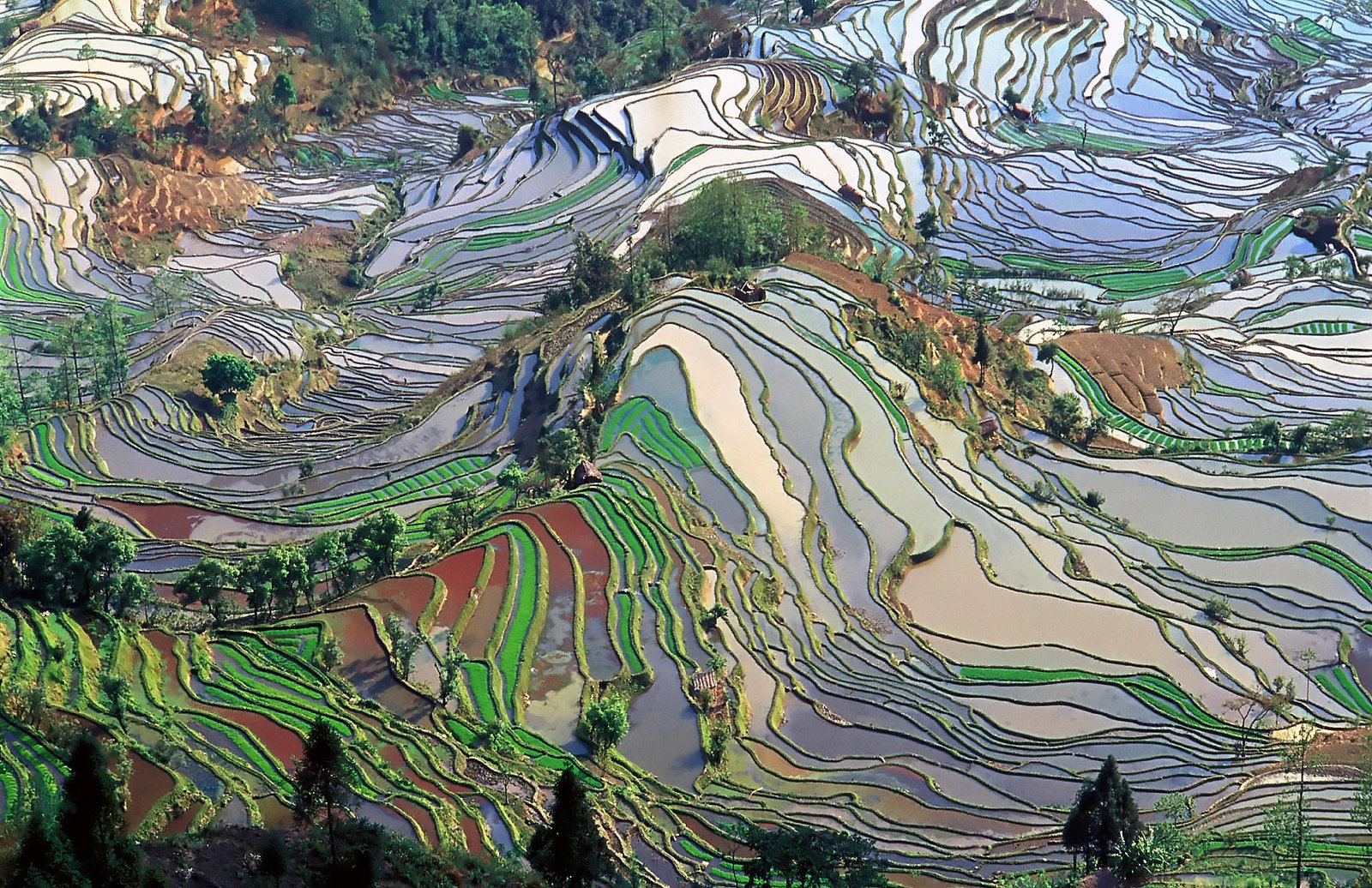
Honghe Hani Rice Terraces
On the steep slopes of the Ailao Mountains in southern Yunnan, the Hani people have built and maintained for over 1,300 years one of the world’s most extraordinary agricultural landscapes: a system of irrigated rice terraces up to 3,000 levels deep, sustained by a sophisticated water management cycle that links mountain forest, village, and valley.
At a glance
The Honghe Hani Rice Terraces cover approximately 16,603 hectares in Honghe Prefecture, Yunnan Province. They were constructed by the Hani ethnic minority over approximately 1,300 years, beginning in the Tang Dynasty. The terraces are remarkable not as static monuments but as a living system: four integrated elements (mountain forests, irrigation channels, villages, and terraces) form an ecological cycle in which rainwater collected in the high forests flows through village water-management networks into the terraced fields, sustaining continuous rice cultivation without the ground water depletion that afflicts modern irrigated agriculture elsewhere. UNESCO inscribed the site in 2013 as a cultural landscape of Outstanding Universal Value.
Key facts
- UNESCO inscription: 2013 (List No. 1111rev), as a cultural landscape
- Area: approximately 16,603 hectares of core zone
- Altitude: terraces from approximately 800 m to 2,000 m on the Ailao Mountain slopes
- Construction: approximately 1,300 years continuous effort, beginning c. Tang Dynasty (7th century CE)
- Ethnic group: Hani people (Yi language family; approximately 1.6 million in Yunnan Province)
- Maximum terrace depth: up to 3,000 individual terrace levels on the steepest slopes
- Cultivation system: flooded paddy rice plus multi-cropping with fish and duck cultivation within the paddy fields
History and significance
The Hani migrated to the Ailao Mountains from further north in the Yunnan-Guizhou plateau over many centuries, and the terrace system represents a long adaptation to one of the most challenging agricultural environments in East Asia: steep slopes, heavy seasonal rainfall, and no flat land. The solution the Hani developed is an integrated hydrological system rather than simply a series of individual fields. The mountain forests at the ridge tops are preserved as sacred water-source forests (not cut for timber or farmland), collecting and filtering rainfall; a network of channels and ditches, maintained communally by each village, distributes water from the forests to the terraces below.
The Hani have no written history: all knowledge of the terrace construction, water-management protocols, and agricultural calendar is transmitted through oral tradition, ceremony, and practical apprenticeship. The village elder system governs water allocation through a protocol that has remained essentially unchanged for centuries: each village section has defined water rights, and disputes are settled by traditional mediators rather than state authority. This makes the Hani terrace landscape one of the most complete surviving examples of a pre-modern common-pool resource management system still in active use.
The 20th century brought significant stress. Collectivisation under the People’s Republic disrupted traditional village water-management authority; then economic reform created incentives to convert terraces to cash crops or to migrate to cities. The UNESCO inscription was partly motivated by the need to protect a system under active threat from economic and demographic change.
What you see
The terraces are best understood from the ridgeline viewpoints above Yuanyang County, where the full scale of the landscape becomes visible: thousands of narrow curved terraces cascading from the summit forest down to the valley floor, each one individually bunded (embanked) by hand. The bunds are constructed of compacted earth faced with stone; the visual effect on a clear morning, with the flooded terraces reflecting clouds and sky, has made Honghe one of the most photographed landscapes in China.
The Hani villages are positioned at mid-altitude between the forest above and the terraces below, at the intersection of the water-distribution network. Traditional Hani architecture uses a distinctive mushroom-shaped house (the straw-roofed diaojiaolou) built on wooden stilts, with livestock on the ground floor and living quarters above. The villages are not tourist sites but active agricultural communities.
The most photographed viewpoints are at Duoyishu (best for sunrise), Bada (broad panoramic view), and Laohuzui (dramatic steep descent to valley). The terraces change in appearance throughout the year: flooded and mirror-like from January to May, brilliant green in summer, gold at harvest in October-November.
The water system
The Hani water management system is the invisible infrastructure that makes the terraces possible. At its apex are the forest reserves on the high ridges, maintained as sacred groves by Hani custom. Below them, a hierarchy of channels (from large main conduits to tiny individual terrace-feeding rills) distributes water to approximately 80 villages in the Yuanyang core zone. The system runs continuously, even in the dry season, because the forests capture and slowly release moisture that flat or deforested land would shed immediately. The result is a landscape that has supported continuous wet-rice cultivation for over 1,000 years without significant soil degradation — an achievement that modern agronomists study as a model of sustainable terraced agriculture.
Practical information
- Getting there: fly to Kunming Changshui International Airport (KMG), then take a high-speed train or long-distance bus to Jianshui or Yuanyang (4-6 hours)
- Base: Yuanyang County (Nansha town at low altitude, or Xinjie town at high altitude near the terraces)
- Best season: January-May for the flooded mirror terraces; October-November for the gold harvest season; June-September is the wet season with limited visibility
- Sunrise viewpoints: Duoyishu (most famous sunrise view), Bada, Laohuzui — require a driver or local taxi booked the evening before
- Entry: the Yuanyang terrace scenic area has an admission fee; viewpoint access may require separate tickets
- Accommodation: guesthouses in Xinjie town; basic but authentic Hani-run options in nearby villages
Getting there
Kunming (KMG, 5-6 hours by bus) is the main gateway. Express buses run from Kunming South Bus Station to Yuanyang Nansha, from which local minibuses or taxis serve Xinjie town and the terrace viewpoints. Alternatively, take the high-speed train from Kunming to Jianshui (1.5 hours) and connect by bus to Yuanyang. A new Yuanyang Airport opened in 2021, with direct flights from Kunming (30 minutes) and select other Chinese cities.
Nearby
- Jianshui Ancient Town (120 km north) — a well-preserved Han Chinese and Hani market town with a famous Confucian temple and the Chaoyang Gate
- Yuanyang Saturday market — a colourful weekly market where Hani, Yi, Dai, and Miao villagers trade; held in Xinjie town
- Ailao Mountain Nature Reserve — contiguous with the sacred forest source zone above the terraces; gibbon habitat
- Yuanjiang, Yunnan — lower-altitude town in the valley below the terraces, with a distinctly tropical climate and the Red River visible
Sources
- UNESCO World Heritage List — Cultural Landscape of Honghe Hani Rice Terraces (No. 1111rev, 2013)
- Wikipedia — Honghe Hani Rice Terraces
- Bai, J. & Xu, J. (2012). Hani Terraced Fields. Yunnan Education Publishing House.
- Michaud, J. & Ovesen, J. (eds, 2013). Turbulent Times and Enduring Peoples. Routledge.
Find it on the map
See this place and what’s around it →📷 Diventa un fotografo di Cultural Heritage Online
Condividi le tue foto dei luoghi: restano pubblicate con la tua firma come autore. Più vengono viste, più ti fai conoscere — e presto un concorso premierà le foto più apprezzate.
Accedi o registrati gratis per aggiungere una foto