
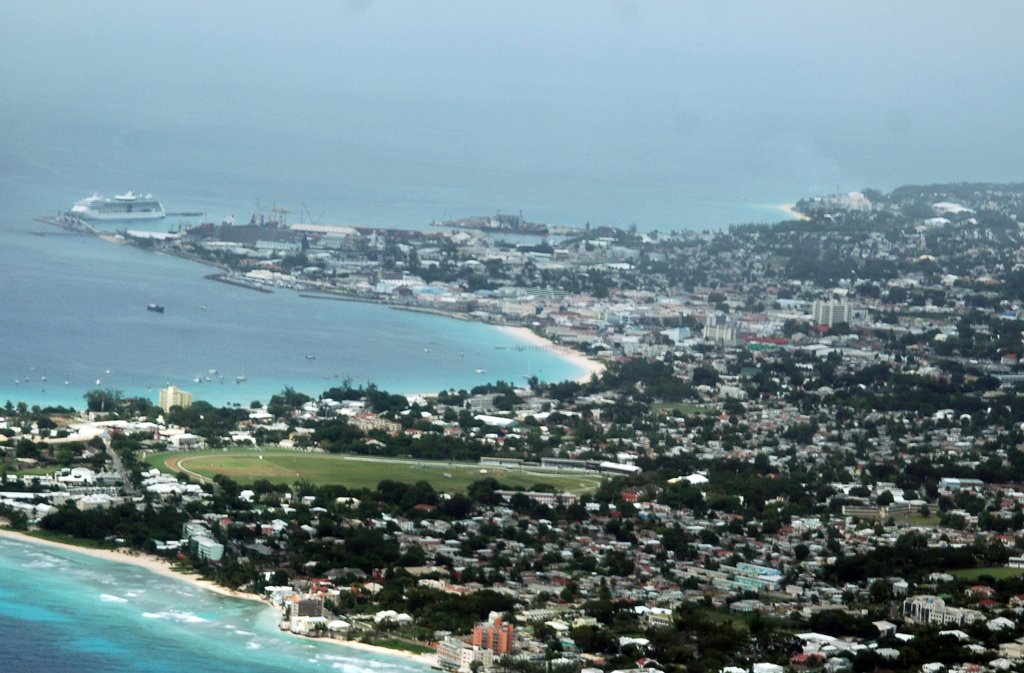
Historic Bridgetown and its Garrison
The capital of Barbados is one of the best-preserved British colonial cities in the Caribbean — a layered townscape of 17th-century street patterns, neo-Gothic parliament buildings, one of the oldest Jewish synagogues in the Western Hemisphere, and a Georgian military garrison that once commanded the entire British West Indies. Inscribed as a UNESCO World Heritage Site in 2011.
At a glance
Historic Bridgetown sits on the southwestern coast of Barbados, clustered around the Careenage — a tidal inlet where colonial-era schooners were once careened for hull repairs. The UNESCO inscription covers the historic city core together with the Garrison Historic Area roughly one kilometre to the south, recognising the ensemble as an exceptional testimony to 17th-century British colonial urban planning and military infrastructure. Founded in 1628, Bridgetown has been continuously inhabited for nearly 400 years and hosts the third-oldest Parliament in the Western Hemisphere, constituted in 1639.
Key facts
- UNESCO inscription: 2011, Criteria iv and vi
- Founded: 1628 CE by English colonists
- Parliament constituted: 1639 — third-oldest in the Western Hemisphere
- Garrison: British Army Caribbean HQ from 1780
- Cast-iron cannons: 70 surviving from the colonial period
- Jewish synagogue: First built 1654, rebuilt 1833
- Republic since: 2021
- Coordinates: 13.1000 N, 59.6167 W
History
English colonists established Bridgetown in 1628 on Barbados’s southwestern coast. By the late 17th century, Barbados was the wealthiest colony in the British Empire, its plantation economy shaping a prosperous merchant townscape whose street grid survives largely intact today. The Sephardic Jewish community arrived from Dutch Brazil in 1654, establishing a synagogue that year and contributing decisively to Barbadian commercial and intellectual life — the island’s early tradition of religious tolerance may have influenced parallel developments in England and New England.
The Garrison became the British Army’s Caribbean headquarters around 1780. Its parade ground, the Savannah, was later converted into one of the oldest active racecourses in the Western Hemisphere. The Main Guard building dates from c. 1803 and the 70 cast-iron cannons still ring the Savannah perimeter. Barbados achieved independence in 1966 and became a republic in November 2021, removing the British monarch as head of state.
What you see
National Heroes Square (formerly Trafalgar Square) is anchored by the neo-Gothic Parliament Buildings (1874), built from local coral limestone and housing the Senate and House of Assembly. A statue of Lord Nelson (1813) — predating the London column — occupies the square, though its future is subject to ongoing public debate since 2020. The Nidhe Israel Synagogue on Synagogue Lane, rebuilt 1833, preserves 370 years of Sephardic Atlantic history; the adjacent museum holds original 17th-century artefacts. The Careenage waterfront has been restored as a pedestrian promenade lined with colourful colonial warehouses. Inside the Garrison, the Barbados Museum occupies the former military prison and contains the island’s finest Amerindian and colonial collections.
Practical information
- Airport: Grantley Adams International (BGI), approx. 16 km southeast
- Parliament Buildings: National Heroes Square — exterior free; interior tours on weekdays
- Nidhe Israel Synagogue: Synagogue Lane — Mon–Fri, admission fee for museum
- Barbados Museum: The Garrison Savannah — Mon–Sat
- Currency: Barbadian dollar (BBD); USD widely accepted
- Best season: December–April (dry); hurricane season June–November
Getting there
Grantley Adams International Airport (BGI) receives direct flights from London, New York, Toronto, and Miami. Taxis and route taxis cover the 16 km to Bridgetown centre in 20–30 minutes. The Garrison is a short walk south of the historic centre along Garrison Road.
Nearby
- Saint Michael’s Cathedral — Anglican cathedral from 1789, a short walk from National Heroes Square
- Queen’s Park — 19th-century park with a massive baobab tree reportedly among the oldest in the Western Hemisphere
- Codrington College — 18th-century Anglican college in Saint John Parish, one of the oldest universities in the Americas
- Harrison’s Cave — crystallised limestone cavern system inland from Bridgetown
Sources
- UNESCO World Heritage List — Historic Bridgetown and its Garrison, 2011
- Barbados Museum and Historical Society
- Nidhe Israel Synagogue and Museum documentation
- Wikipedia — “Historic Bridgetown and its Garrison”
Find it on the map
See this place and what’s around it →📷 Diventa un fotografo di Cultural Heritage Online
Condividi le tue foto dei luoghi: restano pubblicate con la tua firma come autore. Più vengono viste, più ti fai conoscere — e presto un concorso premierà le foto più apprezzate.
Accedi o registrati gratis per aggiungere una foto