
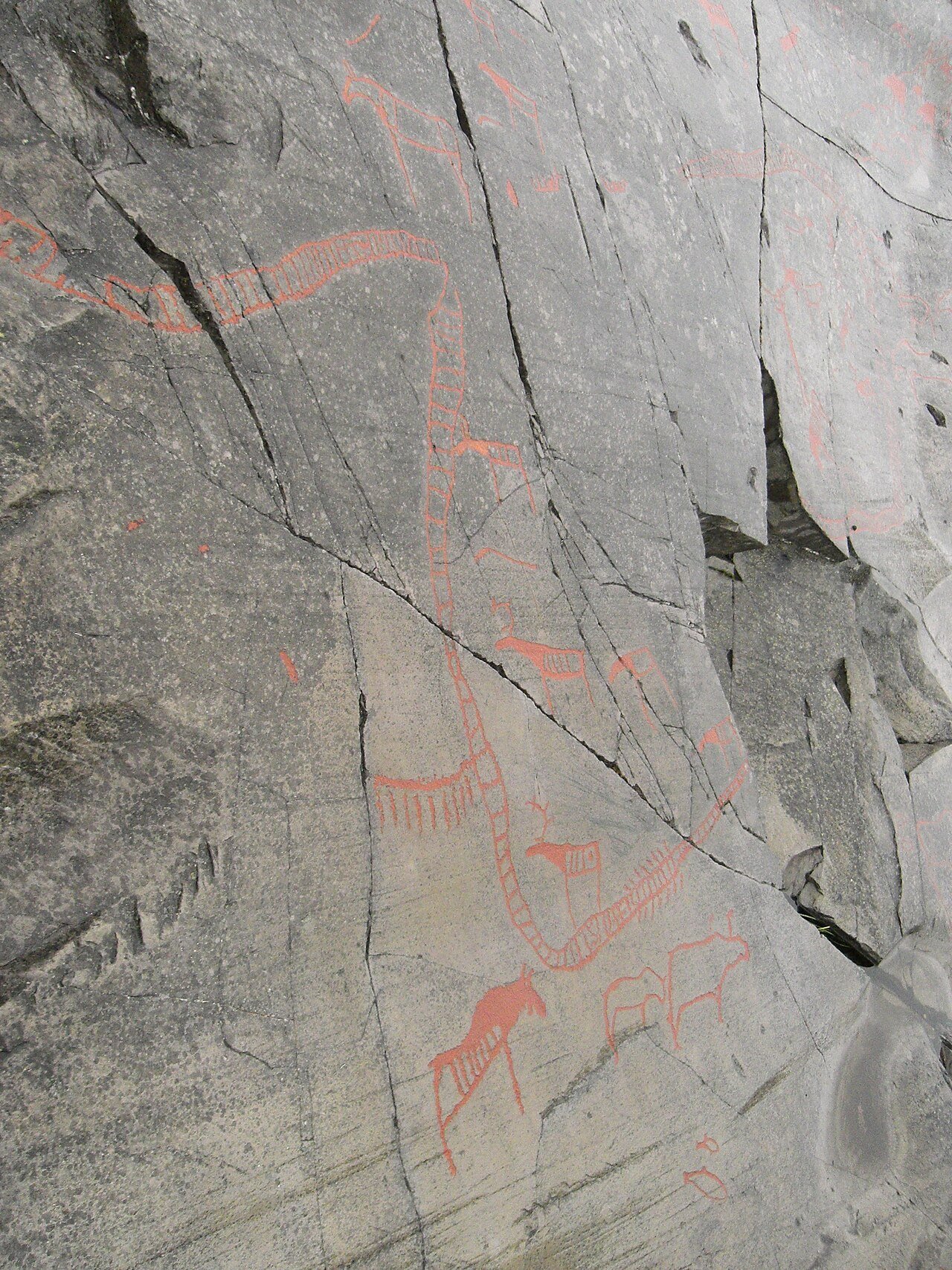
More than 6,000 rock carvings and paintings on the shores of the Alta Fjord, above the Arctic Circle in northern Norway — the largest known concentration of prehistoric rock art in northern Europe, created over 3,700 years by hunter-fisher-gatherer peoples of the Arctic coast, and a UNESCO World Heritage Site since 1985.
At a glance
Along the shores of the Alta Fjord at 70 degrees north latitude, spread across several sites of which Hjemmeluft/Jiepmaluokta is the principal one, more than 6,000 individual rock carvings (petroglyphs) and rock paintings (pictographs) record the life of Stone Age and Bronze Age peoples of the Arctic coast. Carved between approximately 4200 BCE and 500 BCE — a span of 3,700 years — they depict reindeer, elk, bears, salmon, boats, and human figures at a density found nowhere else in northern Europe. Inscribed as a UNESCO World Heritage Site in 1985, the site is managed by the Alta Museum with boardwalk access across the main site at Hjemmeluft.
Key facts
- Location: Alta Fjord, Alta municipality, Finnmark county, Norway (70°N — above Arctic Circle)
- Number of images: more than 6,000 individual figures across multiple sites
- Date range: c. 4200 BCE – c. 500 BCE (Late Stone Age through early Iron Age)
- Techniques: pecking (petroglyphs) and red ochre painting (pictographs)
- Principal site: Hjemmeluft/Jiepmaluokta — most extensive site, boardwalk access
- Other sites: Kafjord, Amtmannsnes, Transfarelv
- UNESCO inscription: World Heritage Site, 1985 (criteria i, iii)
- Museum: Alta Museum — World Heritage Rock Art Centre, adjacent to main site
History
The earliest carvings at Alta date to approximately 4200 BCE, when retreating glaciers made the Alta Fjord accessible to the first human settlers of this extreme latitude. These first arrivals were hunter-fisher-gatherers who pursued reindeer across the coastal tundra, fished the fjord for salmon and halibut, and hunted whale and seal along the ice edge. The rock art is a direct record of this world: the most commonly depicted subjects are reindeer in the thousands, elk, bears, and large fish, alongside boats carrying dozens of human figures representing the maritime dimension of their lives.
The carvings continued across more than three millennia, with detectable stylistic changes across chronological layers. A key dating method exploits isostatic rebound — the land rose as glacial ice retreated, progressively lowering the shoreline. Since the creators always carved near the water’s edge, the height above the modern shoreline indicates relative age: older carvings sit higher on the rock faces. This geological context provides a rare chronological framework for an otherwise undatable tradition.
The rock art entered systematic archaeological documentation in the late 19th century. Large-scale preservation work began in the 1970s, leading to UNESCO inscription in 1985. The Hjemmeluft site is now protected by a raised boardwalk system; carvings are enhanced with red pigment following traces of original ochre found in many figures.
What you see
The main site at Hjemmeluft extends along a smooth south-facing rock surface sloping toward the fjord. Approximately 3 km of elevated wooden boardwalks wind across the carvings. Reindeer are depicted with naturalistic accuracy — antlers, body posture, and movement captured with economy that required deep knowledge of the animal. Beside them: stylised human figures in hunting scenes; boats with paddlers; bears; fish; spirals and labyrinths with no obvious parallel elsewhere in European prehistory. Some panels show composite scenes — a hunting drive with beaters and waiting boats — that read almost narratively.
The Arctic setting is integral. In summer (June–August) the site is bathed in midnight sun; in winter, it is under snow and the museum remains open. The Alta Museum holds casts of key panels, documentation of all 6,000+ figures, and contextual displays on Sami and pre-Sami Arctic prehistory.
Why it matters
The Alta rock art is the largest systematic record of Stone Age and Bronze Age life in the European Arctic. Its 3,700-year span allows researchers to trace continuity and change in human culture across a single place over a timespan that dwarfs recorded history. The isostatic dating method — using shoreline change to date carvings by their height above the water — has influenced rock art study worldwide. The Alta carvings also document a way of life — Arctic hunter-gatherer economy — poorly represented in the European record dominated by agricultural societies further south. They are the primary visual testimony of the people who first made the Arctic coast of Europe their permanent home.
Practical information
- Alta Museum: open year-round; summer (June–Aug) daily 08:00–20:00; reduced winter hours; admission charged
- Boardwalk circuit: ~3 km; allow 1.5–2 hours for the full route; summer access only
- Midnight sun: visible mid-May to late July — the site under midnight-sun light is exceptional
- Northern Lights: September–March offers aurora borealis over the fjord
- Photography: permitted throughout
Getting there
Alta is served by Alta Airport (ALF) with daily flights from Oslo (approximately 2 hours). The Alta Museum and rock art site are approximately 4 km from the airport by taxi or car. Alta is connected to Tromso (approximately 5 hours by road) and Kirkenes (approximately 7 hours). The Hjemmeluft site is approximately 4 km west of Alta town centre along the E6 highway. There is no rail service to Alta.
Nearby
- Nordkapp (North Cape): ~200 km northeast — northernmost accessible point of mainland Europe at 71°N; clifftop location above the Barents Sea
- Alta Canyon (Sautso): ~30 km southeast — deepest river canyon in northern Europe, formed by the Alta River; summer hiking access
- Sami cultural sites: the Alta region is within traditional Sami territory; the Sami Parliament (Sametinget) is in Karasjok, ~130 km southeast
- Tromso: ~5 hours south — Arctic Norway’s largest city; Arctic Cathedral, university museum, northern lights hub
Sources
- Helskog, K. (1988). Helleristningene i Alta. Alta Museum — foundational monograph on the Alta petroglyphs
- Helskog, K. (1999). The shore connection: cognitive landscape and communication with rock carvings in northernmost Europe. Norwegian Archaeological Review 32(2)
- UNESCO World Heritage Committee — Alta nomination dossier and inscription documents, 1985
- Gjerde, J.M. (2010). Rock Art and Landscapes: Studies of Stone Age Rock Art from Northern Fennoscandia. University of Tromso
- Alta Museum — official site documentation and visitor materials
Find it on the map
See this place and what’s around it →📷 Become a Cultural Heritage Online photographer
Share your photos of places: they stay published under your name as the author. The more they're seen, the more you get noticed — and soon a contest will reward the most appreciated photos.
Log in or sign up free to add a photo