
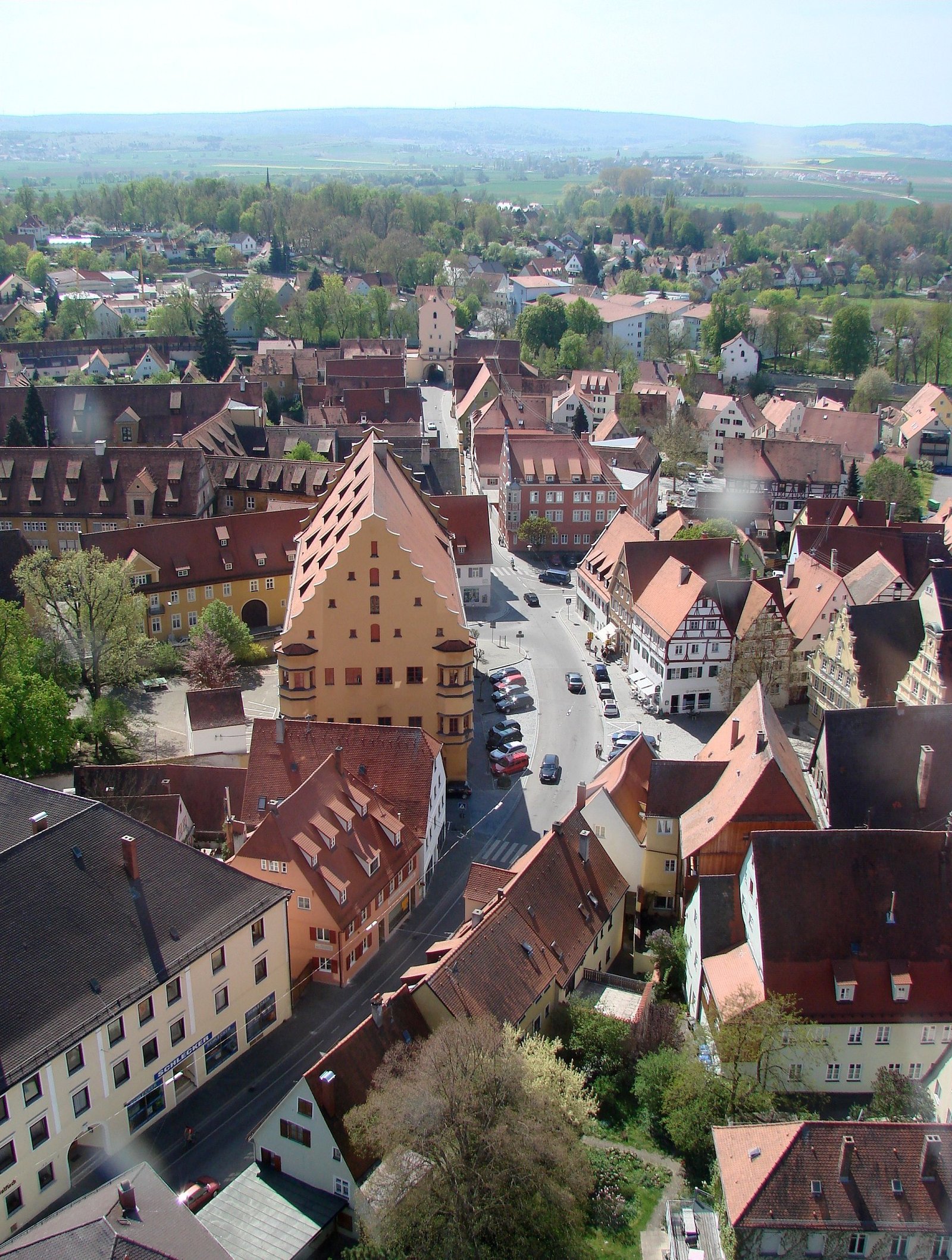
A perfectly preserved medieval circular city built entirely inside a 15-million-year-old meteorite impact crater — whose inhabitants unknowingly quarried diamond-bearing rock to build their cathedral, and whose ring wall traces the crater own curvature around them.
At a glance
Nordlingen stands in the Nordlinger Ries, one of the best-preserved meteorite impact craters on Earth — 24 km diameter, formed c. 14.8 million years ago. The medieval town built inside it is remarkable on three counts: its 2.7 km ring wall traces the crater shape almost perfectly; the Gothic cathedral of St. George is built from suevite, an impact rock containing approximately 72,000 tonnes of microscopic diamonds; and the medieval urban boundary has never been extended, leaving the old town entirely enclosed inside the original wall. The Nordlinger Ries is a UNESCO Global Geopark since 2015.
Key facts
- Location: Nordlingen, Donau-Ries district, Bavaria, Germany
- Crater: Nordlinger Ries — 24 km diameter, c. 14.8 Ma; impact energy equivalent to ~250,000 Hiroshima bombs
- Town founded: c. 1215 CE; ring wall built 1327–1440 in seven phases
- Ring wall: 2.7 km, 16 towers, 5 gates — intact and fully walkable on original footprint
- Suevite diamonds: ~72,000 tonnes of microscopic impact diamonds in local building stone
- Georgkirche: late Gothic hall church, 14th–15th century; tower Daniel 90 m
- Geopark: UNESCO Global Geopark (Nordlinger Ries), 2015
- Apollo link: Apollo 14 astronauts geological training here, 1970
History
The history of Nordlingen begins 14.8 million years ago when an asteroid approximately 1.5 km across struck the Swabian Alb, melting and fracturing the bedrock into suevite. Medieval builders quarried this stone for the city walls, towers, and the Georgkirche, unaware it was impact rock. Its microscopic diamonds — transformed from graphite under the extreme pressure of the collision — were only identified by scientists in the 1960s.
The town was granted city rights around 1215 and grew as a commercial hub on the intersection of major trade routes. The ring wall was built 1327–1440 in seven phases, enclosing a near-perfect circle that follows the crater basin around it. Unlike most German medieval towns, Nordlingen never expanded beyond this boundary. The Georgkirche tower Daniel (90 m) was completed in 1490.
The city survived the Thirty Years War largely intact behind its fortifications, witnessing two major battles (1634, 1645) in its vicinity. In 1970, NASA astronauts including Alan Shepard and Edgar Mitchell conducted impact-crater geology training in the Ries four months before landing at Fra Mauro on the Moon — a site with comparable shock-metamorphosed rocks. The Rieskrater-Museum, opened 1974, holds a Moon rock sample on permanent NASA loan.
What you see
The ring wall walk is the defining experience: a continuous covered gallery 2.7 km long, original timber roofing, running the full circuit with views inward over red-roofed buildings and outward across the flat crater floor. Five fortified gatehouse complexes mark the old town entries; 16 towers stand at intervals, each still individually named.
At the centre, the Georgkirche is built almost entirely in suevite — at certain angles the wall surface glitters faintly with impact diamonds. Tower Daniel (350 steps, open to visitors) gives the signature view: a near-perfect circle of wall below, then fields, then the barely-visible ring of eroded crater hills closing the horizon 12 km away. The Rieskrater-Museum inside the old town displays crater geology, suevite samples, and Moon rock.
Why it matters
Nordlingen operates simultaneously on two time scales: a geological event 14.8 million years ago shaped the land, provided the building material, and determined the circular form of the town; 800 years of human settlement inside the crater preserved both the geology and the medieval fabric intact. The suevite in the church walls is architecture built from an asteroid strike. The ring wall is a human fortification whose geometry was dictated by a planetary collision. No comparable convergence of deep geological time and intact medieval urbanism exists anywhere else.
Practical information
- Tower Daniel: open daily (seasonal hours); ~350 steps; admission charged
- Wall walk: free access; full circuit ~45–60 min
- Rieskrater-Museum: Tue–Sun 10:00–16:30; closed Mon; Moon rock on display
- Romantic Road: Nordlingen is on the official Romantic Road tourist route
- Best season: May–October for walks and panoramic views
Getting there
Nordlingen is ~100 km north of Augsburg, ~90 km southwest of Nuremberg. By rail: regional trains from Augsburg (~1 hour). By road: B25 Romantic Road connects to Dinkelsbuhl (30 km) and Donauworth (30 km). Nearest airports: Munich (120 km), Stuttgart (140 km). The old town is compact and entirely walkable.
Nearby
- Steinheim Basin: 40 km east — twin impact crater (Steinheim Basin, 3.8 km diameter) formed simultaneously in a double-asteroid event; central uplift dome visible
- Dinkelsbuhl: 30 km north on Romantic Road — intact medieval walled town, comparable preservation
- Harburg Castle: 20 km southeast — one of Bavarias best-preserved hilltop castle complexes
- Augsburg: 100 km south — UNESCO WHS 2019 water management; important Roman and Renaissance city
Sources
- Stoffler, D. and Grieve, R.A.F. (2007). Impactites. in Metamorphic Rocks, Cambridge University Press
- Horz, F. et al. (1983). Diamonds from the Ries Crater, Germany. Earth and Planetary Science Letters
- UNESCO Global Geoparks Network — Nordlinger Ries Geopark designation, 2015
- City of Nordlingen — ring wall construction chronology and architectural inventory
- NASA Lunar Sample Curation — Apollo 14 geology training records, Ries crater, 1970
Find it on the map
See this place and what’s around it →📷 Become a Cultural Heritage Online photographer
Share your photos of places: they stay published under your name as the author. The more they're seen, the more you get noticed — and soon a contest will reward the most appreciated photos.
Log in or sign up free to add a photo