
Thimlich Ohinga
The largest and best-preserved dry-stone walled enclosure complex in the Lake Victoria basin — a UNESCO World Heritage Site built without mortar by pastoral farming communities who shaped stone into fortress, home, and clan marker across five centuries.
At a glance
Thimlich Ohinga means fortress in the Luo language. It stands roughly 185 km south of Kisumu in Migori County, at the edge of the Lake Victoria basin. It is the largest and most intact of 521 dry-stone enclosure complexes recorded in the region — a landscape tradition unique to this corner of East Africa and now safeguarded as a UNESCO World Heritage Site, inscribed 2018. The main enclosure wall reaches 1–3 metres in thickness and up to 4.2 metres in height, built entirely from locally quarried basalt stones laid without mortar in a technique that has kept the walls standing for at least five centuries.
Key facts
- UNESCO inscription: 2018 — one of Kenya’s three World Heritage Sites
- Type: Dry-stone walled enclosure complex
- Location: Migori County, western Kenya; ~185 km south of Kisumu
- Construction material: Unmortered basalt stone
- Main wall: 1–3 m thick, up to 4.2 m tall
- Period of use: c. 16th – early 20th century CE, possibly earlier
- Builders: Early Luo-speaking pastoral farming communities
- Regional context: 521 ohinga complexes recorded in the Lake Victoria basin; Thimlich is the largest
History
The ohinga tradition of dry-stone enclosure building evolved among pastoral farming communities around the Lake Victoria basin from at least the 16th century CE, though oral traditions and some archaeological evidence suggest occupation may reach back further. The word ohinga in the Luo language means fortress or fortified settlement, reflecting the primary function these walled compounds served: protecting cattle — the cornerstone of community wealth — and families from raids, while simultaneously marking clan boundaries and articulating social hierarchy.
Thimlich Ohinga comprises a series of nested enclosures, each associated with a specific kin group or household unit. This spatial hierarchy encoded in stone the social organisation of the people who built and maintained the complex. The settlement was inhabited and continuously modified until the early 20th century, meaning the walls represent not a single construction event but centuries of accumulated repairs, additions, and expansions.
The 521 ohinga sites of the Lake Victoria basin form a coherent regional landscape, with Thimlich standing out for its scale and exceptional preservation. Systematic archaeological survey and community documentation by the National Museums of Kenya contributed to the successful 2018 UNESCO inscription — making it one of Kenya’s three World Heritage Sites alongside the Kenyan Lake System in the Great Rift Valley and Lamu Old Town.
What you see
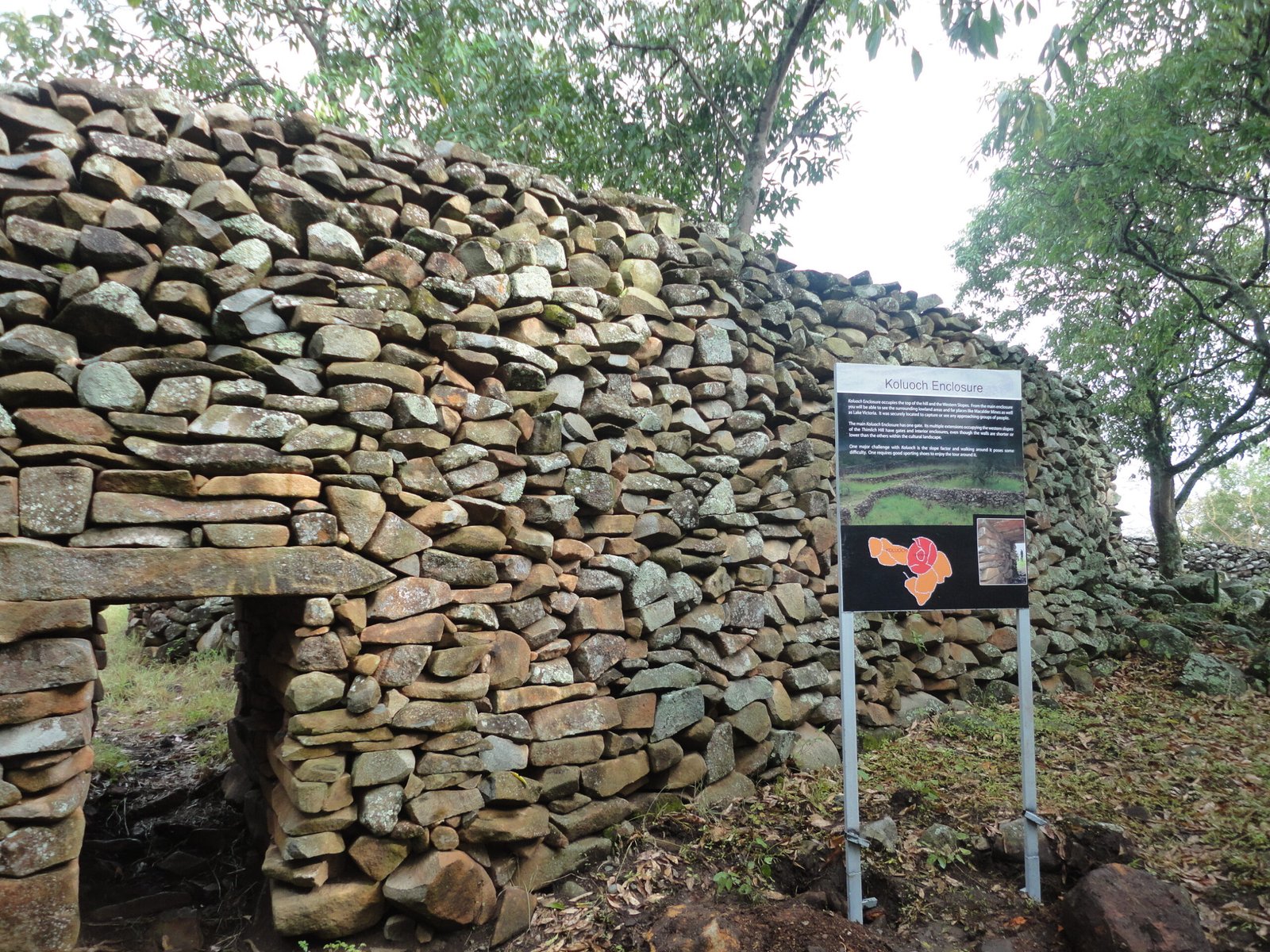
The outer enclosure wall — up to 4.2 metres tall and between one and three metres thick — is built from basalt stones selected and placed with a precision that requires no mortar: each stone locks the next, distributing load across the full width of the wall. The coursing is irregular but purposeful, with larger stones at the base and a slight inward lean that has helped the walls survive centuries of seismic activity and vegetation pressure.
Inside the main enclosure, a sequence of smaller inner enclosures creates a spatial progression from public outer zones to more protected areas associated with family quarters and livestock kraals. Narrow, slightly curved entrance passages — designed so only one person could pass at a time — controlled access and created natural choke points for defence. The surrounding landscape retains evidence of field systems and water management features that connected the ohinga to the wider productive territory its community depended on.
Why Thimlich Ohinga matters
Thimlich Ohinga represents an architectural and social tradition that developed entirely independently of the stone-building traditions of the Zimbabwe Plateau or the Nile Valley. Its 2018 UNESCO inscription acknowledged the exceptional intactness of the complex, the outstanding universal value of the ohinga tradition as a regional cultural landscape, and the importance of preserving associated intangible heritage — oral histories, clan memory, and pastoral practices — alongside the walls themselves.
For the Luo communities of western Kenya, it remains a living site of identity and ancestral connection. For archaeologists, it offers a well-preserved stratigraphic sequence illuminating the relationship between pastoral economy, clan organisation, and built form in pre-colonial East Africa. For architectural historians, the site raises questions about how complex dry-stone engineering techniques spread and evolved without written transmission.
Practical information
- Location: Migori County, Nyanza Province, western Kenya
- Nearest town: Migori (~40 km); Kisumu (~185 km north)
- Access: Via road from Migori; 4WD recommended in wet season
- Entry: National Museums of Kenya site; entry fee applicable — verify current rate on-site
- Opening hours: Typically 8:00–18:00 daily; confirm locally
- Best season: June–September (dry season); avoid long rains March–May
- Photography: Permitted; drones require advance authorisation from National Museums of Kenya
Getting there
From Nairobi: fly to Kisumu, then drive south via B1/A1 through Oyugis and Rongo to Migori (~3.5 hours from Kisumu), then continue ~40 km to the site. From Kisumu: direct road south (~185 km, ~3 hours). Shared matatu transport runs between Migori and nearby villages. The National Museums of Kenya manages the site and can arrange guided visits through their Nairobi office.
Nearby
- Rusinga Island — Lake Victoria island with early hominid fossil sites and the tomb of Tom Mboya
- Mfangano Island — rock art sites and traditional Suba community culture
- Ruma National Park — Kenya’s only roan antelope sanctuary, ~60 km west
- Kit Mikayi — sacred granite rock formation with deep Luo spiritual significance near Kisumu
- Kisumu Museum — regional history, Luo culture, and Lake Victoria natural history
Sources
- UNESCO World Heritage Centre — Thimlich Ohinga Archaeological Site, inscribed 2018
- National Museums of Kenya — Thimlich Ohinga site documentation
- Wikipedia — Thimlich Ohinga
Find it on the map
See this place and what’s around it →📷 Diventa un fotografo di Cultural Heritage Online
Condividi le tue foto dei luoghi: restano pubblicate con la tua firma come autore. Più vengono viste, più ti fai conoscere — e presto un concorso premierà le foto più apprezzate.
Accedi o registrati gratis per aggiungere una foto