
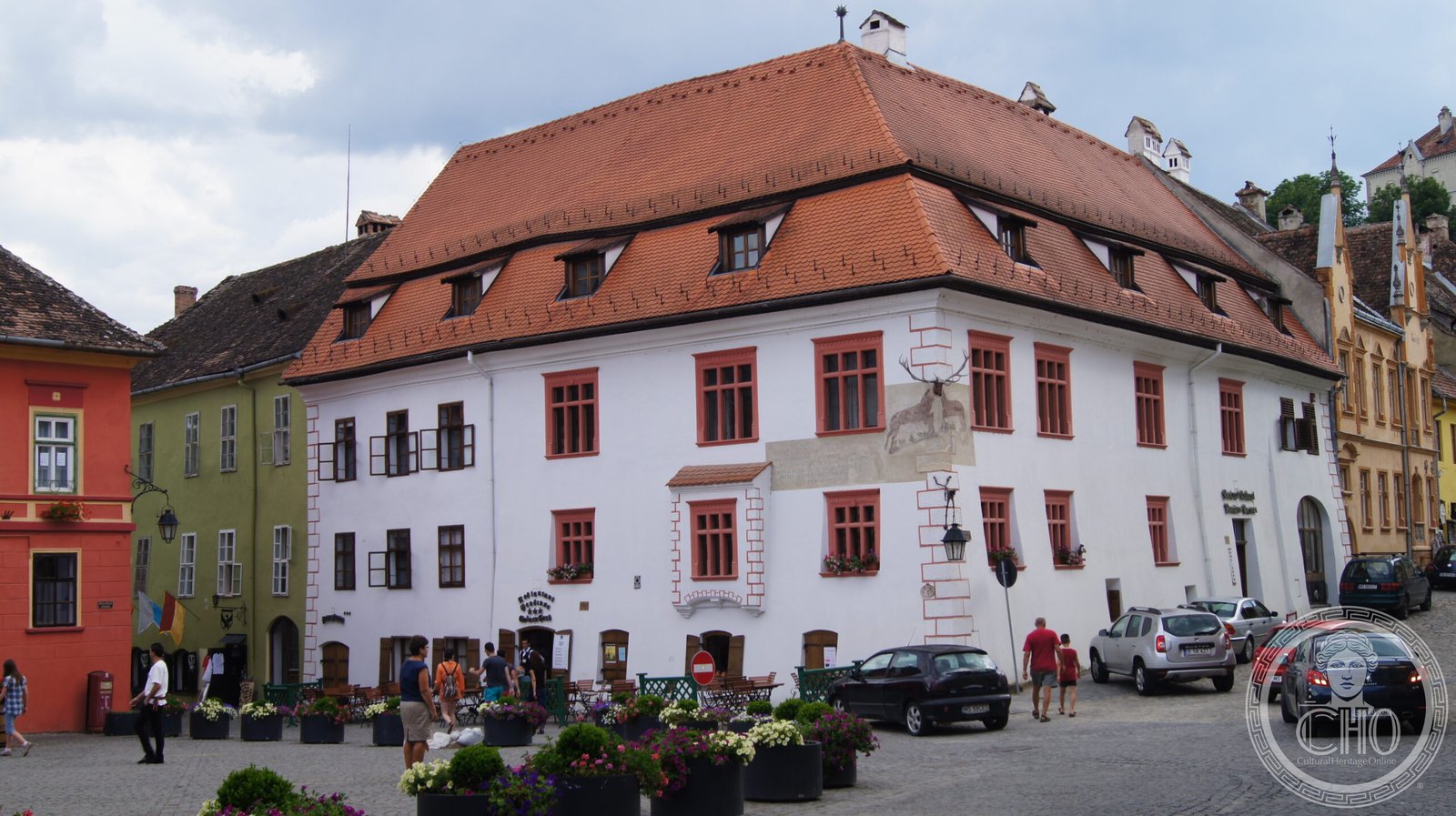
Sighișoara
The best-preserved medieval fortified Saxon city in Transylvania, Sighișoara is a UNESCO World Heritage Site whose intact citadel — nine defensive towers, a 14th-century clock tower, a covered wooden staircase climbing to a hilltop church, and streets of coloured medieval houses — has survived intact since the 12th century. It is also the birthplace, around 1431, of Vlad III Dracula, the historical figure behind the most enduring vampire legend in world literature.
At a glance
Sighișoara sits above the Târnava Mare river in the heart of Transylvania, in Romania’s Mureș County, roughly 100 kilometres east of Sibiu and 120 kilometres south of Cluj-Napoca. Its citadel, perched on a hill known as the Citadel Hill, was built and maintained by the Saxon (German) colonists who settled Transylvania from the 12th century onwards at the invitation of the Hungarian Crown, and who shaped the region’s urban culture for nearly eight centuries. The citadel’s outstanding integrity — its medieval street plan, fortification towers, burgher houses, church, and school remain substantially in their historic form — led to its inscription on the UNESCO World Heritage List in 1999. Today it functions as a living town, with residents, restaurants, and craft workshops occupying houses built between the 14th and 17th centuries.
Key facts
- UNESCO WHS: 1999, criterion (iii) and (v) — outstanding example of a small medieval fortified town
- Founded: c. 1191 CE by Saxon colonists; documented from 1280 as Castrum Sex
- Location: Mureș County, Transylvania, Romania; 100 km east of Sibiu
- Defensive towers: 9 surviving (of original 14), each maintained by a guild of craftsmen
- Clock Tower: 64 metres high; built 14th century; now a history museum
- Famous birthplace: Vlad III “the Impaler” (Vlad Dracula), born c. 1431
- Religion: predominantly Lutheran (Evangelical) Saxon heritage; Church on the Hill is Lutheran
- Population: approx. 26,000 (municipality)
History
The Saxons of Transylvania — Germans who began settling the region at the invitation of the Hungarian King Géza II around 1150 CE, receiving extensive privileges in exchange for defending and developing the frontier — founded a network of fortified market towns across the region. Sighișoara, known in German as Schässburg and in Latin as Castrum Sex (Six Fortress, referring to the fortification count), was one of the most important. By the late medieval period it was a prosperous craft and trade centre, its population of German-speaking merchants and artisans protected by walls whose towers were each assigned to a specific craft guild for maintenance — a system that explains the towers’ names: the Tailors’ Tower, the Tinkers’ Tower, the Tanners’ Tower, and so on.
In the House of the Deer (Casa cu Cerbi) on the Citadel Hill’s main street, the historical records indicate that Vlad II Dracul — a member of the Order of the Dragon (Societas Draconistarum), a chivalric order founded in 1408 by the Holy Roman Emperor Sigismund to defend Christian Europe against Ottoman expansion — fathered a son named Vlad around 1431. This son, Vlad III, became a ruler of Wallachia known to his contemporaries as Vlad Dracula (“son of Dracul”) and later as Vlad Tepes (Vlad the Impaler) for his practice of impaling enemies. His figure, transformed through Gothic literature — principally Bram Stoker’s novel Dracula of 1897, which borrowed the name but set the story in the Borgo Pass of Transylvania rather than in Wallachia — became the template for the vampire count.
The city remained predominantly Saxon in culture until the 20th century. The communist period brought demographic change — industrialisation drew Romanian workers from the countryside — and the post-1989 emigration of the Transylvanian Saxon community to Germany nearly emptied the German-speaking population. Today the Saxons of Sighișoara number only a few hundred, but their architectural legacy — the citadel, the Lutheran Church on the Hill, the school, the tower system — is preserved and functions as a major centre of cultural tourism.
What you see today
The fortified Citadel Hill is the heart of the historic zone. Entry is through the imposing Clock Tower (Turnul cu Ceas), which served as the city’s main gate from the 14th century; its mechanical clock with wooden figures dates to 1648 and is still operational. Inside, the tower houses the History Museum of Sighișoara, with displays of weapons, furniture, and guild artefacts. From the tower, Citadel Street — the main axis of the upper town — leads past coloured burgher houses of the 15th–17th centuries, including the building now marked as the Birthplace of Vlad Dracula. Nine of the original fourteen defensive towers survive, scattered around the citadel perimeter, each in varying states of preservation. The covered Scholars’ Staircase (Scara Acoperita), a wooden stairway of 175 steps, built in the 17th century to allow scholars to reach the hilltop school in winter, connects the citadel to the Church on the Hill (Biserica din Deal), a large Gothic Lutheran church built in the 14th–15th centuries with remarkable medieval frescoes in the choir. The churchyard is one of the most atmospheric Saxon Lutheran cemeteries in Transylvania, with weathered German-language epitaphs spanning five centuries.
Practical information
- Address: Citadel Hill, Sighișoara, Mureș County, Romania
- Clock Tower Museum: open Tuesday–Sunday approximately 09:00–18:30 (summer); reduced hours off-season
- Church on the Hill: open to visitors in daylight hours seasonally
- Best time to visit: May–September; late July features the Medieval Arts Festival
- Duration: half day for citadel; full day for citadel, church, and lower town
- Note: the citadel is a living neighbourhood — residents and businesses operate here year-round
Getting there
Sighișoara is served by rail from Sibiu (approximately 2 hours) and from Cluj-Napoca (approximately 2.5 hours) via the Transylvanian main line. By car it lies on the DN14 and DN13 routes connecting Sibiu and Brasov; the town centre and parking areas are adjacent to the citadel. The nearest international airport is Sibiu (SBZ), approximately 100 kilometres west, with connections to several European cities. Brasov (approximately 120 km east) and Cluj-Napoca (approximately 120 km northwest) also serve as bases for visiting Sighișoara.
Nearby
- Biertan — UNESCO WHS fortified church, a masterpiece of the Transylvanian Saxon fortified church tradition; ~25 km southwest
- Viscri — UNESCO WHS fortified church village, championed by King Charles III; ~40 km south
- Sibiu — the cultural capital of Transylvania, with a beautifully preserved Saxon old town and outstanding museums; ~100 km west
- Bran Castle — popularly associated with Dracula, a spectacular hilltop fortress; ~120 km southeast near Brasov
Sources
- UNESCO World Heritage Committee, Inscription report: “Historic Centre of Sighișoara,” 1999
- Durandin, C., Histoire des Roumains (Paris: Fayard, 1995)
- Treptow, K. W. (ed.), Vlad III Dracula: The Life and Times of the Historical Dracula (Portland / Iasi: Center for Romanian Studies, 2000)
- Wikipedia contributors, “Sighișoara,” Wikipedia, consulted 2026
Find it on the map
See this place and what’s around it →📷 Diventa un fotografo di Cultural Heritage Online
Condividi le tue foto dei luoghi: restano pubblicate con la tua firma come autore. Più vengono viste, più ti fai conoscere — e presto un concorso premierà le foto più apprezzate.
Accedi o registrati gratis per aggiungere una foto