
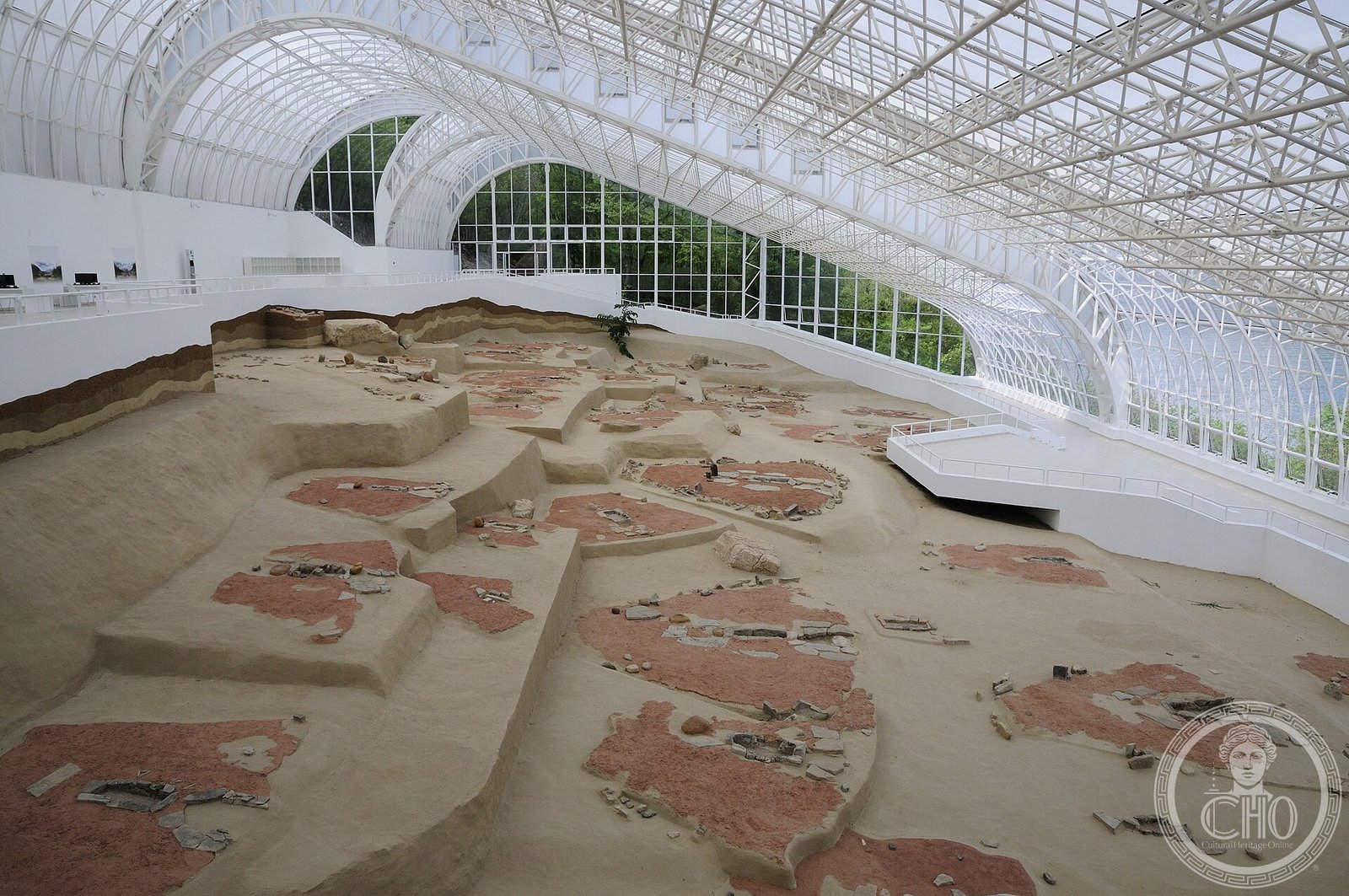
On the right bank of the Danube at the narrowest point of the Djerdap gorge, Lepenski Vir preserves the oldest known planned settlement in Europe — 136 trapezoidal buildings arranged in a precise semicircle, with enigmatic fish-deity sculptures unlike anything else in Mesolithic or Neolithic art.
At a glance
Lepenski Vir (“Lepenski Whirlpool,” named for the permanent eddy in the Danube below the site) sits within the Djerdap Iron Gates gorge, a limestone canyon where the river accelerates between sheer cliffs. Discovered in 1965 by Dragoslav Srejovic of Belgrade University during surveys preceding the Iron Gates hydroelectric dam, the site yielded 136 trapezoidal buildings across seven occupation phases spanning c. 8500–6200 BCE. More than 50 buildings contained carved limestone fish-deity sculptures unique in European prehistory. The inhabitants subsisted almost entirely on Danube sturgeon — isotope analysis shows 80–95% of protein from fish, the highest ratio known for any prehistoric European population. The original site was flooded by the Iron Gates reservoir in 1971; a purpose-built cover structure now shelters the preserved foundations.
Key facts
- Period: c. 8500–6200 BCE (Mesolithic to Early Neolithic)
- Discovered: 1965 by Dragoslav Srejovic, University of Belgrade; excavated 1965–1970
- Buildings: 136 trapezoidal structures in a semicircle, all oriented toward the same point on the opposite bank
- Sculptures: 50+ carved limestone fish-deity heads — unique in Mesolithic/Neolithic Europe
- Diet: 80–95% of skeletal protein from Danube sturgeon (DNA and isotope analysis)
- Fate: Original site submerged 1971; foundations preserved under protective cover structure
- Status: UNESCO Serbia Tentative List
History
Dragoslav Srejovic began survey work in the Djerdap gorge in 1965 ahead of the Iron Gates dam project. Over five field seasons he exposed 136 buildings in seven stratigraphic phases, all sharing the same trapezoidal plan — a form echoing the outline of the limestone cliff of Treskavac on the opposite bank — and all oriented toward the same geographic point on the far shore. The consistency of this orientation across centuries of rebuilding implies a cosmological logic that scholarship has not fully decoded.
The fish-deity sculptures, found in situ around interior hearths, are the most extraordinary product of the Lepenski Vir culture. All share the same formal vocabulary: a flat triangular face, wide gaping mouth, deeply sunken eye sockets, and a forehead marked with incised scale-like lines. No parallel tradition of anthropomorphic-fish hybrid sculpture exists anywhere else in Mesolithic or early Neolithic Europe. DNA studies published in 2018 confirmed genetic continuity across the settlement and identified the population as distinct from both Atlantic Mesolithic hunter-gatherers and the early Neolithic farmers arriving from Anatolia.
The reservoir filled in 1971, permanently submerging the original terrace. A protective steel-and-concrete structure built above the flood line now shelters the preserved building outlines. The original sculptures are held in the National Museum of Serbia in Belgrade; high-quality casts are displayed on site.
What you see
The protective building descends by ramp to the level of the preserved foundations. Trapezoidal building outlines — limestone slabs and compacted clay floors — are arranged in their original semicircular pattern, numbered according to Srejovic’s excavation sequence, with hearths visible at the centre of each building. Cast replicas of the fish-deity sculptures stand in their original positions around the hearths; interpretation panels explain the occupation phases, diet analysis, and genetic studies. The surrounding Djerdap National Park provides dramatic context: the Danube here is compressed to approximately 200 metres wide between 300-metre cliffs, and the whirlpool below the site is visible from the terrace at low water.
The original sculptures — including the celebrated “Danubius,” a 35 cm carved boulder with a refined human-fish face — are on permanent display in the National Museum of Serbia in Belgrade (Trg Republike 1a). The Djerdap National Park visitor centre at Donji Milanovac provides additional context on the gorge’s geology and archaeology.
Practical information
- Address: Lepenski Vir Archaeological Site, near Donji Milanovac, Bor District, Serbia
- Opening hours: April–October daily 08:00–18:00; reduced hours in winter — confirm with Djerdap National Park
- Entry fee: Charged; combination tickets with Djerdap National Park available
- On site: Covered exhibition hall, cast sculptures in situ, interpretation panels
- Photography: Permitted throughout
- Accessibility: Ramp access to main hall; outdoor path is uneven
Getting there
Lepenski Vir sits on the road between Donji Milanovac and Golubac along the Danube right bank. By car from Belgrade take the E75 south to Pozarevac, then regional roads to the Djerdap gorge — approximately 2.5 hours. No direct public transport to the site; the nearest town with accommodation and bus connections is Donji Milanovac (approximately 8 km west). Coming from Romania, cross at the Moldova Noua ferry and drive west along the Serbian bank.
Nearby
- Djerdap National Park: The protected area covering the Iron Gates gorge, with boat excursions and the Roman Tabula Traiana inscription visible at low water
- Golubac Fortress: Well-preserved 14th-century fortress controlling the gorge entrance, approximately 50 km upstream
- Vinca (Belgrade): The type-site of the Vinca culture on the Danube south of Belgrade, with the famous symbolic clay tablets
- National Museum of Serbia (Belgrade): Permanent home of the original Lepenski Vir sculptures
Sources
- Srejovic, D. (1972). Europe’s First Monumental Sculpture: New Discoveries at Lepenski Vir. Thames and Hudson.
- Boric, D. & Price, T.D. (2013). Strontium isotopes and patterns of migration at Lepenski Vir. Journal of Archaeological Science 40(1).
- Mathieson, I. et al. (2018). The genomic history of southeastern Europe. Nature 555, 197–203.
- Djerdap National Park: npdjerdap.rs
- National Museum of Serbia: narodnimuzej.rs
Find it on the map
See this place and what’s around it →📷 Become a Cultural Heritage Online photographer
Share your photos of places: they stay published under your name as the author. The more they're seen, the more you get noticed — and soon a contest will reward the most appreciated photos.
Log in or sign up free to add a photo