
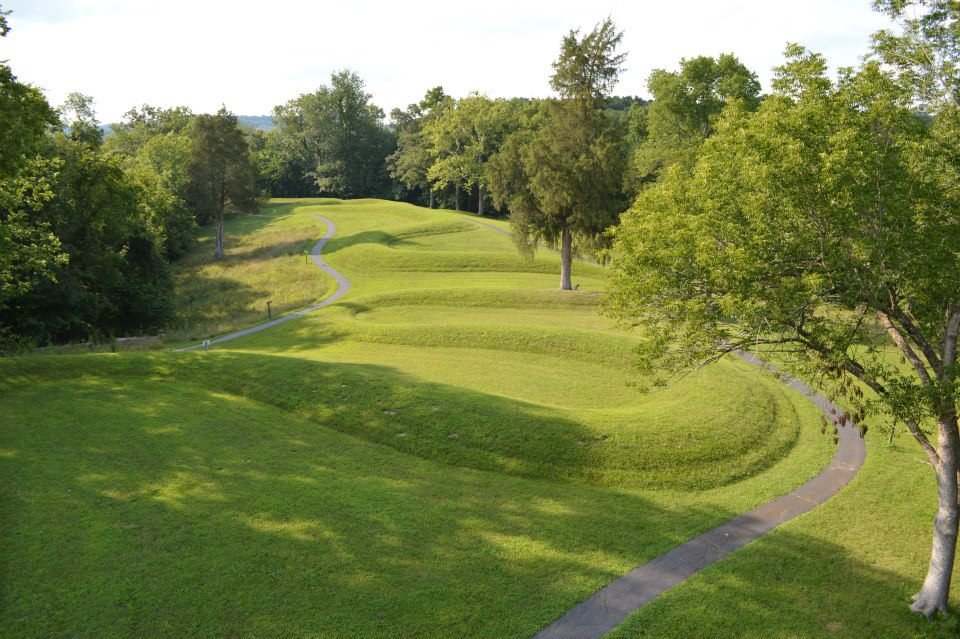
On a wooded plateau above Ohio Brush Creek lies the largest effigy mound in the world: a 411-metre earthen serpent whose coils align with the solstices and equinox. Who built it, and when, remains a genuine archaeological puzzle, argued over for more than a century without resolution.
At a glance
The Great Serpent Mound sits on a plateau above Ohio Brush Creek in Adams County, Ohio, stretching 411 metres from its tightly coiled tail to the open jaws at the northern end, which hold a triangular form read variously as an egg, an eye, or a frog. The earthwork rises only about 1.5 metres and averages 6 metres across, a low, continuous ridge rather than a dramatic monument. It occupies the rim of a cryptoexplosion structure roughly 8 kilometres across, formed either by a meteorite strike or a deep underground explosion, a geological oddity that may itself have drawn the mound’s builders to the spot.
Three of the serpent’s major curves line up with the summer solstice sunset, the winter solstice sunrise, and the equinox sunrise, alignments identified by researchers in the 1980s and since confirmed by independent analysis. The identity of the people who built it is still disputed.
Key facts
- Length: 411 metres, the largest known effigy mound in the world
- Dimensions: roughly 1.5 metres high and 6 metres wide
- Possible builders: the Adena, Hopewell, or Fort Ancient cultures; no consensus
- Dating: radiocarbon results cluster around 321 BC and around 1070 AD, a split still debated
- Astronomical alignment: curves align with the summer solstice sunset, winter solstice sunrise, and equinox sunrise
- Protection status: Ohio State Memorial since 1900, National Historic Landmark since 1966, National Natural Landmark since 1967
History
The mound was first surveyed professionally in 1846 and published in 1848 by Ephraim George Squier and Edwin Hamilton Davis in Ancient Monuments of the Mississippi Valley, a work regarded as foundational to American archaeology. Squier and Davis attributed the earthwork to the Adena culture, largely on the strength of nearby burial mounds containing Adena artefacts, and that view stood largely unquestioned for over a hundred years.
In the 1990s, radiocarbon dating led by archaeologist Robert Fletcher, using charcoal recovered from within the mound, produced two distinct clusters of dates: one around 321 BC, consistent with the Hopewell culture, and another around 1070 AD, consistent with the Fort Ancient culture. The result forced a rethink. Some researchers argue the mound was built once, during the Hopewell period, and that the later dates reflect contamination; others suggest the Fort Ancient people built a larger mound over an earlier structure; a few still defend the original Adena attribution. No agreement has been reached.
Excavations by Frederic Ward Putnam of Harvard’s Peabody Museum in the 1880s and 1890s showed the mound had been built in sections, filled with puddled clay and faced with stone or sand, but found no burials inside it, an absence that sets it apart from almost every other effigy mound. The Peabody Museum bought the site in 1900 to prevent its destruction, and it is now managed by the Ohio History Connection.
What you see
An observation tower at the site lets visitors take in the serpent’s full outline, though the true scale of the 411-metre form comes across more clearly from the air. On foot, a perimeter path traces the length of the earthwork, and the impression is of a broad, subtle landform rather than a ruin or a built structure in the conventional sense. The tightly coiled tail at the southern end, a spiral some 12 metres across, is the most visually striking part of the mound at ground level. At the northern end, a low embankment encloses the oval form held in the serpent’s jaws, the section most often read as an egg or an eye.
Three further effigy mound burial sites lie nearby on the same geological feature. The setting is wooded, with views down into the Ohio Brush Creek valley. A museum run by the Ohio History Connection covers the mound’s history, the ongoing dating controversy, and the geology of the cryptoexplosion structure beneath the site. Around the summer solstice, astronomy demonstrations allow visitors standing at the tail to watch the sun set in direct line with the serpent’s head.
Practical information
- Address: 3850 State Route 73, Peebles, Ohio 45660, USA
- Opening times and admission: the Ohio History Connection publishes current hours and admission details on its website
- Observation tower: open to visitors, with the solstice sunset offering the clearest alignment with the mound
- Photography: permitted on the ground; drone or aerial photography requires a permit from the Ohio History Connection
Getting there
The mound lies in rural Adams County in southern Ohio, roughly 120 kilometres east of Cincinnati and about 100 kilometres south of Columbus. There is no public transport to the site, so a car is needed; the route from Cincinnati runs east on US-32 and then north on State Route 73. The nearest commercial airport is Cincinnati/Northern Kentucky International. A car park sits directly beside the mound plateau.
Nearby
- Hopewell Culture National Historical Park — about 90 km north, near Chillicothe; the core complex of Hopewell burial mounds and earthwork enclosures, inscribed as a UNESCO World Heritage Site
- Fort Ancient Earthworks and Nature Preserve — about 80 km northwest, near Oregonia; a hilltop enclosure built by the Hopewell culture and later occupied by the Fort Ancient people
- Seip Earthworks — near Bainbridge; a Hopewell burial mound complex with reconstructed sections open to visitors
Sources
- Squier, E.G. & Davis, E.H. (1848). Ancient Monuments of the Mississippi Valley. Smithsonian Contributions to Knowledge, vol. 1
- Fletcher, R., Cameron, T., Lepper, B.T., Wymer, D., & Pickard, W. (1996). Serpent Mound: A Fort Ancient icon? Midcontinental Journal of Archaeology, 21(1), 105–143
- Romain, W.F. (2000). Mysteries of the Hopewell: Astronomers, Geometers, and Magicians of the Eastern Woodlands. University of Akron Press
- Lepper, B.T. (2004). The Newark Earthworks and the geometric enclosures of the Scioto Valley. In R.V. Sharp (ed.), Hero, Hawk, and Open Hand. Art Institute of Chicago
- Ohio History Connection. (2024). Serpent Mound. ohiohistory.org
Find it on the map
See this place and what’s around it →📷 Become a Cultural Heritage Online photographer
Share your photos of places: they stay published under your name as the author. The more they're seen, the more you get noticed — and soon a contest will reward the most appreciated photos.
Log in or sign up free to add a photoIs this page about you?
This page is read by travellers and heritage enthusiasts who find it on Google. Tell us how you are connected to this place and we will take it from there.