

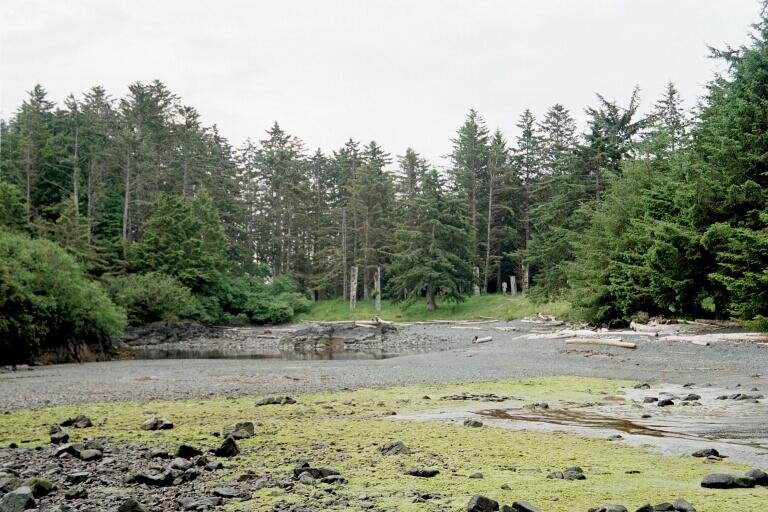
The most intact abandoned Haida village in existence, with approximately 32 standing mortuary and house poles still in their original positions on a remote Pacific island — the largest surviving concentration of Northwest Coast monumental wood carving anywhere in the world, UNESCO-inscribed in 1981.
At a glance
SGang Gwaay Llnagaay (known historically as Ninstints) occupies a small island off the southern tip of the Haida Gwaii archipelago in coastal British Columbia. Abandoned around 1880 following catastrophic smallpox epidemics that reduced the Haida population from approximately 20,000 to around 600, the village preserves approximately 32 standing poles and the remnants of 10 longhouse structures in their original positions — a concentration of in-situ Northwest Coast monumental carving unmatched anywhere on earth. UNESCO designated the site a World Heritage Site in 1981 under the joint stewardship of the Haida Nation and Parks Canada.
Key facts
- Location: Anthony Island (SGang Gwaay), southern Haida Gwaii, British Columbia, Canada
- UNESCO WHS: 1981
- Occupation: Several centuries pre-contact – c. 1880 AD
- Standing poles: Approximately 32 mortuary and house poles in original positions
- Longhouse remnants: 10 cedar-plank structures, partially collapsed
- Custodians: Haida Nation + Parks Canada (joint management)
- Access: Remote Pacific island; helicopter or boat from Sandspit or Skidegate; Haida Gwaii Watchmen guides required
History
The Kunghit Haida lineages occupied SGang Gwaay for centuries before European contact, building a community of approximately 300 people in large cedar-plank longhouses whose facades and interior posts were carved with monumental sculptures depicting lineage histories, supernatural beings, and the mythological cycles of Haida oral tradition. The village reached its height in the 18th century as sea-otter pelts drew European trading ships to Haida Gwaii and briefly enriched the Haida economy. The catastrophic reversal came with smallpox: successive epidemics between the 1770s and 1880s reduced the Haida population by approximately 90 per cent. The survivors consolidated at Masset and Skidegate on the main island, leaving SGang Gwaay empty around 1880.
Because the island was inaccessible and its former residents had no reason to return, the poles and house structures were never systematically removed, burned, or collected by missionaries or museum expeditions — the fate that stripped comparable villages elsewhere on the Northwest Coast. The cool, humid Pacific climate also slowed the decay that ravages wood in warmer environments. When the Canadian government and the Haida Nation began formal protection in the late 20th century, SGang Gwaay held the most complete in-situ record of Haida monumental carving in existence. The site is now monitored by Haida Gwaii Watchmen, Haida cultural monitors whose seasonal presence ensures site protection and visitor interpretation within a Haida cultural framework.
What you see
Approaching by boat through coastal mist, the village site appears as a row of weathered grey poles rising above a beach of smooth stones, backed by dense Sitka spruce and red cedar forest. The poles — mortuary poles housing the remains of high-ranking Haida at their tops, memorial poles, and house frontal poles — stand in various states of decay: some tilting, some with carved figures barely legible through decades of lichen, others still sharply detailed. Behind the poles, collapsed cedar planks and posts of the longhouse foundations form low mounds in the undergrowth across approximately 150 metres of shoreline.
The carved imagery — killer whales, ravens, bears, eagles, supernatural beings, and human ancestor figures in the fluid positive-negative design language of Northwest Coast art — represents the finest surviving outdoor ensemble of Haida monumental carving. The Haida Nation and Parks Canada have made a deliberate decision not to restore or stabilize the poles, allowing them to return naturally to the earth as Haida tradition holds appropriate; visitors witness both artistic achievement and inevitable dissolution.
Practical information
- Access: Boat charter or floatplane from Sandspit or Skidegate Landing, Haida Gwaii
- Permits: Guided visits only; no independent landing permitted
- Season: Summer (June–August) when Watchmen are on-site
- Nearest town: Queen Charlotte / Daajing Giids, approx. 100 km north by sea
- Entry: Parks Canada fee applicable; contact Parks Canada Haida Gwaii office
Getting there
Haida Gwaii (formerly the Queen Charlotte Islands) is accessible by BC Ferries from Prince Rupert (approximately 7 hours) or by daily flights from Vancouver and Prince Rupert to Sandspit Airport. From Haida Gwaii, access to SGang Gwaay requires a boat charter of approximately 5–6 hours from Sandspit, or a floatplane flight of about 30 minutes. The Haida Gwaii Watchmen programme coordinates visitor access; contact in advance through Parks Canada or the Council of the Haida Nation.
Nearby
- Gwaii Haanas National Park Reserve — the protected area encompassing SGang Gwaay and dozens of other Haida cultural sites
- Haida Heritage Centre at Kay Llnagaay (Skidegate) — principal museum of the Haida Nation, with major totem pole and canoe collections
- Skedans (Koona) — another partially standing Haida village site within Gwaii Haanas, accessible by boat tour
Sources
- UNESCO World Heritage Committee, SGang Gwaay nomination and evaluation, 1981
- Parks Canada & Council of the Haida Nation, Gwaii Haanas Management Plan, 2002
- MacDonald, George F., Ninstints: Haida World Heritage Site, UBC Press, 1983
- UNESCO World Heritage List: whc.unesco.org/en/list/157
Find it on the map
See this place and what’s around it →📷 Become a Cultural Heritage Online photographer
Share your photos of places: they stay published under your name as the author. The more they're seen, the more you get noticed — and soon a contest will reward the most appreciated photos.
Log in or sign up free to add a photo