

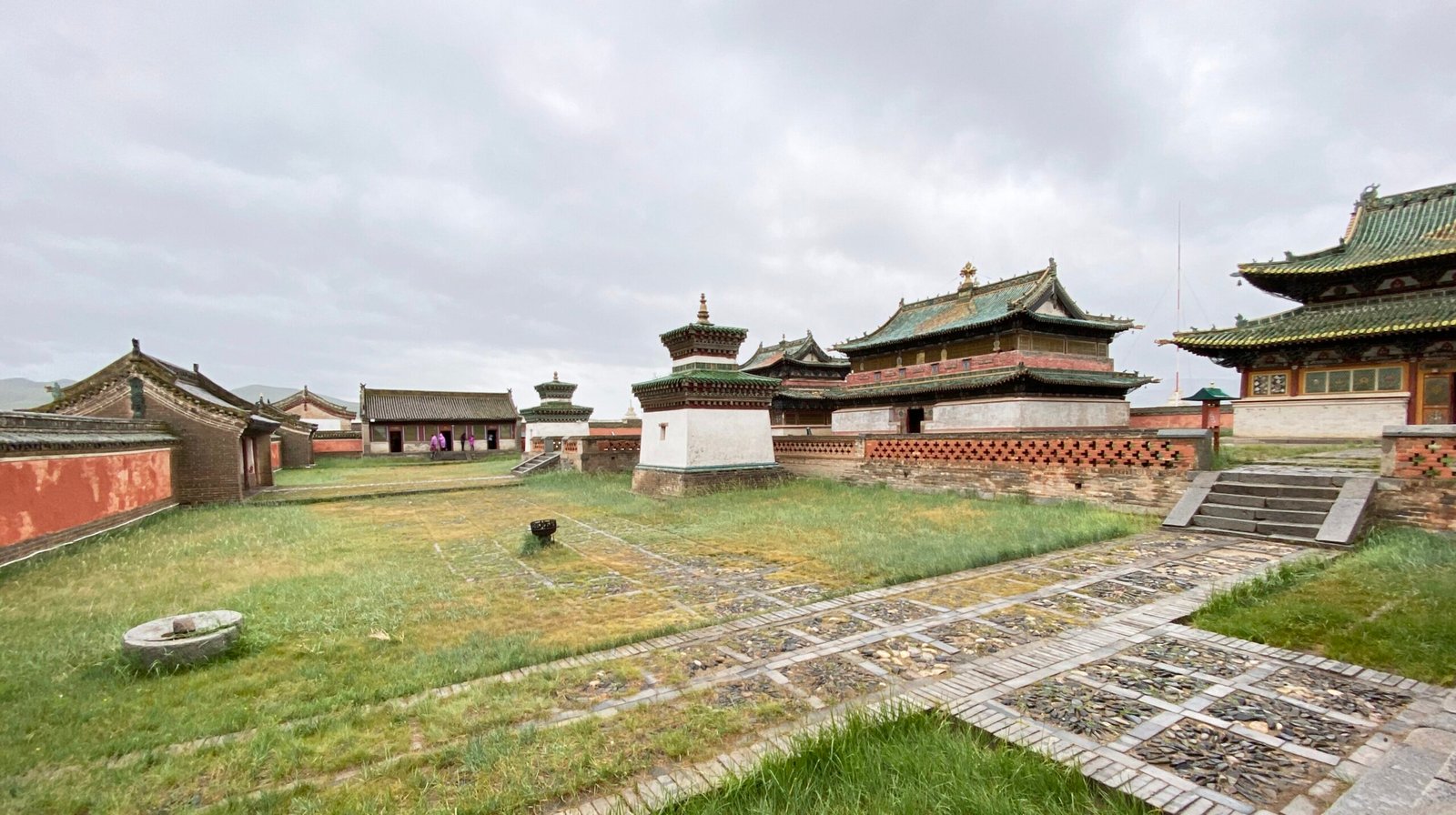
In the Orkhon Valley of central Mongolia, 370 km from Ulaanbaatar, the ruins of Karakorum — the capital from which the Mongol Empire governed the largest contiguous land empire in human history — lie almost entirely beneath the open steppe, overlaid in part by the white walls of Erdene Zuu, Mongolia’s first Buddhist monastery, founded 1586 with stones quarried from the city’s ruins.
At a glance
Karakorum was founded in 1235 by Ögedei Khan, son of Genghis Khan, at a location on the Orkhon river that Genghis had chosen as his administrative base. For approximately 25 years (1235–1260) it was the capital of an empire extending from the Pacific Ocean to Poland — the largest contiguous land empire in history. Despite its global significance it was a relatively small city: the Franciscan friar William of Rubruck, who visited in 1254, described four or five streets, a Nestorian church, Muslim mosques, twelve pagan temples, and a marketplace. Yet its cosmopolitan character was extraordinary: artisans, merchants, and diplomats from China, Persia, Russia, France, Georgia, Korea, and the Byzantine Empire all resided there simultaneously. The site is part of the UNESCO-listed Orkhon Valley Cultural Landscape (2004). Palace ruins and religious buildings lie below the surface; Erdene Zuu’s 108-stupa wall circuit stands above ground as the primary visible feature.
Key facts
- Founded: 1235 AD by Ögedei Khan; Genghis Khan established presence on Orkhon c. 1220
- Extent: Approximately 1.5 by 2.5 km; population c. 10,000–25,000 at peak
- UNESCO: Orkhon Valley Cultural Landscape, inscribed 2004
- Best source: William of Rubruck (Franciscan friar, 1253–1255); left the most detailed medieval description
- Silver tree fountain: Built by Parisian goldsmith William Buchier; dispensed kumiss, mead, wine, and rice wine simultaneously
- Abandoned: Capital moved to Khanbaliq (Beijing) by Kublai Khan, 1264; sacked by Ming forces, 1388
- Erdene Zuu: First Buddhist monastery in Mongolia, founded 1586; 108 white stupas encircle the compound
History
Genghis Khan selected the Orkhon Valley as his administrative base around 1220, recognising it as the heartland of the Eurasian steppe world — the same valley that had been the centre of the Xiongnu, Göktürk, and Uyghur empires for over a millennium. His son Ögedei formalised it as an imperial capital in 1235 with the construction of a palace (the Tumen Amugulang, “Ten Thousand Years of Peace”) and surrounding city walls. From Karakorum the Mongol governors of conquered China, Persia, and Russia reported in; tribute in silk, silver, grain, and artisans arrived from every direction; and campaigns to Hungary, Japan, and Vietnam were planned. William of Rubruck, arriving in 1254 on a diplomatic mission from King Louis IX of France, described a city small in physical scale but astonishing in cultural density: “You must know that, setting aside the Khan’s palace, it is not as big as the village of Saint-Denis” — but then described the silver tree in the palace courtyard, crafted by a Parisian goldsmith named Guillaume Boucher (William Buchier), with four silver serpents coiling up the trunk, each dispensing a different drink: kumiss, honey mead, rice wine, and grape wine, activated by a hidden bellows mechanism.
When Kublai Khan moved the capital to Khanbaliq (Daidu, modern Beijing) in 1264, Karakorum entered rapid decline. Ming Chinese forces sacked it in 1388. By the 16th century, only earthen mounds remained. In 1586, the Khalkha Mongol leader Abtai Khan founded Erdene Zuu — the first Buddhist monastery in Mongolia — within sight of the ruins, using cut stones from Karakorum’s buildings for the monastery walls and foundations. The monastery compound, surrounded by a wall of 108 white stupas, has stood since and is the primary above-ground feature of the site. German-Mongolian joint excavations from 1999 onwards have recovered Chinese ceramic tiles, Mongol pottery, Islamic glass, and fragments of Buddhist and Nestorian Christian objects testifying to the extraordinary cultural mixing of the 13th-century capital.
What you see
The most visible structure is the Erdene Zuu monastery enclosure: roughly square, approximately 400 metres per side, its perimeter wall punctuated by 108 white stupas. Within the compound stand three 17th-century temples (the Dalai Lama Temple, the Laviran Temple, and the main assembly hall), decorated with Tibetan Buddhist murals and housing significant collections of Buddhist sculpture and thankas. The Erdene Zuu monastery museum is one of the best in Mongolia. Just outside the monastery walls to the northwest stands a large stone tortoise — one of four that originally marked the cardinal points of Karakorum as bases for inscribed steles; it is the most evocative above-ground marker of the ancient capital.
The Karakorum Museum (opened 2011, rebuilt 2018) adjacent to the monastery displays finds from the German-Mongolian excavations: palace roof tiles with Chinese-style decoration, floor-heating channels, a bronze lion, Islamic glass vessels, and interpretation panels in Mongolian, German, and English. The open steppe around the monastery reveals, on close inspection, the low rectangular earthwork traces of streets and building foundations — the ghost of the imperial grid.
Practical information
- Location: Kharkhorin (Kharkhorun), Övörkhangai Province, Mongolia; 370 km southwest of Ulaanbaatar (4–6 hours by road)
- Museum: Karakorum Museum adjacent to Erdene Zuu; open daily (summer 09:00–18:00)
- Erdene Zuu: Active monastery and UNESCO monument; entry fee; guided tours available
- Best time: June to September (steppe accessible; winter temperatures reach −30°C)
- Accommodation: Ger camps in and around Kharkhorin; advance booking recommended in summer
Getting there
From Ulaanbaatar: a paved road completed in 2023 reduces drive time to approximately 4–5 hours. Shared minibus and jeep hire with driver are the standard options; most tour operators include Karakorum as part of a central Mongolia circuit taking in the Orkhon Valley, Erdene Zuu, and Tuvkhun Monastery. No regular rail service; domestic flights to Arvaikheer (Övörkhangai capital) exist infrequently; Karakorum is then 130 km by road.
Nearby
- Tuvkhun Monastery — 60 km southwest; 17th-century hermitage in forested mountains above the Orkhon Valley
- Orkhon Waterfall (Ulaan Tsutgalan) — 50 km southwest; basalt gorge waterfall, spectacular July–August
- Göktürk steles at Orkhon — 8th-century Turkic runic inscriptions on stone steles in the valley; part of the same UNESCO landscape
- Khar Balgas ruins — 20 km north; mudbrick ruins of the 8th-century Uyghur Khaganate capital, predecessor to Karakorum on the same valley
Sources
- UNESCO World Heritage: Orkhon Valley Cultural Landscape (No. 1081)
- William of Rubruck (1253). Itinerarium (Journey to the Eastern Parts of the World); trans. W.W. Rockhill (1900)
- Pohl, Ernst; Conermann, Stephan (eds.) (2015). Karakorum in Transition. Bonn: V&R unipress
- Morgan, David (2007). The Mongols, 2nd ed. Oxford: Blackwell
- Karakorum Museum, Kharkhorin — permanent collection documentation
Find it on the map
See this place and what’s around it →📷 Become a Cultural Heritage Online photographer
Share your photos of places: they stay published under your name as the author. The more they're seen, the more you get noticed — and soon a contest will reward the most appreciated photos.
Log in or sign up free to add a photo