
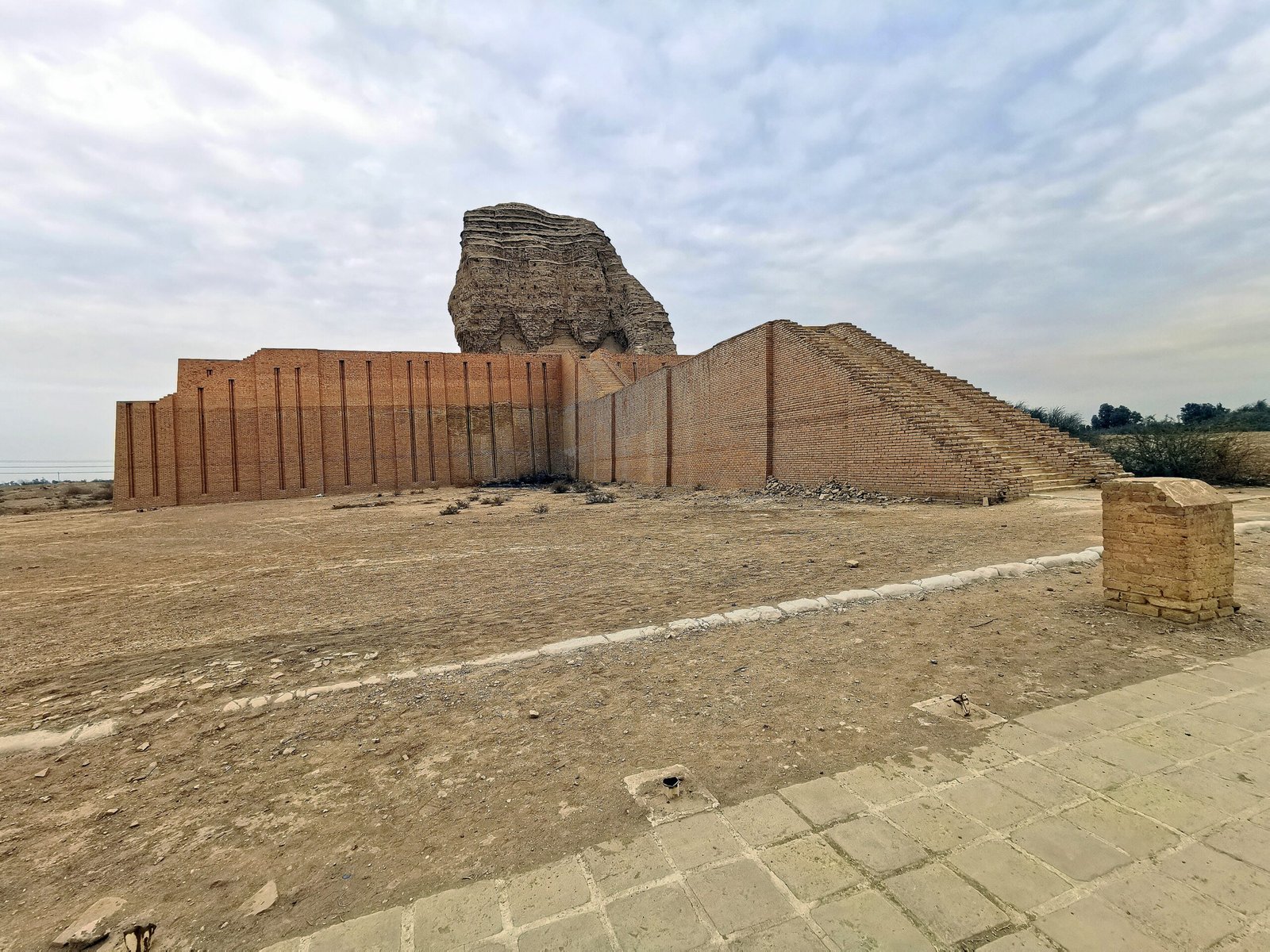
Approximately 30 km west of modern Baghdad, the Kassite ziggurat of Aqar Quf rises 57 metres from the flat alluvial plain—one of the tallest surviving ancient structures in the Mesopotamian world, the monumental core of a royal capital founded around 1400 BC by the longest-ruling dynasty in Babylonian history.
At a glance
Aqar Quf preserves the ziggurat of the ancient Kassite city of Dur-Kurigalzu, founded c. 1400 BC by King Kurigalzu I as a new royal capital of the Babylonian Empire. Standing approximately 57 metres tall, it is one of the tallest surviving structures in the ancient Near East and remains visible on the Baghdad horizon. Its remarkable preservation owes to a Kassite engineering technique: layers of reed matting woven between courses of mudbrick at regular intervals, creating a reinforced composite that has resisted millennia of weathering that reduced most Mesopotamian ziggurats to low mounds.
Key facts
- Founded: c. 1400 BC by Kassite king Kurigalzu I
- Height: approximately 57 metres surviving
- Dynasty: Kassite dynasty of Babylon, the longest-ruling dynasty in Babylonian history (c. 1595–1155 BC)
- Location: approximately 30 km west of central Baghdad
- UNESCO status: not yet inscribed
- Excavation: Iraqi Directorate of Antiquities, 1940s–50s; joint Iraq–Italy mission, 1970s–80s
- Access: by permission from Iraq’s State Board of Antiquities and Heritage
History
The Kassites were a people of uncertain geographic and ethnic origin who seized the throne of Babylon around 1595 BC following the Hittite raid that ended the Old Babylonian dynasty. Rather than ruling as conquerors, they assimilated so thoroughly into Babylonian culture that their approximately 500-year dynasty—the longest in Babylonian history—is characterised by a revival and consolidation of Babylonian religious and cultural traditions. Kurigalzu I, one of the dynasty’s most powerful kings, founded Dur-Kurigalzu as a demonstration of Kassite legitimacy: a planned city with a ziggurat dedicated to the chief god Enlil, a palace complex approximately 225 by 325 metres, temples to Enlil, Ninlil, and other Babylonian deities, and residential quarters for the royal court.
The city was occupied into the late Kassite period, approximately 1150 BC, when the Elamites sacked Babylon and ended Kassite rule. Excavations by the Iraqi Directorate of Antiquities in the 1940s and 1950s, and a joint Iraq–Italy mission in the 1970s–1980s, revealed a palace decorated with painted frescoes—rare survivals from the Kassite period—and terracotta decorations including lion-headed drain spouts. The site suffered damage during the 2003 invasion and subsequent instability, but the ziggurat core survived intact.
The name “Aqar Quf” is Arabic for approximately “tell of the hump,” describing the distinctive silhouette of the surviving mudbrick mass rising above the plain. The ancient name “Dur-Kurigalzu” means “fortress of Kurigalzu” in Akkadian.
What you see
What stands at Aqar Quf is the surviving core of the temple tower, now approximately 57 metres tall though originally higher. The structure is built of mudbrick with interlaced layers of woven reed matting and twisted reed rope inserted approximately every 8 courses—a Kassite innovation that distributed stress and bound the structure against the settlement and freeze-thaw cycling that destroyed most Mesopotamian mudbrick monuments. The outer surface shows the characteristic weathering of exposed mudbrick: a rough, rounded profile with vertical erosion channels.
Around the base, the remains of a courtyard complex, subsidiary chapels, and the city plan of Dur-Kurigalzu are visible as low mounds and surface scatters. Excavation finds from the site—painted frescoes, terracotta figurines, cuneiform tablets, and cylinder seals in the Kassite style—are held in the Iraq Museum in Baghdad. The landscape setting is itself significant: the ziggurat rises from a completely flat alluvial plain, making it visible from a great distance in all directions and from parts of the Baghdad skyline.
Practical information
- Access: permission required from Iraq’s State Board of Antiquities and Heritage in Baghdad
- Distance: approximately 30 km west of central Baghdad, near Abu Ghraib
- Facilities: open site; no visitor facilities on site
- Security: check current FCO/State Department travel advisories before planning a visit
- Museum: Kassite finds in the Iraq Museum, Baghdad
Getting there
Aqar Quf is located approximately 30 km west of central Baghdad, near the town of Abu Ghraib, accessible via the Baghdad–Fallujah motorway. The site is approximately 5 km from the nearest motorway exit. Independent access requires a vehicle; visits organised through a Baghdad-based cultural heritage organisation are strongly recommended given current security conditions in the area.
Nearby
- Iraq Museum, Baghdad — the national collection includes Kassite material from Dur-Kurigalzu alongside masterworks from every period of Mesopotamian civilisation
- Babylon — approximately 90 km south, the ancient city of Nebuchadnezzar II, now a UNESCO World Heritage Site
- Ctesiphon — approximately 35 km southeast of Baghdad, the great Sasanian arch—the largest surviving single-span brick vault in the world
Sources
- Brinkman, J.A., A Political History of Post-Kassite Babylonia, Pontifical Biblical Institute, 1968
- Clayden, T., “Kurigalzu I and the Restoration of Babylonia,” Iraq 58 (1996), pp. 109–121
- Wikipedia, “Dur-Kurigalzu,” retrieved June 2026
- Wikipedia, “Kassites,” retrieved June 2026
Find it on the map
See this place and what’s around it →📷 Become a Cultural Heritage Online photographer
Share your photos of places: they stay published under your name as the author. The more they're seen, the more you get noticed — and soon a contest will reward the most appreciated photos.
Log in or sign up free to add a photoIs this page about you?
This page is read by travellers and heritage enthusiasts who find it on Google. Tell us how you are connected to this place and we will take it from there.