
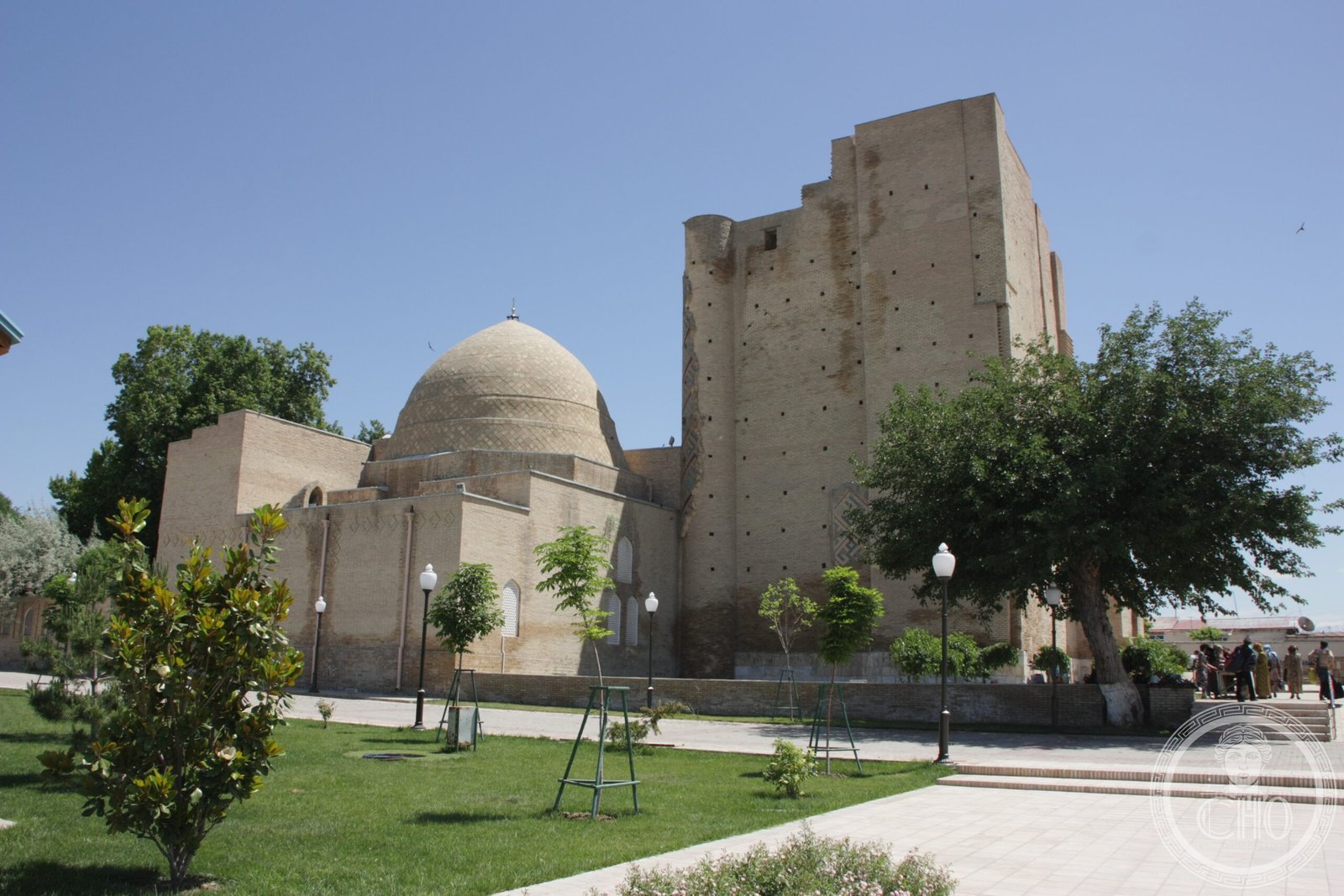
In the Kashkadarya valley of southern Uzbekistan, approximately 80 km south of Samarkand, the city of Shakhrisabz was the birthplace of Timur (Tamerlane) and the site where he built the most ambitious architectural projects of the medieval Islamic world — structures designed, in his own words, to be “the wonder of the world.” UNESCO-inscribed in 2000, it is the only surviving Central Asian city where Timurid architecture can be seen in its original urban context.
At a glance
Shakhrisabz (Persian: “green city”) is located 80 km south of Samarkand through the Takhta Karach Pass in the Zerafshan Mountains. The UNESCO inscription of 2000 recognises the ensemble of Timurid-era buildings as “an outstanding example of Central Asian urban planning and architecture.” The defining structure is the Ak-Saray (White Palace), Timur’s summer palace begun in 1380: at completion, its main entrance iwan would have been approximately 65 metres tall — the largest arch ever built in the Islamic world — decorated entirely in blue and gold glazed tilework. Two flanking towers of the monumental gate survive to a height of approximately 38 metres, still displaying their extraordinarily refined geometric and calligraphic tile decoration.
Key facts
- Location: Kashkadarya valley, southern Uzbekistan; 80 km south of Samarkand
- UNESCO World Heritage: Inscribed 2000 (Historic Centre of Shakhrisabz)
- Builder: Timur (Tamerlane, r. 1370–1405 AD); extended by grandson Ulugh Beg
- Ak-Saray entrance iwan: Designed at approx. 65 m height — the largest arch in the medieval Islamic world; flanking towers survive to approx. 38 m
- Surviving monuments: Ak-Saray gate towers; Dorus-Saodat mausoleum complex; Kok-Gumbaz Mosque (1435); Dorus-Tilovat khanqah
- Timur’s birthplace: The village of Khoja Ilgar near Shakhrisabz, 1336 AD
- Context: Only surviving Central Asian city showing Timurid architecture in original urban setting
History
Timur was born in 1336 in the village of Khoja Ilgar near Shakhrisabz (then known as Kesh) in the Kashkadarya valley, the son of a minor Barlas clan chieftain. After seizing power in the Chagatai Khanate in 1370, he spent three decades creating one of the largest empires in history — stretching from Anatolia and Russia to India and China — through a combination of devastating military campaigns and sophisticated administrative organisation. Throughout his conquests, Timur channelled enormous wealth and the craftsmen of conquered cities into two projects: the beautification of Samarkand as his imperial capital, and the construction of a personal memorial city at his birthplace of Kesh, which he renamed Shakhrisabz.
Construction of the Ak-Saray (White Palace) began in 1380, immediately after Timur’s conquest of Khorezm, and continued for the remaining 25 years of his life without ever being completed — a colossal royal statement of ambition and power. Contemporary accounts by ambassadors and travellers describe the palace as surpassing anything they had ever seen. The Spanish ambassador Ruy González de Clavijo, who visited in 1404 (the year before Timur’s death), wrote descriptions of the tile decoration, gardens, and scale of the gate towers that have proved archaeologically accurate. Timur died in 1405 during a campaign against China, and the palace was never finished; subsequent Timurid rulers including his grandson Ulugh Beg continued building in Shakhrisabz but on a reduced scale.
The UNESCO World Heritage inscription of 2000 recognised the ensemble of surviving Timurid monuments as exceptional. However, a controversy has emerged regarding post-inscription urban redevelopment: large-scale demolition of the historic urban fabric surrounding the monuments in the 2010s to create a tourist promenade caused UNESCO to place the site on the List of World Heritage in Danger in 2016, a designation that has complicated Uzbekistan’s management of the site.
What you see today
The two surviving flanking towers of the Ak-Saray gate are the most dramatic sight in Shakhrisabz — massive rectangular towers rising approximately 38 metres, covered from base to top in geometric mosaic tilework of extraordinary refinement: interlocking stars, hexagons, and Kufic and Thuluth calligraphic inscriptions in blue, turquoise, white, and gold, executed in the cut-and-set faience technique that represents the absolute peak of medieval Central Asian tile craftsmanship. Between the towers, the space where the 65-metre iwan arch would have risen is now open sky — making the absence of the completed palace a presence in itself, a ruin that speaks to the scale of what was intended.
The Dorus-Saodat complex (House of Power and Might) was Timur’s family mausoleum: it contains the crypt of Timur’s eldest son Jahangir, who died young and was mourned by his father, and the Ak-Saray of the Saodat, a smaller palace pavilion. The underground crypt with its original tile decoration is accessible and preserves some of the finest small-scale Timurid tile work in existence. The Kok-Gumbaz Mosque (1435), built by Ulugh Beg as the Friday mosque of Shakhrisabz, has a blue-tiled dome that gives it its name and represents the mature Timurid style at its most serene.
Practical information
- Location: Shakhrisabz city centre, Qashqadaryo Region, Uzbekistan
- Opening hours: Monuments generally open daily; hours vary by site
- Admission: Fees charged for individual monument complexes; combined area ticket available
- UNESCO status: World Heritage Site (2000); on List of World Heritage in Danger since 2016
- Best time to visit: Spring (April–May) and autumn (September–October) for comfortable temperatures
Getting there
Shakhrisabz is approximately 80 km south of Samarkand by road, crossing the Takhta Karach Pass through the Zerafshan Mountains. Shared taxis (marshrutka) from Samarkand’s Registani taxi stand depart throughout the day and take approximately 1.5–2 hours. The road over the mountain pass is scenic but can be closed by snow in winter. Samarkand has an international airport with connections to Tashkent, Moscow, Istanbul, and several other destinations. An alternative approach is by taxi via the longer valley road that avoids the pass.
Nearby
- Samarkand — 80 km north; Timur’s imperial capital, UNESCO World Heritage, Registan ensemble, Shah-i-Zinda necropolis, Gur-e-Amir mausoleum
- Bukhara — approximately 270 km northwest; UNESCO World Heritage, the other great Timurid/Uzbek heritage city of Central Asia
- Kitab Geological Reserve — near Shakhrisabz; significant Palaeozoic fossil site
Sources
- Golombek, Lisa & Wilber, Donald. The Timurid Architecture of Iran and Turan. Princeton: Princeton University Press, 1988. — Standard reference
- Clavijo, Ruy González de. Embassy to Tamerlane 1403–1406. Trans. Guy Le Strange. London: Routledge, 1928.
- Manz, Beatrice Forbes. The Rise and Rule of Tamerlane. Cambridge: Cambridge University Press, 1989.
- UNESCO: Historic Centre of Shakhrisabz — whc.unesco.org/en/list/885
- Wikipedia: Shahrisabz — en.wikipedia.org/wiki/Shahrisabz
Find it on the map
See this place and what’s around it →📷 Become a Cultural Heritage Online photographer
Share your photos of places: they stay published under your name as the author. The more they're seen, the more you get noticed — and soon a contest will reward the most appreciated photos.
Log in or sign up free to add a photo