

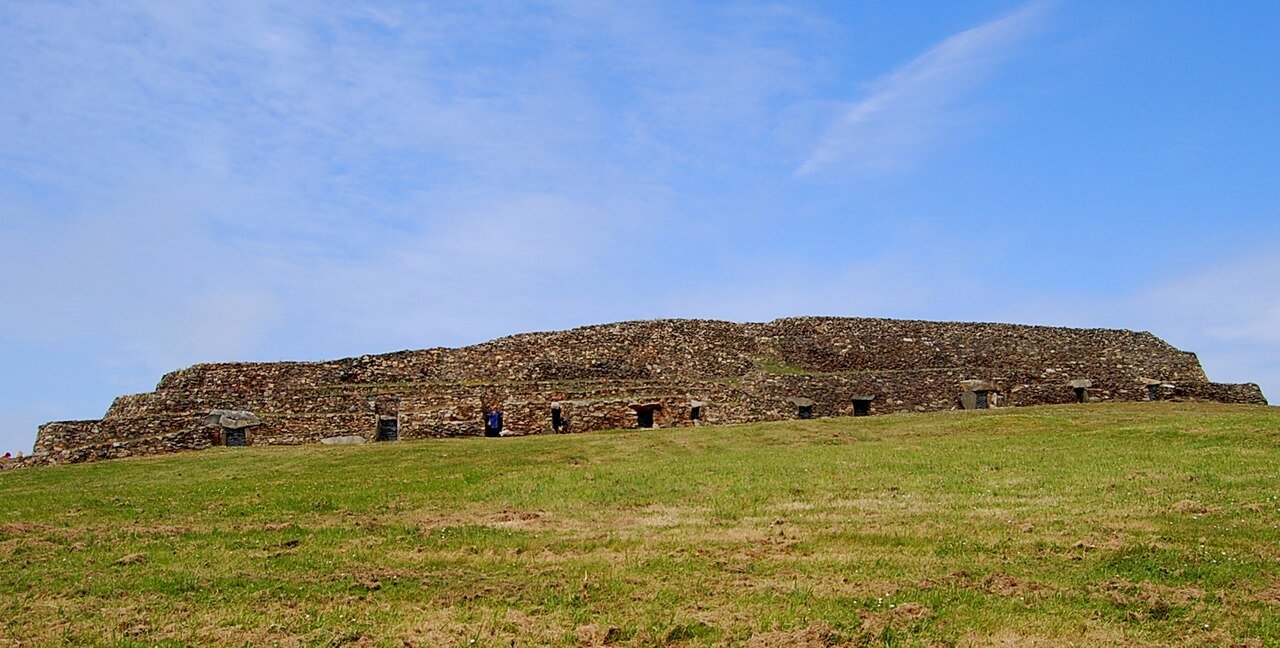
On a promontory above the Morlaix estuary in northern Brittany, the stepped megalithic cairn of Barnenez stands as the largest Neolithic monument in Europe and one of the oldest stone constructions in the world — built approximately 4800 BC, it predates the Great Pyramid of Giza by roughly 2,000 years and Stonehenge by 1,600.
At a glance
Barnenez occupies a commanding headland above the Morlaix estuary in the Finistère department of northern Brittany. The monument measures approximately 75 metres in length, 25 metres in width, and 8 metres in height — making it the largest megalithic monument in Europe by volume. Built in two principal phases beginning around 4800 BC, it encases 11 parallel passage tombs beneath a single stepped trapezoidal cairn of drystone construction. The monument was saved from complete quarry destruction only by the intervention of the French government in 1955, following which systematic excavation by archaeologist Pierre-Roland Giot (who called it “the megalithic Parthenon”) revealed its true extent and antiquity.
Key facts
- Dimensions: ~75 m long, ~25 m wide, ~8 m tall — largest megalithic monument in Europe by volume
- Date: c. 4800–4000 BC (two construction phases); ~2,000 years older than the Great Pyramid of Giza
- Structure: 11 parallel passage tombs encased in a single stepped trapezoidal drystone cairn
- Conservation status: French national monument; severely damaged by quarrying 1954–55
- Nickname: “The megalithic Parthenon” (archaeologist Pierre-Roland Giot)
- Access: 11 internal passage tombs accessible to visitors by reservation
- Decoration: Several orthostats retain traces of engraved Neolithic decoration
History
Barnenez was built in two principal construction phases. The first, around 4800 BC, produced the eastern half of the cairn, encasing five passage tombs in a stepped trapezoidal platform of drystone masonry. The second phase, approximately 4200–4000 BC, extended the monument westward, adding six more passage tombs and significantly enlarging the overall structure. This two-phase construction is archaeologically legible in the materials used: the first phase employed dolerite (a volcanic rock from outcrops on the Kernéléhen peninsula approximately 10 km away), while the second phase used both dolerite and granite. The scale of organisation required to transport and assemble these materials — some individual slabs weighing several tonnes — speaks to a level of social coordination and specialisation well beyond what is conventionally imagined for Neolithic communities.
The monument suffered catastrophic damage in the early 1950s when a quarrying company began extracting the drystone construction as road fill, destroying approximately half of the original cairn volume before the French government intervened. The archaeologist Pierre-Roland Giot had begun excavating the site in 1954, almost simultaneously with its quarrying, and his publications and advocacy were instrumental in the 1955 protected monument classification that halted the destruction. What was saved constitutes approximately 50% of the original monument; the damaged portions are visible at the site’s western end as a raw stone face.
What you see
Barnenez presents from the exterior as a massive stepped platform of grey-brown drystone masonry, rising in three to four stepped tiers from the promontory on which it stands. The stepped profile — reminiscent, as many visitors note, of the stepped pyramids of ancient Mesoamerica or the Near East, though built independently and 1,400 years earlier than any of them — is the result of the monument’s two construction phases, each of which built outward and upward from the previous. The stone surface is weathered and lichen-covered. Eleven entrance passages are visible on the monument’s southern face, each marked by two large orthostats flanking a narrow corridor that leads into the darkness of the chamber beyond.
Access to the 11 internal passage tombs is available with guided reservation. The corridors are low and narrow, requiring visitors to crouch; the chambers at their ends are small polygonal spaces roofed by corbelling or by a single capstone. Several of the orthostats retain traces of Neolithic engraving — pecked and incised lines, geometric patterns — visible in raking light, a reminder that the builders of Barnenez were participants in the same Atlantic megalithic tradition of carved stone that produced the elaborate decoration of Gavrinis and the dolmens of the Morbihan.
Practical information
- Status: French national monument (classified 1955); open to visitors
- Entry: Fee applies; guided tours of the interior tombs by reservation
- Opening: Open seasonally (consult local tourism office for current hours)
- Interior visits: Some of the 11 passage tombs are accessible by guided reservation only
- Physical access: Exterior freely walkable; interior passages require crouching — not suitable for severe mobility limitations
- Photography: Permitted
Getting there
Barnenez is located near the village of Plouezoc’h in the Finistère department of Brittany, approximately 7 km north-east of Morlaix. By car: from Morlaix, take the D76 northward toward Plouezoc’h, then follow signs to Cairn de Barnenez on the Kernéléhen peninsula road. By public transport: trains to Morlaix from Paris (approximately 3h30 by TGV via Rennes) or Brest (1h). From Morlaix there is limited bus service toward Plouezoc’h; a taxi or hire car from Morlaix is practical.
Nearby
- Morlaix (7 km): Historic Breton market town with a spectacular 19th-century viaduct, maison à pondalez (lantern house), and Musée de Morlaix
- Cairn de Guennoc (Île Guennoc, 10 km): Another major Neolithic monument in the Bay of Morlaix, accessible only by boat
- Roscoff (30 km): Coastal town with ferry connections to Plymouth and Cork; botanical garden; Neolithic monuments nearby
- Parc naturel régional d’Armorique (30 km): Protected natural and cultural landscape encompassing western Finistère’s Neolithic heritage
Sources
- Wikipedia: Barnenez
- Centre des monuments nationaux: monuments-nationaux.fr
- Giot, P.-R. (1987): Barnenez, Carn, Guennoc, Travaux du Laboratoire d’Anthropologie, Rennes
- Joussaume, R. (1988): Dolmens for the Dead, Batsford — comprehensive treatment of Breton Neolithic megalithic tradition
- Office de tourisme de Morlaix Communauté
Find it on the map
See this place and what’s around it →📷 Become a Cultural Heritage Online photographer
Share your photos of places: they stay published under your name as the author. The more they're seen, the more you get noticed — and soon a contest will reward the most appreciated photos.
Log in or sign up free to add a photo