
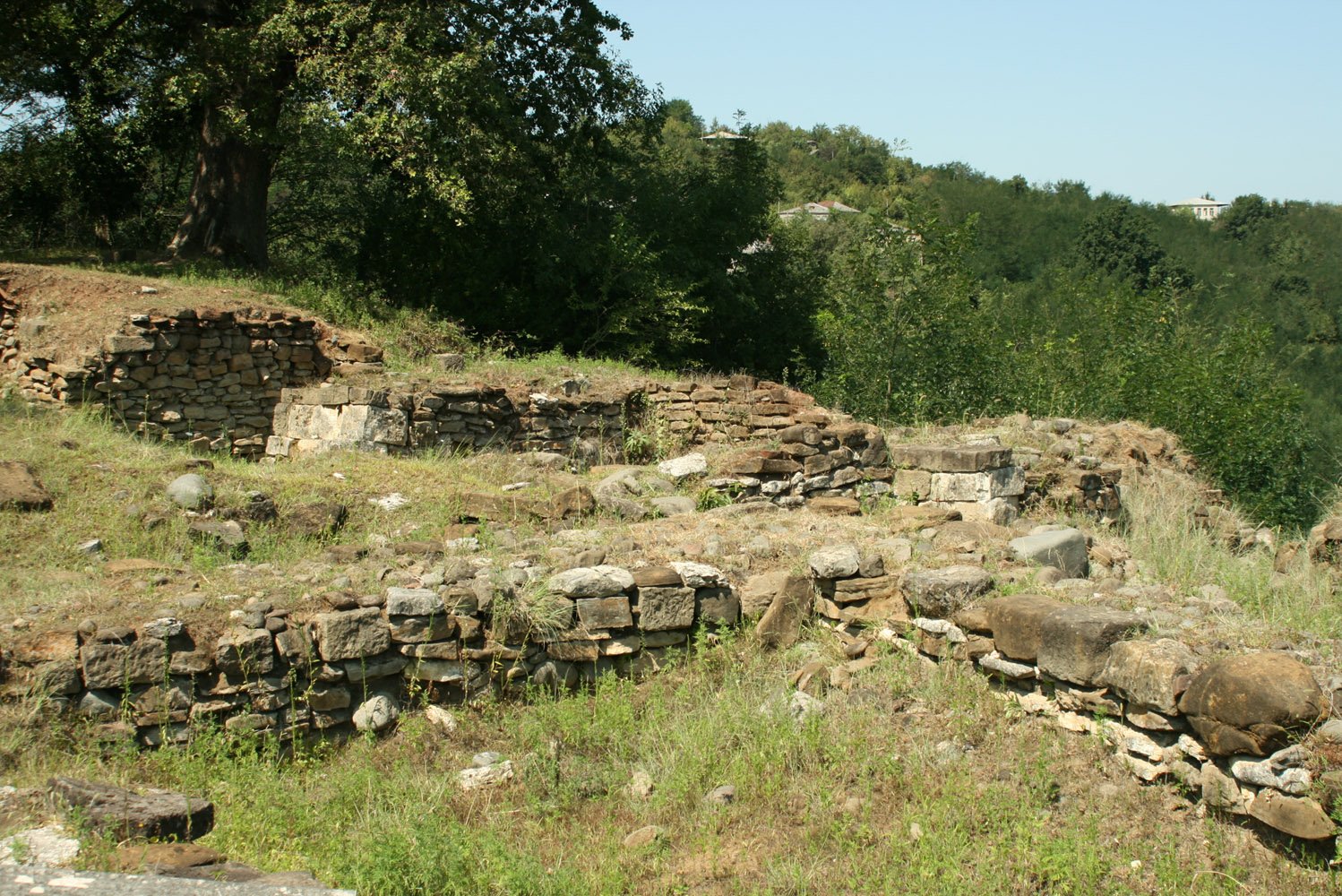
In the foothills above the Rioni River in western Georgia, the ancient Colchian city of Vani was one of the richest gold-working cities of the ancient world — and the probable historical core of the Greek legend of the Golden Fleece and Jason and the Argonauts.
At a glance
Vani sits in the Imereti region of western Georgia, approximately 50 km east of the Black Sea coast and above the Rioni River valley. Occupied from approximately the 8th to the 1st century BC, it was one of the major urban and ritual centres of Colchis — the ancient eastern Black Sea kingdom the Greeks called “the land of the Golden Fleece.” Excavations since 1947 have revealed a planned sanctuary city with temples, colonnaded processional ways, and a necropolis that has yielded approximately 1,000 gold objects of extraordinary craftsmanship. The city was violently destroyed in the 1st century BC, simultaneously with Roman operations in Pontus and Colchis.
Key facts
- Occupied: c. 8th – 1st century BC (Colchian culture)
- Kingdom: Colchis — eastern Black Sea coast, corresponding to modern western Georgia
- Gold finds: Approximately 1,000 gold objects in the necropolis — diadems, bracelets, necklaces, ritual vessels, and figurines
- Goldsmith tradition: Colchian granulation and filigree work — highest level of pre-Achaemenid goldwork in the Caucasus
- Historical gold connection: Ancient sources describe Colchians using sheepskins to trap alluvial gold particles from the Rioni River — likely historical basis for the Golden Fleece myth
- Destruction: Violent destruction c. 50–30 BC; destruction layer clearly identified in excavations
- Excavation: Since 1947 (Georgian archaeologists); since 2007 in collaboration with the University of Chicago
History
Colchis — the ancient kingdom of the eastern Black Sea coast — was known to the Greeks from at least the 8th century BC as a land of gold, magic, and exotic fertility. The legend of Jason and the Argonauts, recorded in multiple versions across Greek literature and culminating in Apollonius of Rhodes’s Argonautica (3rd century BC), describes a Greek expedition to Colchis to obtain the Golden Fleece: the skin of a supernatural ram, guarded by a sleepless dragon in a sacred grove, which Jason retrieved with the help of the Colchian princess Medea. Whether the myth records a genuine Greek commercial expedition to obtain alluvial gold — historical sources describe local Colchians stretching sheepskins across the river bed to trap gold particles washed down from the Caucasus mountains, producing “golden fleeces” that were then dried and the gold collected — or is wholly mythological remains debated by scholars. What is certain is that Colchis was a sophisticated, wealthy, gold-working culture with extensive connections to the Greek world.
Vani was one of the richest Colchian sites. Excavations have revealed a planned urban sanctuary with multiple levels: a lower residential area, a middle ceremonial zone with temples and altars, and an upper area probably reserved for the ruling class or priesthood. The colonnaded processional way leading to the main temple complex, with bronze statues and elaborate architectural terracottas, indicates a city of significant wealth and artistic sophistication. The necropolis is the richest find: burial pits contain individuals interred with extraordinary quantities of gold jewellery crafted in the specifically Colchian tradition — granulation, filigree work, coloured stone inlays — that has no direct parallel in the Greek or Achaemenid Persian worlds and represents an independent goldsmith tradition of the highest quality. The city was destroyed suddenly and violently around 50–30 BC; the destruction layer shows evidence of burning and abandonment, consistent with the Roman military operations under Pompey and Lucullus that ended Colchian political independence.
What you see
The archaeological site at Vani is still an active excavation site; the visible remains include the foundations of temple buildings, the colonnaded processional way, storage pits, and the exposed sections of the necropolis. Bronze statues (now in the Vani Archaeological Museum) were found in the sanctuary zone. The on-site Vani Archaeological Museum is built directly at the excavation and displays the gold finds in their excavation context — a rare arrangement that allows visitors to understand the spatial relationship between the objects and the city that produced them.
The gold collection in the Vani Museum is the primary reason to visit: the diadems, elaborate multi-strand necklaces with pendant figurines, heavy gold bracelets with granulated decoration, and gold ritual vessels display a goldsmith tradition of extraordinary technical refinement. Selected major pieces from Vani are also on permanent display at the National Museum of Georgia in Tbilisi (the Simon Janashia Museum), which houses the largest collection of Colchian gold in the world.
Practical information
- Vani Archaeological Museum: Open Tuesday–Sunday; admission approximately 5–7 GEL; labels in Georgian and English
- Site access: The outdoor site is accessible during museum opening hours; active excavation areas may be restricted
- Photography: Permitted in most areas of the museum; check for restrictions on the gold collection room
- Duration: Allow 2–3 hours for site and museum
- National Museum Tbilisi: For the largest collection of Colchian gold objects from across Georgia, the Simon Janashia Museum of Georgia in Tbilisi is essential
Getting there
Vani is approximately 230 km west of Tbilisi and 50 km east of Kutaisi. From Kutaisi (served by regular marshrutkas, buses, and trains from Tbilisi, journey approximately 3.5 hours), local marshrutkas connect to Vani town; the archaeological site is at the edge of the town. Kutaisi International Airport (approximately 50 km from Vani) has regular flights from Tbilisi and several European cities. Tour operators in Tbilisi and Kutaisi offer day trips to Vani.
Nearby
- Kutaisi — Imereti regional capital, 50 km west; Bagrati Cathedral (UNESCO, partially restored) and Gelati Monastery (UNESCO)
- Sataplia Nature Reserve — dinosaur footprints and cave system, 10 km northwest of Kutaisi
- Prometheus Cave — large show cave system near Kutaisi, one of the largest in the Caucasus
- National Museum of Georgia (Tbilisi) — Simon Janashia Museum with the greatest concentration of Colchian gold, 230 km east
Sources
- Kakhidze, A. Vani — an ancient city of Colchis. Tbilisi: Metsniereba, 1999.
- Lordkipanidze, O. Phasis: The River and Kingdom of Colchis. Archaeologische Forschungen, 2000.
- University of Chicago — Vani Archaeological Project (ongoing since 2007).
- Wikipedia contributors. “Vani, Georgia.” Wikipedia, The Free Encyclopedia. Accessed 2026.
Find it on the map
See this place and what’s around it →📷 Become a Cultural Heritage Online photographer
Share your photos of places: they stay published under your name as the author. The more they're seen, the more you get noticed — and soon a contest will reward the most appreciated photos.
Log in or sign up free to add a photo