
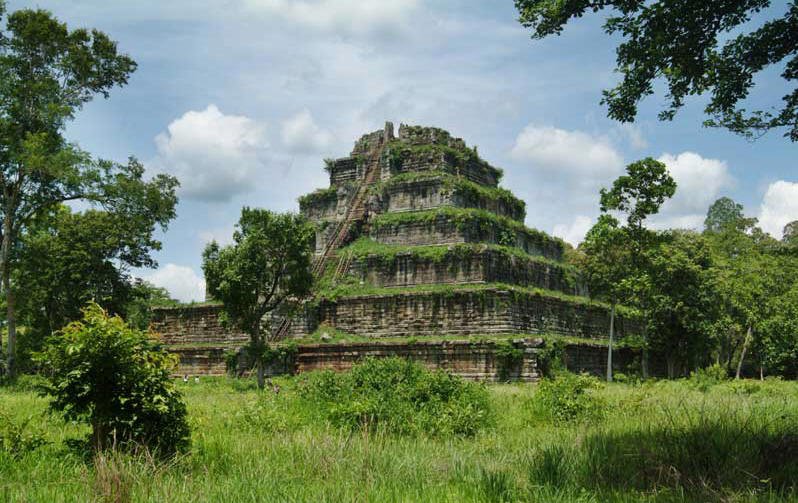
The short-lived jungle capital of the Khmer Empire — an extraordinary ensemble of approximately 200 temples and sanctuaries dominated by the tallest pyramid in Southeast Asia, inscribed as a UNESCO World Heritage Site in 2023.
At a glance
Approximately 120 km northeast of Angkor in the remote jungle of Preah Vihear Province, Koh Ker (ancient name Lingapura or Chok Gargyar) was the capital of the Khmer Empire for just 23 years under King Jayavarman IV (r. 921–944 AD). After his death, the capital returned to Angkor, and the site was reclaimed by dense jungle for nearly a millennium. Today the 35 km² archaeological zone preserves around 200 sanctuaries, ritual causeways, reservoirs, and temple compounds — a UNESCO World Heritage Site since September 2023, and one of the most dramatic and least-crowded archaeological landscapes in all of Southeast Asia.
Key facts
- Ancient name: Lingapura (City of Lingams) or Chok Gargyar
- Period: Capital of the Khmer Empire c. 921–944 AD under Jayavarman IV
- Scale: Approximately 200 monuments across a 35 km² zone
- Centrepiece: Prasat Thom — a seven-tiered sandstone pyramid, c. 36 m high, the tallest temple tower in Southeast Asia
- UNESCO WHS: Inscribed September 2023 as “Koh Ker: Archaeological Site of Ancient Lingapura or Chok Gargyar”
- Looted sculptures: Many key pieces repatriated from the Metropolitan Museum of Art (New York) and Norton Simon Museum (Pasadena) after 2010 negotiations
- Distance from Angkor: Approximately 120 km northeast — reachable as a long day trip or overnight from Siem Reap
History
The Khmer Empire’s capital was Angkor — until 921 AD, when King Jayavarman IV, who had seized the throne after a period of dynastic conflict, made the radical decision to relocate the imperial seat 120 km northeast into remote jungle. For 23 years he poured enormous resources into transforming this jungle clearing into a royal capital, constructing an extraordinary concentration of religious monuments in sandstone and laterite. The dominant cult was Shaivite: the principal object of veneration at Prasat Thom, the great pyramid at the site’s centre, was a massive Shiva linga. Jayavarman IV died in 944 without heirs capable of maintaining the capital, and his successor Rajendravarman II immediately moved the court back to Angkor. Koh Ker was abandoned almost overnight.
The site then disappeared into the jungle, known only to local villagers, for almost a thousand years. A French archaeological mission under Henri Parmentier mapped the main monuments in 1921. The decades of the Khmer Rouge (1975–1979) and subsequent civil war proved catastrophic: systematic looting removed dozens of major sculptures — including the famous wrestling giants (Valin and Sugrîva) and fighting monkeys — which found their way into the collections of the Metropolitan Museum of Art, the Norton Simon Museum, and Sotheby’s. Repatriation negotiations, led by Cambodia’s Ministry of Culture and Fine Arts with support from international legal teams, have been ongoing since 2010, with some significant pieces already returned.
In September 2023, Koh Ker was inscribed on the UNESCO World Heritage List as an outstanding example of Khmer imperial architecture and urban planning from the early Angkor period — the only Khmer WHS outside the Angkor Archaeological Park.
What you see
The centrepiece is Prasat Thom, a seven-tiered pyramid of sandstone approximately 36 metres high, whose summit originally held the site’s principal Shiva linga. It is the tallest prasat (temple tower) in Southeast Asia, and its summit — accessible by steep stone staircases — commands sweeping views across the flat jungle canopy for dozens of kilometres in every direction. Around Prasat Thom, linked by ceremonial causeways and moats, stand the principal temple compounds. Prasat Krahom (the Red Temple) is remarkable for its elaborate bas-relief panels depicting wrestling giants and mythological scenes among the finest in Khmer art. A large baray (ritual reservoir) lies to the east. Dozens of satellite temples, many still partially buried under tree roots and accumulated jungle soil, dot the zone between the main compounds.
The jungle atmosphere at Koh Ker is intense: many of the satellite temples are encountered in states of semi-collapse, their stone blocks displaced by the roots of enormous tropical trees, recalling Ta Prohm at Angkor but in a far more remote and less-managed setting. The site receives a small fraction of Angkor’s visitors, lending it a quality of archaeological discovery that more famous sites cannot offer.
Practical information
- Opening hours: Approximately 7:30 am – 5:30 pm daily
- Admission: Separate from the Angkor Pass — a specific Koh Ker ticket is required; check current pricing with APSARA Authority or local tour operators
- Best time to visit: November to April (dry season); the site is accessible but muddier during the wet season (May–October)
- Landmine awareness: Remain on marked paths; the surrounding jungle has not been fully demined
- Guides: Local guides available at the site entrance; recommended for navigating the satellite temples beyond the main compounds
- Water and food: Basic facilities at the entrance; bring water for the full site
Getting there
Koh Ker is approximately 120 km northeast of Siem Reap and about 80 km from Preah Vihear City. Most visitors arrive by hired car or motorbike from Siem Reap (2.5–3 hours on Route 66 and Provincial Road 62), which allows a long day trip combining Koh Ker with nearby Beng Mealea. There is no public transport to the site. Some tour operators offer combined Koh Ker – Beng Mealea day tours from Siem Reap. Accommodation in the area is extremely limited; Siem Reap remains the practical base.
Nearby
- Beng Mealea — a large, dramatically jungle-engulfed Angkor-era temple approximately 40 km to the southwest, often combined with Koh Ker in a single day itinerary
- Angkor Archaeological Park — the main Khmer temple complex at Siem Reap, approximately 120 km southwest, the essential context for understanding Koh Ker’s place in Khmer history
- Preah Khan of Kompong Svay — another remote Angkor-era complex approximately 100 km from Koh Ker, for dedicated Khmer archaeology enthusiasts
Sources
- UNESCO World Heritage List, “Koh Ker: Archaeological Site of Ancient Lingapura or Chok Gargyar,” inscribed 2023. whc.unesco.org
- APSARA National Authority, “Koh Ker Archaeological Zone.” autoriteapsara.org
- Parmentier, Henri. L’Art khmèr primitif. Paris: École française d’Extrême-Orient, 1927.
- Levin, Michael D. “The Repatriation of Koh Ker Sculptures.” International Journal of Cultural Property, Cambridge University Press.
- Wikipedia, “Koh Ker.” en.wikipedia.org/wiki/Koh_Ker
Find it on the map
See this place and what’s around it →📷 Become a Cultural Heritage Online photographer
Share your photos of places: they stay published under your name as the author. The more they're seen, the more you get noticed — and soon a contest will reward the most appreciated photos.
Log in or sign up free to add a photo