
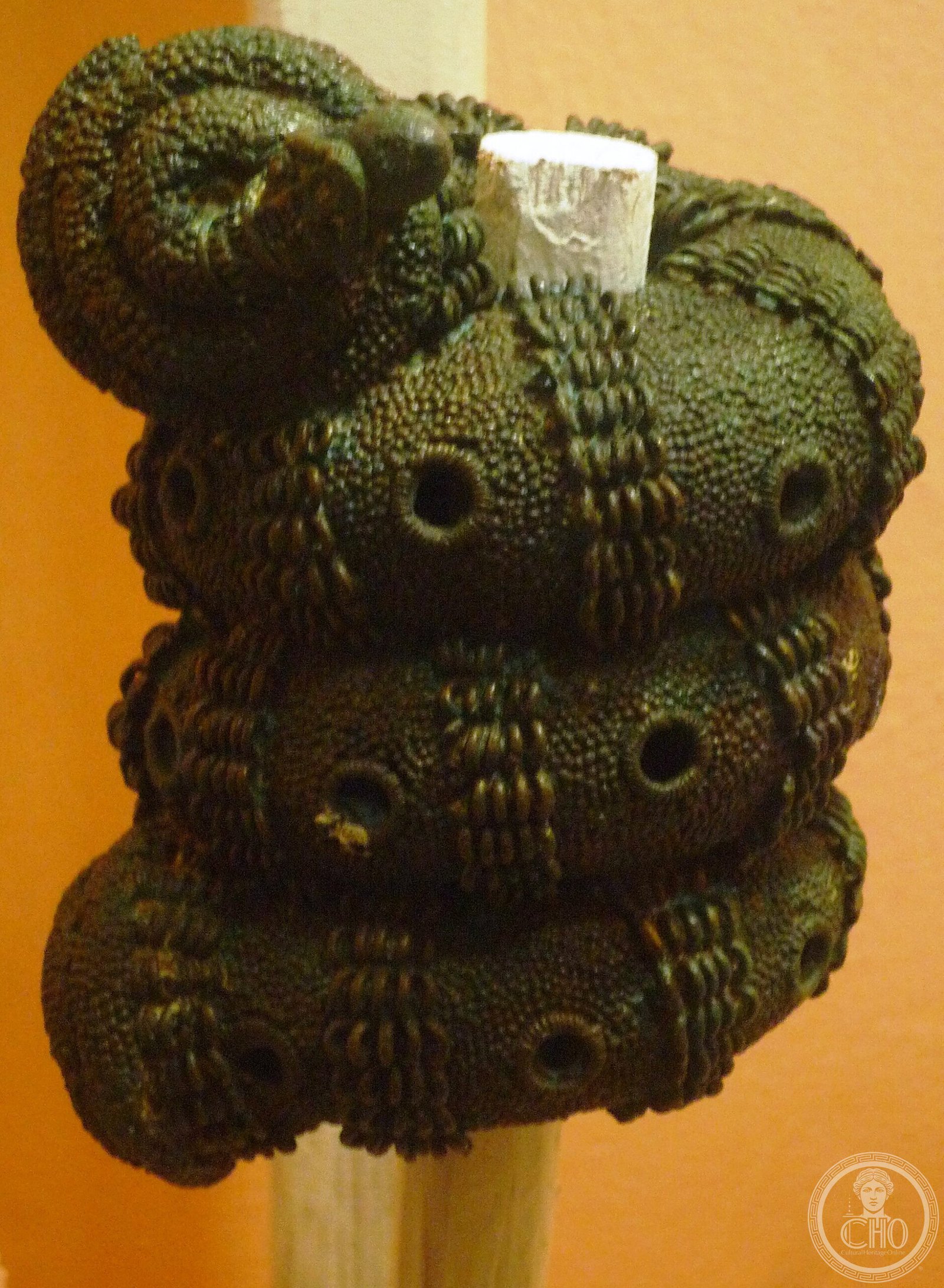
In a small town in southeastern Nigeria, excavations in 1939 and 1959 uncovered bronze objects of extraordinary intricacy that overturned everything Western archaeology assumed about sub-Saharan Africa: the oldest known complex metal-casting on the continent, four centuries before the famous Benin bronzes.
At a glance
Igbo-Ukwu is a small town in Anambra State, southeastern Nigeria, where three excavations between 1939 and 1975 — led principally by Thurstan Shaw of Cambridge University — uncovered approximately 700 bronze and copper objects from around 850–1000 AD. These objects constitute the oldest known evidence of complex metal-casting in sub-Saharan Africa and among the most technically sophisticated bronzes produced anywhere in the world in the first millennium AD. The site appears to represent the burial chamber of an Eze Nri, the sacred ritual king of the Igbo people.
Key facts
- Period: c. 850–1000 AD
- Objects: ~700 bronze and copper artefacts recovered
- Technique: lost-wax (cire perdue) bronze casting
- Significance: oldest known complex bronze-casting in sub-Saharan Africa
- Excavator: Thurstan Shaw, University of Cambridge (1939–40, 1959–60)
- Location: Anambra State, southeastern Nigeria
- Collections: National Museum, Lagos and Onitsha; British Museum, London
History
In 1938, a man named Isaiah Anozie was digging a cistern in his compound in Igbo-Ukwu when he struck a cache of bronze objects at a depth of about one metre. The British colonial administration arranged for the objects to be stored locally, and in 1939 the British archaeologist Thurstan Shaw conducted the first formal excavation. A second season in 1959–60 revealed a burial chamber (Igbo-Richard) that contained the skeletal remains of a person of high status, seated and adorned with elaborate regalia: bronze staff ornaments, crown fittings, anklets, a pectoral, and a fly-whisk. A third site, Igbo-Jonah, contained a pit cache of further objects.
The bronzes were cast using the lost-wax method, in which a wax model is coated in clay, melted out, and replaced with molten bronze. The technique produces objects of extreme intricacy impossible to achieve by other casting methods. It is the same method used in ancient Greece, Renaissance Europe, and the great West African bronze-casting traditions — but the Igbo-Ukwu bronzes predated any possible European influence by centuries. The copper content of the alloys was traced to Saharan sources hundreds of kilometres to the north, demonstrating extensive long-distance trade networks.
The discovery challenged two prevailing assumptions: that complex bronze-casting in sub-Saharan Africa was introduced from North Africa or Europe, and that the famous Benin bronzes (beginning c. 1300 AD) represented the earliest such tradition. Igbo-Ukwu showed instead an indigenous, highly developed tradition approximately 400 years older than Benin, with no evidence of external influence.
The bronzes
The Igbo-Ukwu bronzes are immediately distinctive. The ceremonial vessel in the form of a snail shell — the “roped pot” — approximately 32 cm tall, is covered in a network of twisted copper wire, with small insects and animals added in relief. A bronze pendant in the form of a human face with elaborate scarification marks is one of the earliest known representations of an African face in bronze. Staff ornaments, flywhisk handles, crown fittings, and ceremonial vessels are decorated with geometric patterns, animal figures, and scenes of human activity rendered with a confidence and technical mastery that suggests centuries of accumulated craft tradition, not a first experiment.
What you see today
The excavation sites in Igbo-Ukwu are not maintained as an open-air museum; the town has continued to develop around them. The most important objects are held in the National Museum, Lagos, and a dedicated Igbo-Ukwu gallery at the National Museum, Onitsha, where replicas and original pieces are displayed. The British Museum holds a significant collection. The landscape of Anambra State — densely settled, intensively farmed lowland forest country in the Niger delta region — gives little visual indication of the Bronze Age deposits beneath.
Practical information
- Getting there: Asaba Airport or Enugu Airport, then road to Awka or Igbo-Ukwu (approximately 30 km from Awka)
- Main collection: National Museum Onitsha, Anambra State; National Museum Lagos
- On-site: the excavation locations in the town are not formally open to visitors; local guides available
- Best time: November to March (dry season)
Nearby
- Onitsha National Museum — holds Igbo-Ukwu bronze collection, ~30 km northwest
- Benin City — capital of Edo State, home of the Benin bronzes (c. 1300 AD onwards), ~160 km west
- Awka — Anambra State capital, ~30 km from Igbo-Ukwu
Sources
- Shaw, Thurstan. Igbo-Ukwu: An Account of Archaeological Discoveries in Eastern Nigeria. 2 vols. London: Faber and Faber / Northwestern University Press, 1970.
- Northrup, David. “Igbo and Myth Igbo: Culture and Ethnicity in the Atlantic World, 1600–1850.” Slavery and Abolition 21:3 (2000).
- Insoll, Timothy. The Archaeology of Islam in Sub-Saharan Africa. Cambridge University Press, 2003.
- Wikipedia. “Igbo-Ukwu.” en.wikipedia.org/wiki/Igbo-Ukwu
Find it on the map
See this place and what’s around it →📷 Become a Cultural Heritage Online photographer
Share your photos of places: they stay published under your name as the author. The more they're seen, the more you get noticed — and soon a contest will reward the most appreciated photos.
Log in or sign up free to add a photo