
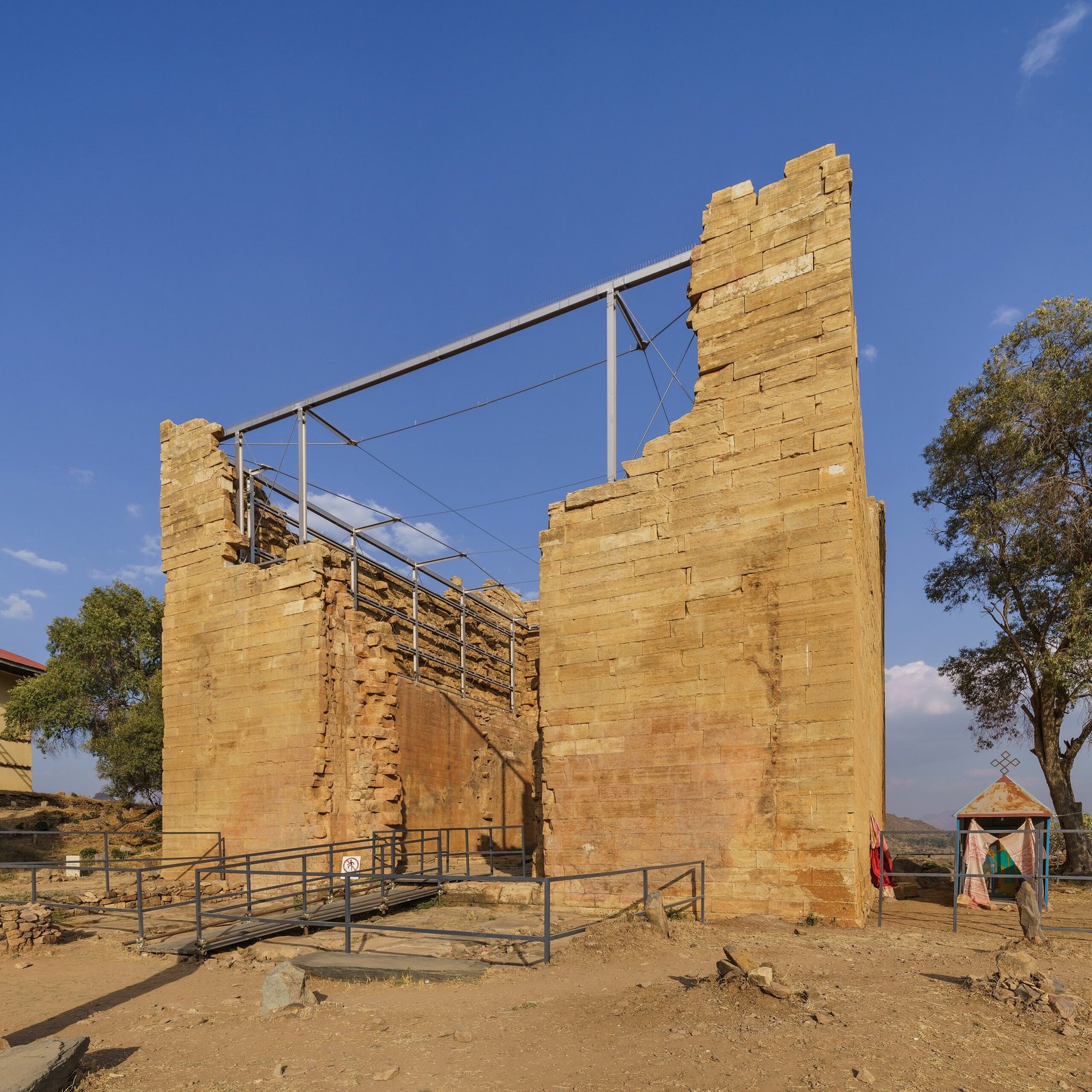
A South Arabian-style temple built 2,700 years ago in the Tigray highlands — the oldest standing stone building in sub-Saharan Africa, and proof that sophisticated stone architecture existed in Ethiopia a full millennium before Axum.
At a glance
In a small village approximately 65 km northeast of Axum, the Great Temple of Yeha stands as one of the most remarkable ancient structures in Africa: a dressed-sandstone temple built approximately 700–500 BC in the South Arabian architectural tradition, rising to a surviving height of approximately 12 metres, whose construction predates the more famous monuments of the Axumite civilisation by at least five centuries. Yeha was likely the capital or principal religious centre of the D’mt Kingdom — a polity that flourished in the northern Ethiopian highlands from approximately 980 to 400 BC and that shows extensive material and linguistic evidence of contact with the Sabaean civilisation of ancient Yemen. The temple now functions as a Christian church, consecrated since the Axumite period, but its exterior walls of perfectly dressed ashlar masonry constitute the oldest datable standing stone building in the entire sub-Saharan African continent.
Key facts
- Built: c. 700–500 BC, D’mt Kingdom period
- Dimensions: approximately 18 m × 14 m plan; surviving wall height approximately 12 m
- Construction: large dressed sandstone blocks, ashlar technique — laid in regular horizontal courses without mortar, closely paralleled in Sabaean temples from ancient Yemen
- Deity: inscriptions mention Almaqah, the South Arabian moon deity also worshipped at Marib and Sirwah
- Script: dedicatory inscriptions in ancient South Arabian (Sabaean) script
- Current use: ground floor enclosed and consecrated as an Ethiopian Orthodox church (Abba Afse) since the Axumite period
- Status: part of the Aksum UNESCO World Heritage Site (inscribed 1980)
History
The D’mt Kingdom (also spelled Da’amat or D’mt) was a polity that occupied the northern Ethiopian highlands from approximately 980 to 400 BC, broadly contemporaneous with the early Iron Age in the Mediterranean world. It is the earliest complex society yet identified in the Ethiopian-Eritrean highlands, and its material culture — monumental stone architecture, bronze tools, iron working, cattle domestication, and a written script — demonstrates that the region was not an isolated backwater but a participant in the wider world of the ancient Red Sea and Indian Ocean. The evidence for D’mt-Sabaean contact is substantial: the script used at Yeha is South Arabian (specifically Sabaean), the deity invoked in inscriptions is the Sabaean moon god Almaqah, and the architectural style of the Great Temple is closely paralleled in temples at Marib (the Sabaean capital in modern Yemen) and Sirwah. Whether this contact represented colonisation, trade, dynastic intermarriage, or cultural borrowing remains debated among scholars, but the physical evidence at Yeha is among the most compelling in the ancient world for cross-Red-Sea cultural transfer.
After the decline of D’mt around 400 BC, Yeha was absorbed into the sphere of the rising Aksumite civilisation. The Aksumites, who reached their peak between approximately 100 and 700 AD, appear to have venerated Yeha as a sacred site — an early church was built on or near the temple, and the temple precinct was gradually Christianised. The temple’s ground floor was enclosed and consecrated as a church dedicated to Abba Afse, one of the Nine Saints, at some point during the Aksumite period. The structure has been maintained as a functioning church continuously since then, making Yeha one of the longest continuously used sacred sites in Africa. A secondary church on the site (Abba Afse church) was rebuilt in the 20th century and is also active today.
What you see
The Great Temple is a rectangle of approximately 18 × 14 metres, constructed entirely of large, perfectly dressed sandstone ashlar blocks laid in regular horizontal courses without mortar — the same technique used in the great Sabaean temples of ancient Yemen. The surviving walls rise to approximately 12 metres, though the original temple almost certainly had a roof or upper storey that has not survived. The precision of the stone cutting is extraordinary: the blocks fit together with almost no visible joint, and the regularity of the courses gives the exterior a striking horizontal banding. The dedicatory inscriptions — carved in the ancient South Arabian script, mentioning the moon deity Almaqah — were found inside and around the temple and are now partially preserved in the site museum. The interior space, now the church nave, retains the original ashlar walls; the ceiling and fittings are modern church furnishings.
The setting of Yeha is itself part of the experience: the temple rises directly from the village square of a small farming community, surrounded by acacia trees, teff fields, and traditional stone houses. There is no barrier or perimeter fence separating one of the world’s oldest standing buildings from daily village life. A small site museum adjacent to the temple houses finds from excavations including Bronze Age objects, inscribed stone panels, and ceramic fragments. A short walk up the hill behind the village reveals additional ruins of the D’mt-period settlement, including architectural fragments and potsherds from the same period as the temple.
Practical information
- Opening hours: the church is open daily; times vary — the church caretaker holds a key for the interior; arrive before midday
- Entry fee: small entry fee charged at the site; donation for the church is appreciated
- Dress code: modest clothing required; remove shoes before entering the church interior
- Site museum: small museum on site with inscribed stones and finds; may have limited opening hours
- Photography: permitted on the exterior; ask permission inside the church
- Guides: local guides available in Yeha village and in Axum — strongly recommended for context
Getting there
Yeha is approximately 65 km northeast of Axum on the road towards Adwa. From Axum, take the road towards Adwa and follow signs for Yeha; the village is approximately 15 km off the main Axum-Adwa highway on a secondary road. The drive from Axum takes approximately 1–1.5 hours. There is no public transport direct to Yeha; hire a vehicle from Axum or join an organised tour. Axum is the natural base for visiting both Yeha and Debre Damo (approximately 20 km further north). As with all Tigray region travel, check current security and access conditions before departure — the region experienced severe conflict in 2020–2022.
Nearby
- Axum (Aksum): ~65 km southwest — the ancient Aksumite capital with stelae, royal tombs, and the Church of Our Lady Mary of Zion (UNESCO World Heritage Site)
- Debre Damo: ~20 km north — the 6th-century cliff-top monastery accessible only by leather rope, oldest complete standing church in Ethiopia
- Adwa: ~40 km west — site of the 1896 Battle of Adwa, Ethiopia’s defining victory over Italian colonial forces
- Hawzien plain rock-hewn churches: approximately 60 km southeast — a cluster of Tigray rock-hewn churches of the Aksumite and post-Aksumite periods
Sources
- David W. Phillipson, Ancient Ethiopia: Aksum — Its Antecedents and Successors, British Museum Press, 1998
- Jacke Phillips, “D’mt and the rise of Aksum” in Cambridge World History, Vol. 3, Cambridge University Press, 2015
- UNESCO World Heritage Centre — Aksum (inscribed 1980): whc.unesco.org/en/list/15
- Wikipedia — Yeha: en.wikipedia.org/wiki/Yeha
- Rodolfo Fattovich, “The Emergence of Complex Societies in the Horn of Africa,” Journal of World Prehistory, 2010
Find it on the map
See this place and what’s around it →📷 Become a Cultural Heritage Online photographer
Share your photos of places: they stay published under your name as the author. The more they're seen, the more you get noticed — and soon a contest will reward the most appreciated photos.
Log in or sign up free to add a photoIs this page about you?
This page is read by travellers and heritage enthusiasts who find it on Google. Tell us how you are connected to this place and we will take it from there.