
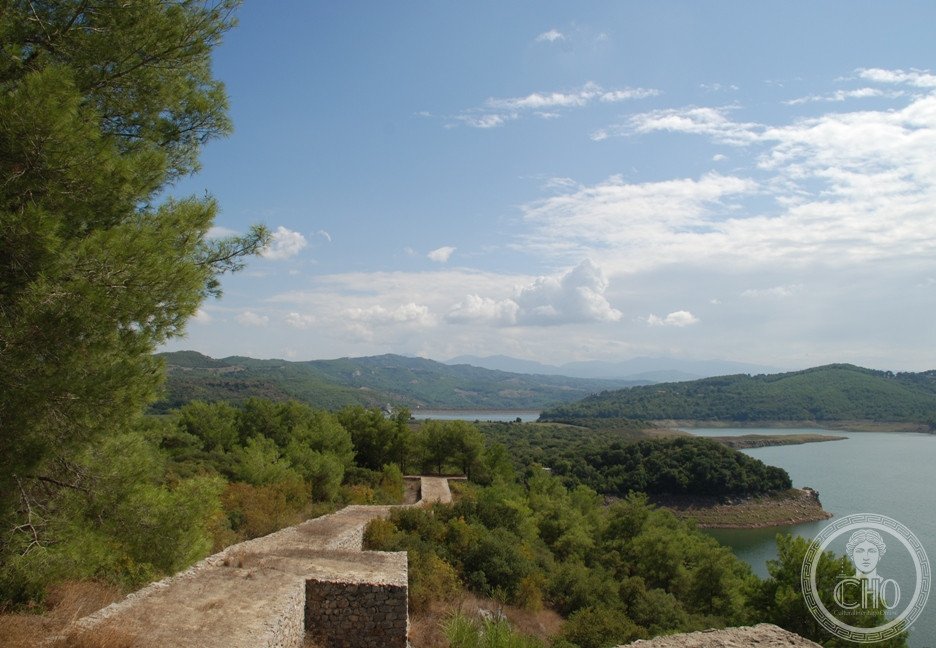
In the forested Taurus foothills of southeastern Turkey, a hilltop Neo-Hittite palace preserves the bilingual Phoenician-Luwian inscription that unlocked the Hieroglyphic Luwian script — and one of the most atmospheric open-air archaeological museums in the Middle East.
At a glance
Karatepe-Aslantash (“Black Hill-Lion Stone” in Turkish) was the summer palace and fortified hilltop city of Asitawandas, king of the Neo-Hittite state of Que (ancient Cilicia), built around 800 BC — four centuries after the collapse of the Hittite Empire. Its two ceremonial gates are lined with basalt orthostats carved with processions, feasting scenes, musicians, lions, and mythological figures, alongside a long bilingual inscription in Phoenician and Hieroglyphic Luwian. Discovered in 1947, the bilingual text provided the key to fully deciphering Hieroglyphic Luwian, comparable to the Rosetta Stone’s role for Egyptian hieroglyphics. The site is preserved under protective canopy structures in a forest national park beside the Ceyhan River.
Key facts
- Location: Kadirli district, Osmaniye Province, southeastern Turkey, above the Ceyhan River
- Period: c. 800 BC (Neo-Hittite / Iron Age); palace of Asitawandas, king of Que
- Discovery: Helmut Theodor Bossert and Halet Cambel, 1947
- Key feature: Bilingual Phoenician-Hieroglyphic Luwian inscription (same text in both scripts)
- Significance: Enabled full decipherment of Hieroglyphic Luwian; largest known Phoenician inscription
- Protection: Karatepe-Aslantash National Park; ongoing excavation by Istanbul University
- UNESCO: Not inscribed; on Turkey’s Tentative List
History
The Hittite Empire, one of the great powers of the Late Bronze Age, collapsed catastrophically around 1200 BC along with most other eastern Mediterranean civilisations. In the aftermath, several successor states emerged in southeastern Anatolia and northern Syria, using Luwian (a language related to Hittite) and a hieroglyphic script inherited from the old empire. These Neo-Hittite or Syro-Hittite states were smaller and more regionalised, heavily influenced by Phoenician, Aramaic, and Assyrian cultures. Karatepe was the creation of Asitawandas, king of Que (the ancient Cilician plain, in what is now the Adana region), who built his hilltop palace around 800 BC and left an unusually detailed autobiographical inscription praising his achievements, his promotion of prosperity, and his foundation of the city of Azatiwataya.
The site was discovered in 1947 by German-Turkish archaeologist Helmut Theodor Bossert and Turkish archaeologist Halet Cambel during a survey of the Ceyhan River valley. The discovery of the bilingual gate inscriptions caused immediate scientific excitement: Phoenician was already well understood, so the parallel Luwian text could for the first time be systematically compared word by word with a known language. Within a decade, the Karatepe bilingual enabled scholars to complete the decipherment of Hieroglyphic Luwian that had stalled since the early 20th century, opening hundreds of other Neo-Hittite inscriptions to understanding. Halet Cambel continued excavations at Karatepe until shortly before her death in 2014, spanning one of the longest continuous archaeological careers at a single site in modern history.
The site is now a national park, and the gate orthostats are protected by purpose-built shelter structures. The conservation approach — preserving carved stones in situ within their original landscape setting — has been praised internationally as a model for open-air archaeological presentation.
What you see
Karatepe occupied an elongated basalt hilltop with natural defensive advantages reinforced by stone walls. The two ceremonial gates — the North Gate and the South Gate — are the principal focus of visits. Both follow the same structural pattern: a stepped approach leads through a gatehouse flanked by guardian lions and sphinxes in basalt, beyond which stone-paved passages lined with carved orthostats lead to the interior. The orthostats carry a continuous programme of carved relief scenes of exceptional variety: feasting scenes show musicians, acrobats, and attendants serving a seated ruler; hunting scenes show lions, deer, and birds; mythological scenes include gods, composite creatures, and cult symbols inherited from both Hittite and Phoenician traditions. A frigate scene showing a ship with oarsmen is unique in Anatolian Iron Age art. The bilingual inscription runs along the top of the orthostat programme, the Phoenician text at one gate and the Luwian at the other.
The relief style occupies a distinctive middle ground between the formal rigidity of Assyrian palace sculpture and the more naturalistic Phoenician tradition: figures have individualised faces, expressive postures, and a narrative energy that makes the scenes immediately engaging. The site’s forest setting above the Ceyhan River adds a quality of isolation and discovery rarely encountered at major archaeological sites — visitors are almost entirely alone with the stones, the river sounds, and the surrounding woodland, a contrast with the heavily touristed sites of western Turkey.
Practical information
- Opening hours: Daily, approximately 08:00-17:00 (seasonal variation; check locally)
- Entry fee: National park fee applies; modest charge
- On site: Protective canopy shelters over gate orthostats; walking paths; small site office; no restaurant
- Best season: April-June and September-October (avoiding summer heat)
- Photography: Permitted throughout
- Guided tours: Available from Osmaniye or Adana; local guide recommended for epigraphic context
Getting there
Karatepe-Aslantash is located approximately 60 km northeast of Osmaniye and 115 km east of Adana, in the Karatepe-Aslantash National Park. The nearest town is Kadirli (c. 25 km). The site is reached by private vehicle or taxi from Kadirli or Osmaniye; there is no regular public transport to the site itself. The nearest airports are Adana Sakirpasa Airport (roughly 115 km west) and Gaziantep Oguzeli Airport (roughly 120 km east). The drive from Adana via the D400 highway takes approximately 90 minutes.
Nearby
- Hierapolis-Castabala: Neo-Hittite and Hellenistic city 40 km southwest — colonnaded street, theatre, temple of Artemis Perasia
- Anavarza (Anazarbus): Roman-Byzantine city with striking cliff citadel, c. 60 km west near Kozan
- Adana: Major city 115 km west — Sabanci Central Mosque, Stone Bridge (2nd century AD), archaeological museum
- Yilan Kalesi (Snake Castle): Armenian medieval hilltop fortress c. 50 km west above the Ceyhan plain
Sources
- Bossert, H. T. Die Inschriften des Konigs Asitawandas von Adana. Jahrbuch fur Kleinasiatische Forschung (1953).
- Cambel, H. and Ozyar, A. Karatepe-Aslantash: Azatiwataya. Die Bildwerke. Philipp von Zabern, 2003.
- Hawkins, J. D. Corpus of Hieroglyphic Luwian Inscriptions, Vol. I. Walter de Gruyter, 2000.
- Wikipedia contributors. Karatepe. Wikipedia, The Free Encyclopedia. Accessed 2026.
- Bryce, T. The World of the Neo-Hittite Kingdoms. Oxford University Press, 2012.
Find it on the map
See this place and what’s around it →📷 Become a Cultural Heritage Online photographer
Share your photos of places: they stay published under your name as the author. The more they're seen, the more you get noticed — and soon a contest will reward the most appreciated photos.
Log in or sign up free to add a photo