
Takht-i-Bahi
The best-preserved ancient Buddhist monastery in the world, occupying a hilltop 152 metres above the Gandharan plain — the birthplace of the human image of the Buddha.
At a glance
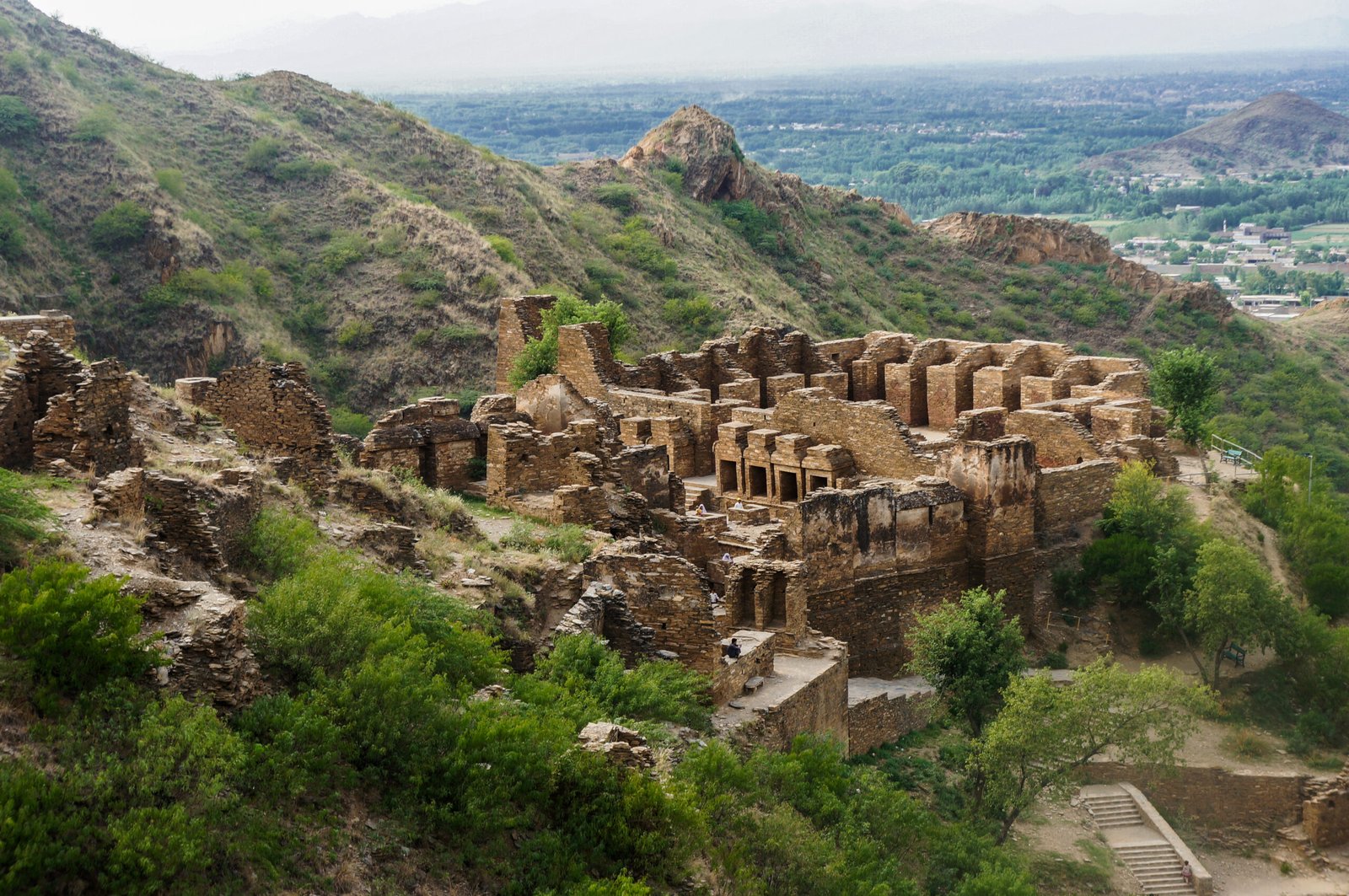
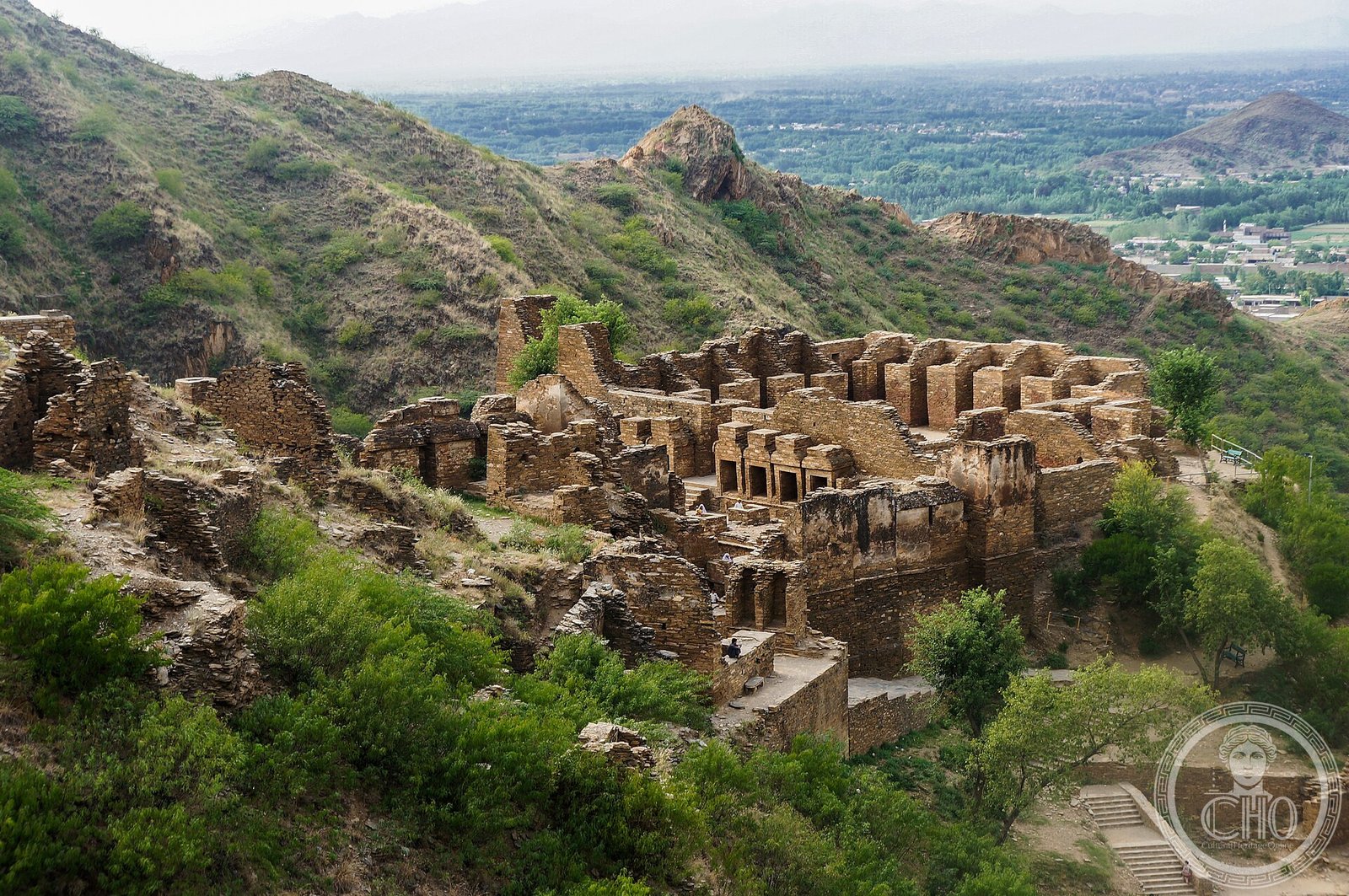
On a steep ridge in Khyber Pakhtunkhwa province, Pakistan, the monastery of Takht-i-Bahi (Spring of the Throne) was founded in the 1st century BC and occupied continuously until approximately the 7th century AD. Unlike most ancient sites, it was never buried — it was simply abandoned when Buddhism declined following the Islamic conquest of the region — and its hilltop position protected it from agricultural disturbance. The result is a structural completeness unmatched anywhere in the Buddhist world: the main court, votive stupas, assembly hall, monks’ cells, and tantric chambers survive to considerable height, their walls and niched pillars still standing after two millennia.
Key facts
- Founded: 1st century BC; continuously occupied to c. 7th century AD
- Location: Khyber Pakhtunkhwa province, 15 km northwest of Mardan
- Elevation: 152 metres above the surrounding plain
- UNESCO designation: World Heritage Site since 1980 (alongside Sahr-i-Bahlol)
- Artistic tradition: Gandharan — the school that created the first human images of the Buddha
- Key collections: Scattered finds in the British Museum, Peshawar Museum, and private collections worldwide
History
Takht-i-Bahi was established during the Gandharan period of the 1st century BC, when this region of northwestern Pakistan stood at the intersection of Greek, Persian, Indian, and Scythian cultural currents following Alexander the Great’s conquest of the area in 327 BC. The monastery grew over successive centuries, expanding through the Kushan Empire (1st–3rd century AD) when the region reached its greatest prosperity and artistic flowering. It was during this era that the Gandharan artistic tradition developed its defining achievement: the first human representations of the Buddha. Before this moment, the Buddha had always been depicted symbolically — by a footprint, a wheel, a parasol, an empty throne. Under Greek artistic influence, Gandharan sculptors created the canonical human Buddha image that all subsequent Buddhist cultures — Chinese, Japanese, Korean, Southeast Asian — would inherit and adapt.
The monastery continued to function into the 7th century AD, when Buddhist institutions throughout the region declined following the arrival of Islam. Unlike many sites that were actively dismantled for building stone, Takht-i-Bahi’s hilltop location made quarrying impractical. The site fell into disuse and slow ruin, never buried, never rebuilt over — preserving its structure at a level of completeness that makes it the primary reference point for understanding Gandharan monastic architecture. British archaeologists began systematic excavations in the 19th century; the site was inscribed on the UNESCO World Heritage List in 1980.
What you see
The monastery complex is organised around a central courtyard containing a series of tall, elaborate niched pillars — the most striking architectural feature of the site. Each niche once sheltered a Buddha or Bodhisattva statue; the niches are now empty, the sculptures dispersed to museums worldwide over a century of excavation and looting. Around the main court cluster a votive stupa court (where devotees placed small stupas as acts of religious merit), an assembly hall, and a series of monks’ cells — small, functional rooms where individual monks lived and studied. A separate tantric chamber complex indicates the presence of esoteric Buddhist practices. The walls throughout are of roughly dressed stone set in clay mortar, the construction technique standard for the region in this period.
From the monastery’s hilltop position the views across the Vale of Peshawar are extensive — the same agricultural landscape that sustained the monastery’s community for seven centuries stretches to the horizon in every direction. The nearest town, Mardan, is visible to the southeast. The walk up from the site entrance takes approximately 20–30 minutes on a rocky path with significant elevation gain; the site is exposed to sun and wind and requires sturdy footwear.
Practical information
- Entry fee: Small admission charged; Archaeological Survey of Pakistan manages the site
- Opening hours: Daylight hours; closed in extreme heat
- Best time to visit: October to March (cooler; summer temperatures can exceed 45°C)
- Photography: Permitted throughout the site
- Guides: Local guides available at the entrance; recommended for context
- Facilities: Minimal; bring water and sun protection
Getting there
Takht-i-Bahi is located approximately 15 km northwest of Mardan and 80 km east of Peshawar. From Mardan, shared taxis and local transport connect to the site. From Peshawar, hire a private car or join an organised tour — public transport to the site itself is limited. The nearest airport is Bacha Khan International Airport in Peshawar (approximately 90 km). The road from Mardan to the site is paved; the final ascent to the monastery is on foot.
Nearby
- Sahr-i-Bahlol — small fortified Gandharan city, UNESCO-listed alongside Takht-i-Bahi, 3 km away
- Peshawar Museum — one of the world’s finest collections of Gandharan sculpture, 80 km west
- Taxila — major Gandharan city and UNESCO World Heritage Site, 130 km southeast
Sources
- UNESCO World Heritage List — whc.unesco.org/en/list/10
- Wikipedia — Takht-i-Bahi
- Archaeology Survey of Pakistan — site documentation
- Boardman, J., The Diffusion of Classical Art in Antiquity, Princeton UP, 1994
- Zwalf, W., A Catalogue of the Gandharan Sculpture in the British Museum, 1996
Find it on the map
See this place and what’s around it →📷 Diventa un fotografo di Cultural Heritage Online
Condividi le tue foto dei luoghi: restano pubblicate con la tua firma come autore. Più vengono viste, più ti fai conoscere — e presto un concorso premierà le foto più apprezzate.
Accedi o registrati gratis per aggiungere una fotoDo you manage this place?
This page is read by travellers and heritage enthusiasts who find it on Google. Keep it accurate — and make it work for you. Free for non-profit heritage institutions.