

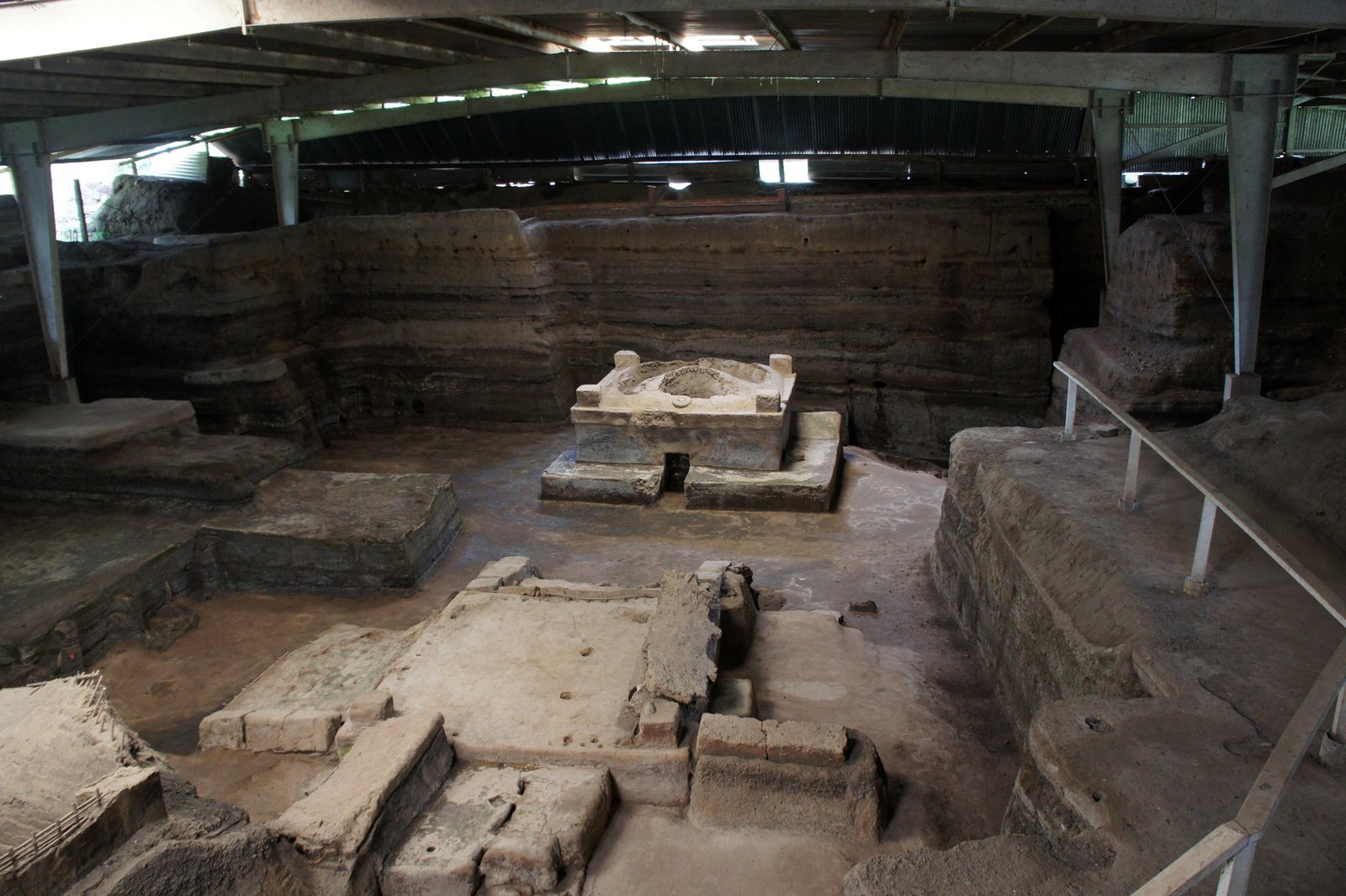
When the Loma Caldera volcano erupted around 660 AD, a small Maya village in what is now El Salvador was buried under six metres of ash in an instant — preserving cooking pots with food still inside, garden furrows with plant casts still in the soil, and the only archaeological record of ordinary Maya domestic life ever found.
At a glance
Called the “Pompeii of the Americas”, Joya de Cerén was discovered in 1976 when a bulldozer cut into a mound and exposed ancient walls and pottery. Unlike most Maya sites — which preserve ceremonial centres and elite architecture — Cerén is a farming village caught mid-life: food in cooking pots on hearths, plants rooted in garden soil, sleeping mats, tools, a sweat bath, a shaman’s workshop. A warning tremor before the eruption allowed all residents to escape; no human remains have been found. The ash sealed everything for 1,300 years. UNESCO inscribed the site in 1993.
Key facts
- Buried: c. 660 AD, eruption of Loma Caldera volcano; depth of ash up to 6 metres
- Discovered: 1976, by archaeologist Payson Sheets (University of Colorado Boulder)
- UNESCO WHS: Inscribed 1993
- Population: Estimated 70–200 people; a small farming village, not a ceremonial centre
- Food preserved: Beans, chili peppers, maize, cacao, maguey — still in cooking pots and storage vessels
- Garden casts: Volcanic ash preserved the furrows and casts of standing plants (corn, squash, cacao, medicinal herbs)
- Unexcavated: Ground-penetrating radar estimates at least 70 structures remain buried; only a fraction has been excavated
History
Joya de Cerén was inhabited during the Classic Maya period, from roughly 400 AD until its destruction around 660 AD. Its residents were farmers in the fertile Zapotitán Valley, growing maize, beans, squash, chili peppers, cacao, and maguey. They were not elites: the archaeology reveals a community of subsistence farmers who also produced specialised goods and participated in a broader regional exchange network connecting them to the larger Maya ceremonial centre of San Andrés, just 6 km away.
The Loma Caldera volcano, less than one kilometre north of the village, erupted in a phreatomagmatic event — an especially explosive type caused by magma meeting groundwater. A preliminary tremor apparently preceded the main blast. Archaeologists infer that all inhabitants fled in time: no human remains have ever been found, though food was discovered still on hearths and personal objects left where they were being used. Successive layers of ash and tephra buried the village to a depth of six metres.
The site was accidentally rediscovered in 1976 when a construction crew operating a bulldozer for a grain storage project cut into a mound and exposed ancient walls. Payson Sheets recognised the significance and began systematic excavation. Work has continued intermittently since, punctuated by El Salvador’s civil war in the 1980s and periods of limited funding. Ground-penetrating radar surveys have revealed that most of the site remains unexcavated.
What you see
The excavated portion of Joya de Cerén is covered by a large protective roof structure that allows visitors to walk around and look down at the preserved structures. Key buildings include:
- Structure 1 (main house): A sleeping and living house with painted plaster walls, sleeping benches, and stored goods including ceramics and grinding stones.
- Structure 2 (kitchen): A separate cooking building with a hearth, cooking pots, stored food, and traces of the last meal being prepared at the moment of eruption — beans and chili peppers.
- Structure 6 (sweat bath / temascal): A domed sweat bath preserved in three-dimensional form, evidence of a widespread Mesoamerican hygiene and ritual practice.
- Structure 9 (shaman’s workshop): Identified by specialised vessels and residues consistent with ritual use, possibly including psychoactive substances.
- Community storehouse: A large building for shared food storage, with evidence of multiple grain types.
- Garden plots: Ash preserved the furrows and plant casts (corn, squash, cacao, agave) in the exact positions they occupied on the night of the eruption.
Practical information
Joya de Cerén is located near San Juan Opico in the La Libertad department of El Salvador, approximately 36 km west of San Salvador. The site has a visitor centre, guided tours, and a small museum. Opening hours and admission fees vary — verify with the Salvadoran Secretariat of Culture before visiting. Photography is permitted. The site is accessible and family-friendly.
Getting there
From San Salvador: take the CA-1 highway west toward Santa Ana; exit at San Juan Opico and follow signs to the archaeological park. By public transport, buses run from the Terminal de Occidente in San Salvador toward San Juan Opico; a taxi or tuk-tuk covers the final stretch to the site. The site can be combined with a visit to the nearby San Andrés Maya site (6 km away).
Nearby
- San Andrés Archaeological Park — Maya ceremonial centre 6 km away; part of the same Zapotitán Valley cultural complex
- Tazumal — One of El Salvador’s largest Maya sites, featuring a large stepped pyramid; approximately 50 km west
- Parque Nacional Los Volcanes — Active volcano complex including Santa Ana (Ilamatepec) and Izalco, the “Lighthouse of the Pacific”
Sources
- Sheets, Payson D. (ed.). Before the Volcano Erupted: The Ancient Cerén Village in Central America. University of Texas Press, 2002.
- Sheets, Payson D. The Cerén Site: An Ancient Village Buried by Volcanic Ash in Central America. Wadsworth, 2006 (2nd ed.).
- UNESCO World Heritage List. “Joya de Cerén Archaeological Site”, inscribed 1993. whc.unesco.org.
- McKee, Brian R. “Household archaeology at Joya de Cerén.” In Ancient Maya Commoners, ed. Lohse & Valdez. University of Texas Press, 2004.
Find it on the map
See this place and what’s around it →📷 Become a Cultural Heritage Online photographer
Share your photos of places: they stay published under your name as the author. The more they're seen, the more you get noticed — and soon a contest will reward the most appreciated photos.
Log in or sign up free to add a photo