
Ancient Merv
Silk Road Metropolis of the Karakum Desert • Turkmenistan • UNESCO World Heritage
Five Cities, One Oasis
At the edge of the Karakum Desert, where a river once made the otherwise impassable landscape habitable, five successive cities were built on the same site over five millennia. Ancient Merv — known to its inhabitants across different eras as Margush, Antiochia Margiana, Merv, and Marw al-Shahijan — is one of the great palimpsests of world history. Each civilization built on top of or beside its predecessor, leaving a landscape of overlapping ruins visible as distinct earthwork mounds today. UNESCO inscribed the site in 1999.
Possibly the Largest City in the World
At its height under the Seljuk Turks in the 11th and 12th centuries AD, Merv may have been the largest city on Earth, with a population estimated at over 200,000 people. It served as the capital of the Seljuk Empire under Sultan Sanjar (ruled 1118-1157), and its bazaars, libraries, and observatories made it one of the intellectual centers of the Islamic world. The Mausoleum of Sultan Sanjar, built around 1157, still stands — its turquoise dome visible for a day’s walk across the desert in every direction.
The Silk Road’s Crossroads
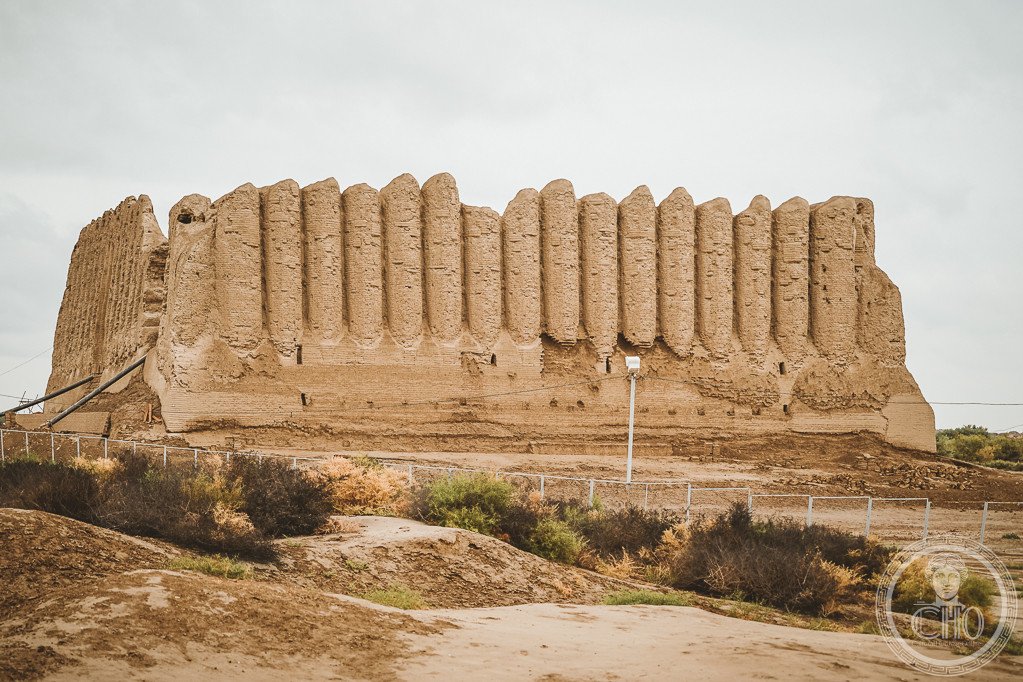
Merv sat at the intersection of the great Silk Road routes connecting China and Central Asia with Persia, the Arabian Peninsula, and the Mediterranean. Alexander the Great passed through in 329 BC and is credited with founding or refounding the city as Alexandria Margiana. The Arab armies conquered it in 651 AD during the Islamic expansion, and under the Abbasid caliphate Merv became a major administrative center. The governor Abd al-Rahman ibn Muslim built the great Kiz Kala citadel, whose mud-brick walls still partially stand. Merv’s libraries housed some of the finest manuscript collections in the medieval world.
Tolui’s Massacre: 1221
In 1221, Genghis Khan’s son Tolui besieged Merv. After a brief resistance, the city surrendered on promises of safe conduct. The promise was broken. Tolui ordered the complete destruction of the city and the killing of its entire population. Medieval sources — Juzjani, Ibn al-Athir — record figures of 700,000 to 1,200,000 dead, though historians debate the exact numbers. What is undisputed is that Merv was effectively erased as a major city in a matter of days, in what stands as one of the most catastrophic urban destructions in the pre-modern world. The ruins of the pre-Mongol city are among those visible today.
The Five Settlement Layers
Archaeological investigation reveals five distinct urban periods at Merv, each represented by separate mound complexes across the oasis:
- Erk Kala: The oldest citadel, dating to the Bronze Age (3rd millennium BC) and the Achaemenid period.
- Gyaur Kala: The Hellenistic and Parthian city, later the early Islamic city; its walls enclose approximately 4 square kilometers.
- Sultan Kala: The great Seljuk capital at its peak; the Mausoleum of Sultan Sanjar stands here.
- Abdullah Khan Kala: Built after the Mongol destruction, 15th-16th century.
- Bairam Ali Khan Kala: The latest city, 18th century, abandoned when the river shifted course in 1794.
The Mausoleum of Sultan Sanjar
The most intact monument at Merv is the mausoleum built for the Seljuk Sultan Ahmad Sanjar around 1157, designed by the architect Muhammad ibn Atsiz of Sarakhs. Its double-shell dome — the outer dome once covered in turquoise tiles visible across the desert, the inner dome creating a serene space of filtered light — was one of the engineering achievements of its age, influencing Islamic funerary architecture from Iran to India. Restoration work supported by UNESCO and the Turkmen government has stabilized the structure, which remains the dominant feature of the site.
Visit
- Location
- Near the city of Mary, in southeastern Turkmenistan; approximately 30 km from the city center.
- Access
- Turkmenistan requires a visa and a government-approved guide for most foreign visitors; the site is accessible by road from Mary.
- UNESCO status
- World Heritage Site (1999): “State Historical and Cultural Park Ancient Merv.”
- Coordinates
- 37.6540 N, 62.1910 E
Find it on the map
See this place and what’s around it →📷 Become a Cultural Heritage Online photographer
Share your photos of places: they stay published under your name as the author. The more they're seen, the more you get noticed — and soon a contest will reward the most appreciated photos.
Log in or sign up free to add a photo