
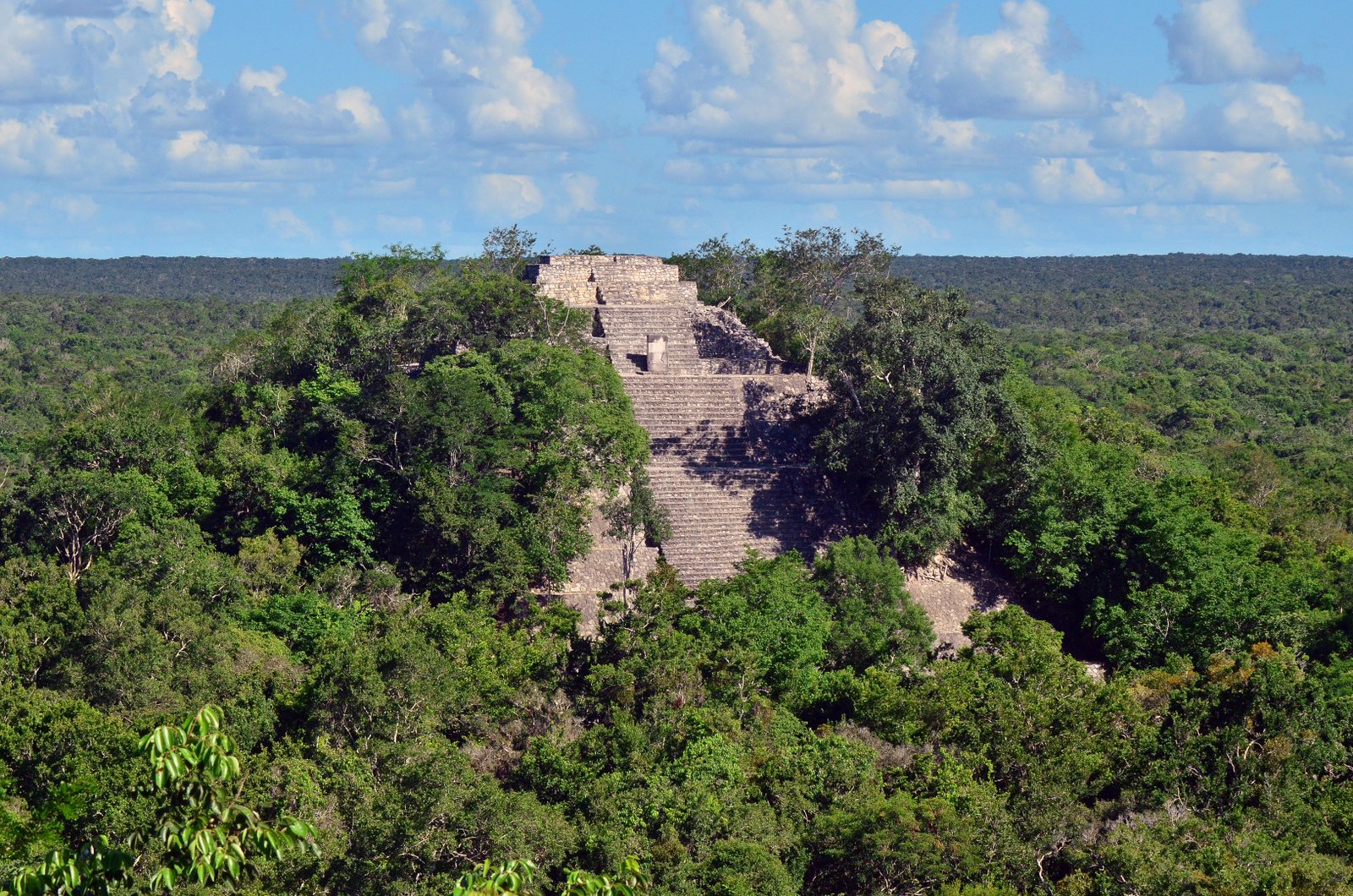
Deep in the Calakmul Biosphere Reserve — the largest tropical forest in Mexico — the ruins of one of the greatest Maya cities lie half-swallowed by the jungle. For centuries, Calakmul was the seat of the Kaan dynasty, the “Snake Kingdom,” and the most formidable rival of Tikal in the contest for Maya supremacy.
At a glance
Calakmul sits in the southern Yucatán Peninsula, 35 kilometres from the Guatemalan border, inside a biosphere reserve that is home to jaguars, spider monkeys, toucans, and scarlet macaws. The site covers roughly 70 square kilometres of mapped structures; its urban core contains more than 6,000 buildings. At its peak in the Classic period (c. 550–700 AD), Calakmul may have housed 50,000 people. It was designated a UNESCO World Heritage Site in 2002, and the designation was extended in 2014 to a mixed cultural-natural listing encompassing the surrounding biosphere.
Structure 2 — the city’s central pyramid — stands 45 metres tall and is the largest Maya pyramid in the world by base area. Its footprint exceeds that of the Temple of the Sun at Teotihuacan.
The Shadow Kingdom
Where Tikal led a network of allies linked to the great highland city of Teotihuacan — sometimes called the “Alliance of the Sun” — Calakmul built a rival constellation of vassal states across the Maya lowlands. Scholars today call this network the “Snake Kingdom,” after the Kaan dynasty’s serpent head emblem glyph.
The greatest ruler of Calakmul, Yuknoom the Great (r. 636–686 AD), orchestrated a series of proxy wars and diplomatic marriages that brought most of the Maya world into Calakmul’s orbit and encircled Tikal with hostile states. In 657 AD, Calakmul’s ally Dos Pilas attacked Tikal directly. In 679 AD, Tikal suffered a catastrophic defeat. The rivalry between the two superpowers shaped Maya history for more than a century.
The reversal came in 695 AD when Tikal’s king Jasaw Chan K’awiil I captured and sacrificed Yuknoom Ch’een II — Yuknoom the Great’s successor — on the battlefield, breaking Calakmul’s hegemony. Calakmul continued as a regional power for another two centuries before the broader Classic Maya collapse depopulated the southern lowlands by around 900 AD.
What you see
The site is anchored by two enormous pyramids — Structure 1 and Structure 2 — that face each other across the main plaza, forming the architectural core of the city. Structure 2 is the taller and wider of the two, built in five construction phases over many centuries; each dynasty added a new layer around the previous pyramid. Jade masks and royal burials were discovered inside it during excavations by William Folan (1984 onward) and subsequent archaeologists.
Calakmul holds a record among Maya sites: more than 120 stelae — carved stone monuments depicting rulers and recording dates and conquests — have been found here, more than at any other Maya city. Many are heavily eroded by the acidic jungle soil; others are preserved in the on-site museum.
The jungle is very much part of the experience. Unlike Chichen Itza or Tulum — which receive millions of visitors per year on paved access roads — Calakmul requires a 60-kilometre drive on a dirt road through the biosphere reserve. Noise from howler monkeys and toucans accompanies the climb up the pyramids. Jaguars are occasionally spotted near dawn.
Discovery and excavation
Calakmul was first surveyed from the air in 1932 by botanist Cyrus Longworth Lundell, who named it: in Mayan, the name is variously translated as “City of Two Adjacent Mounds” or “City of Two Towers.” Ground surveys and limited excavation followed in the 1930s and 1950s, but the site remained poorly understood until Folan’s systematic programme beginning in 1984. Epigraphic work by Simon Martin, Nikolai Grube, and others deciphered the Snake Kingdom’s history from inscriptions at Calakmul and across the Maya lowlands in the 1990s and 2000s, revealing the full extent of Yuknoom the Great’s empire.
Cultural significance
Calakmul forces a recalibration of the Maya story. For decades, Tikal — heavily excavated and prominently featured in popular media — was treated as the dominant Classic Maya city. Calakmul’s emergence as an equal or greater power rewrites that narrative: Classic Maya civilization was not centred on one capital but shaped by the long, complex rivalry between two roughly matched superpowers, each with its own network of allies and its own vision of Maya order.
The site also illustrates how jungle preservation paradoxically protects heritage. The remoteness that kept Calakmul from mass tourism also protected it from the looting that stripped many better-known Maya sites in the 20th century.
Key facts
- Location: Campeche, Mexico (18.10°N, 89.81°W)
- Period: c. 5th century BC – 9th century AD (Preclassic to Terminal Classic Maya)
- Peak population: Estimated 50,000 at Classic period apogee
- Structure 2: 45m tall; largest Maya pyramid by base area
- Stelae count: 120+ — most of any Maya city
- UNESCO: World Heritage Site (2002; extended to mixed cultural/natural 2014)
- Biosphere: Located within Calakmul Biosphere Reserve — largest tropical forest in Mexico
Practical information
- Access: 60km dirt road from Escárcega or Chetumal; 4WD recommended in wet season (May–November)
- Best time: November to April (dry season); early morning for wildlife and cooler temperatures
- On-site museum: Displays jade masks, stelae, and artefacts; included in site admission
- Nearest town: Xpujil (52 km north), the closest point for fuel, accommodation, and supplies
- Guided tours: Local guides available at the entrance; strongly recommended for context
Nearby
- Balamkú — 60 km north; a smaller Maya site with an intact stucco frieze of exceptional quality, rarely visited
- Becán — 155 km northeast; Classic Maya site with a 2km defensive ditch, one of the oldest known Maya defensive works
- Tikal — 100 km southeast across the Guatemalan border; the great rival city, with taller pyramids and better visitor infrastructure
Sources
- Calakmul — Wikipedia
- Martin, S. & Grube, N. (2008). Chronicle of the Maya Kings and Queens. Thames & Hudson.
- UNESCO World Heritage — Calakmul
Find it on the map
See this place and what’s around it →📷 Become a Cultural Heritage Online photographer
Share your photos of places: they stay published under your name as the author. The more they're seen, the more you get noticed — and soon a contest will reward the most appreciated photos.
Log in or sign up free to add a photo