
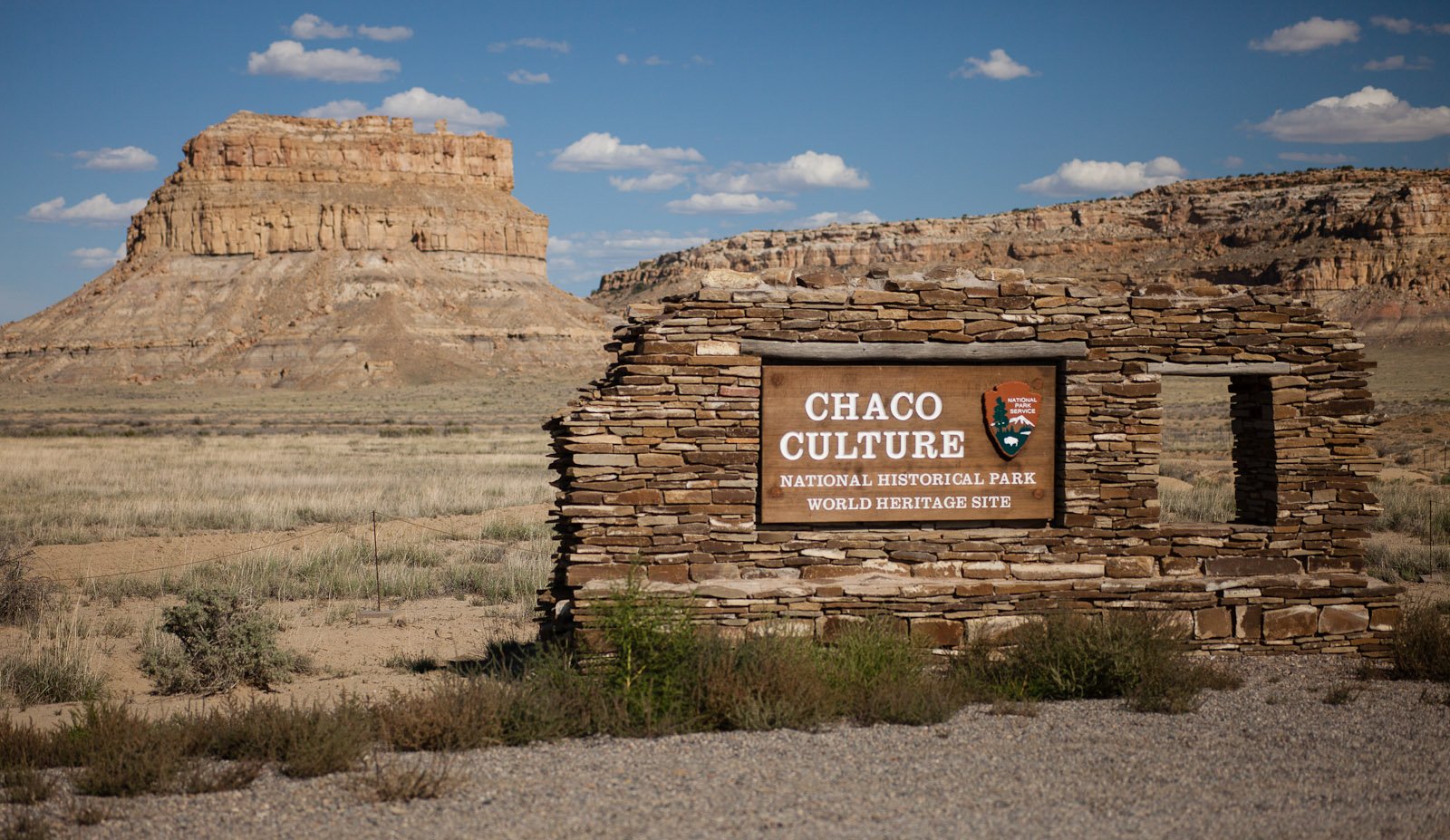
Deep in a remote canyon in New Mexico, a civilisation built the most sophisticated architecture north of Mexico — and then abandoned it. Chaco Canyon was the ceremonial and political heart of the Ancestral Puebloan world between roughly 850 and 1150 AD. Its great houses, astronomical alignments, and engineered desert roads remain among the most studied and debated monuments on the continent.
A Desert Capital Aligned to the Sky
The canyon holds 15 major great houses. The largest, Pueblo Bonito, contained more than 650 rooms in a D-shape rising four storeys, with 40 kivas — circular ceremonial chambers sunk into the earth. Doorways, walls, and entire building wings are astronomically aligned: some track the summer and winter solstices, others the 18.6-year lunar standstill cycle. The builders encoded the sky into stone.
The Sun Dagger: A Calendar in Rock
On Fajada Butte, three tall stone slabs lean against a cliff face. At solar noon on the summer solstice, a single dagger of light pierces the exact centre of a spiral petroglyph behind them. At the winter solstice, two daggers frame it. At the equinoxes, a smaller spiral is bisected. The Sun Dagger, documented by researcher Anna Sofaer in 1977, is one of the most elegant solar calendars ever found. Erosion shifted the slabs in 1989 and the site is now closed to visitors.
Roads Visible from Space
Radiating from Chaco in perfectly straight lines across cliffs and open desert are more than 650 km of engineered roads, some up to nine metres wide. They connect the canyon to outlier communities across the plateau and are visible from satellite. They cut through terrain rather than following it. Whether they served as trade routes, pilgrimage paths, or ceremonial axes remains debated — all three may be true.
Architecture Without Metal or Wheel
The builders had no metal tools, no wheel, no draft animals. Hundreds of thousands of timber beams were carried from forests 80 km away. The core-and-veneer masonry — a rubble core faced in precisely shaped stone — was engineered to carry four storeys. Casa Rinconada, a great kiva 19 m in diameter aligned to the cardinal directions, could hold hundreds in ceremony. Modern engineers study the masonry technique today.
The Ancestral Puebloan People
The builders of Chaco are the direct ancestors of today's Pueblo peoples — the Hopi, Zuni, Acoma, and the nineteen Pueblos of New Mexico. The accepted scholarly term is Ancestral Puebloan. The older label Anasazi, from a Navajo word meaning roughly ancient enemies, is considered offensive by many Indigenous communities and is no longer used in scholarship or by the National Park Service. The Navajo hold Chaco as sacred. Living descendants participate in site management and in debates about oil development near the park.
Abandonment and Dispersal
Around 1150 AD, after three centuries of florescence, Chaco was abandoned. Tree-ring records document a severe prolonged drought. Many archaeologists trace a dispersal northward toward Mesa Verde and other canyon systems, where the great house tradition continued. Excavation began with rancher-turned-archaeologist Richard Wetherill in 1896. Later expeditions by the American Museum of Natural History and the Smithsonian also removed vast material to eastern institutions — a chapter central to current NAGPRA repatriation discussions.
UNESCO World Heritage and Getting There
Chaco Culture National Historical Park was inscribed as a UNESCO World Heritage Site in 1987 and designated an International Dark Sky Park in 2013 — one of the darkest night-sky sites in the contiguous United States. The park covers more than 14,000 hectares. Access requires roughly 40 km of unpaved road from Nageezi or Crownpoint, impassable when wet; high-clearance vehicle required. Ranger-led stargazing programmes run in summer.
Essential Information
- Location: Nageezi, New Mexico, USA
- GPS: 36.0608° N, 107.9579° W
- Period: c. 850–1150 AD
- UNESCO WHS: 1987
- Dark Sky Park: 2013
- Access: ~40 km unpaved; high-clearance required
- Managed by: US National Park Service
Find it on the map
See this place and what’s around it →📷 Become a Cultural Heritage Online photographer
Share your photos of places: they stay published under your name as the author. The more they're seen, the more you get noticed — and soon a contest will reward the most appreciated photos.
Log in or sign up free to add a photo