
Larger Than Stonehenge
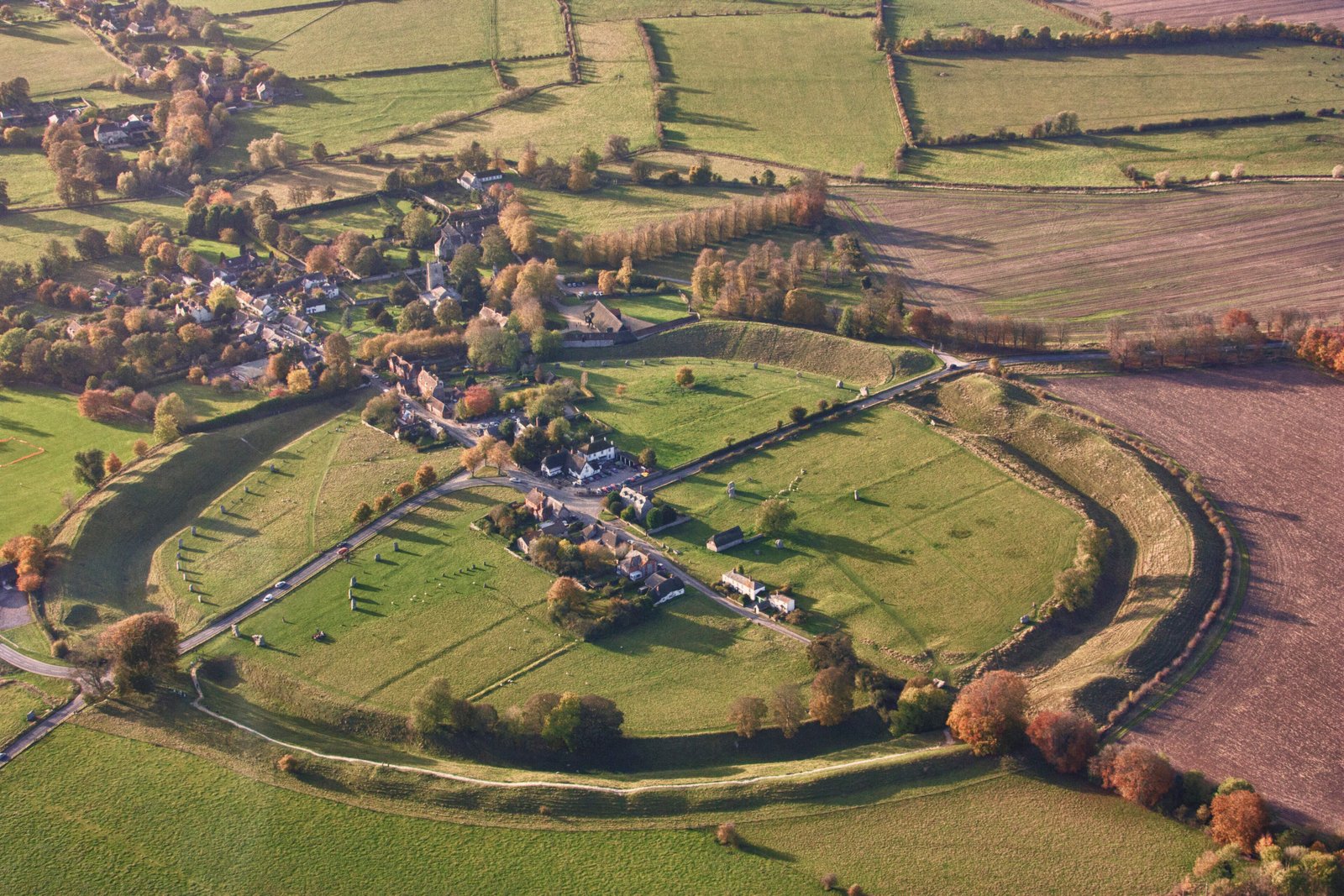
Stonehenge is 33 kilometres to the south and draws five million visitors a year. Avebury, its older and larger neighbour, is visited by a fraction of that number — and it is arguably the more extraordinary site. The outer stone circle at Avebury measures 347 metres in diameter, making it the largest prehistoric stone circle in the world. The modern village of Avebury — with its thatched cottages, its National Trust car park, and The Red Lion pub — is built entirely inside it. Some houses lean against the sarsen megaliths. You can eat a Sunday roast in a pub whose garden wall is a standing stone erected 4,500 years ago.
The monument was constructed between 2850 and 2200 BC during the Late Neolithic, contemporary with the final phases of Stonehenge and roughly coeval with the Great Pyramid of Giza. Its builders quarried sarsen sandstone from the Marlborough Downs, 30 kilometres north, and transported the stones — some weighing over 40 tonnes — without wheeled vehicles or metal tools.
The Henge: Ditch, Bank, and Scale
Avebury is technically a henge monument: a circular earthwork consisting of a ditch cut into the bedrock and a spoil bank piled outside. At Avebury, the ditch was cut 9 metres deep into the chalk — substantially deeper than at most henges — with the excavated material piled into a bank reaching 6 metres above the surrounding ground. The bank’s original circumference enclosed 11.5 hectares. The scale of labour is hard to overstate: estimates suggest the entire earthwork required somewhere between 1.5 million and 2 million person-hours using antler picks and ox scapula shovels.
The outer stone circle — 98 original stones, of which only 27 survive today — was set inside the ditch. Within the outer ring, two smaller inner circles were constructed: the North Circle (30 stones in a ring approximately 98 metres diameter) and the South Circle (29 stones, approximately 104 metres diameter). The South Circle contained a central stone called the Obelisk, now destroyed, which stood approximately 6 metres tall. The North Circle contained a three-stone cove — a U-shaped setting — of which two stones remain.
William Stukeley and the Documentation of Destruction
When the Wiltshire antiquarian William Stukeley visited Avebury in the 1720s, the monument had already been subjected to a century of systematic destruction. Medieval villagers had buried many of the stones (the Church considered them pagan); 17th-century farmers had begun breaking them with fire and cold water to clear farmland. Stukeley drew meticulous plans and sketches that recorded the monument’s configuration before further loss — his documentation is now the primary evidence for what Avebury originally looked like.
Stukeley was also the first to identify and map the West Kennet Avenue: a 2.4-kilometre processional road lined with pairs of standing stones, running southeast from the henge to a smaller monument called The Sanctuary on Overton Hill. He identified a second avenue — the Beckhampton Avenue — running west; this was doubted for 200 years until excavation in 1999 confirmed it. Stukeley’s field notes have proven more reliable than posterity initially credited.
Alexander Keiller and the 20th-Century Re-Erection
The systematic archaeological excavation of Avebury was undertaken between 1934 and 1939 by Alexander Keiller, a marmalade heir with a passion for Neolithic archaeology. Keiller purchased much of the land around Avebury specifically to conduct the work. His excavations discovered buried and fallen stones, many of which he re-erected in their original positions using concrete packing — a restoration approach now considered archaeologically controversial but which gave the monument much of its current visual coherence.
During excavation, Keiller’s team found the skeleton of a man — a medieval barber-surgeon, based on the scissors and probe found with him — crushed beneath a fallen stone, likely in the 14th century. He had apparently been part of a stone-toppling effort and died in the attempt. The stone was re-erected above him; a marker now identifies the spot.
UNESCO World Heritage and the Associated Landscape
Avebury was inscribed as a UNESCO World Heritage Site in 1986, as part of the combined nomination “Stonehenge, Avebury and Associated Sites.” The protected area extends beyond the henge to include Silbury Hill (the largest prehistoric artificial mound in Europe, 40 metres high, purpose unknown), the West Kennet Long Barrow (a Neolithic collective burial chamber predating the henge by 600 years), Windmill Hill (a Neolithic causewayed enclosure 1.2 kilometres north), and the remains of both avenues.
The Avebury WHS management has been contentious: the village within the monument is a living community, and balancing conservation requirements with residents’ property rights has produced decades of friction. The National Trust, English Heritage, and Wiltshire Council share overlapping responsibilities across the different components of the site.
Visiting Avebury
Unlike Stonehenge, Avebury has no barrier separating visitors from the stones. You can touch them, walk between them, sit against them. Entry to the stone circle is free year-round; the National Trust car park charges a fee. The Alexander Keiller Museum in the village — housed in a 17th-century barn — displays Keiller’s excavation finds and provides the clearest introduction to the monument’s phasing and construction. The Red Lion pub, though commercially unconnected to the National Trust, has become an unofficial part of the Avebury experience: it is the only pub in the world located inside a prehistoric monument, and its beer garden sits within the northern sector of the outer circle.
Essential Facts
- Period
- c. 2850–2200 BC (Late Neolithic)
- Outer circle diameter
- 347 metres (largest prehistoric stone circle in the world)
- Original stones
- 98 outer + ~30 North Circle + ~29 South Circle (most destroyed or buried)
- Earthwork
- Ditch 9m deep, bank 6m high, enclosing 11.5 hectares
- Location
- Avebury, Wiltshire, England
- GPS
- 51.4286°N, 1.8537°W
- UNESCO WHS
- 1986 — Stonehenge, Avebury and Associated Sites
- Access
- Free entry to stone circle year-round; NT car park fee applies
Find it on the map
See this place and what’s around it →📷 Diventa un fotografo di Cultural Heritage Online
Condividi le tue foto dei luoghi: restano pubblicate con la tua firma come autore. Più vengono viste, più ti fai conoscere — e presto un concorso premierà le foto più apprezzate.
Accedi o registrati gratis per aggiungere una foto