
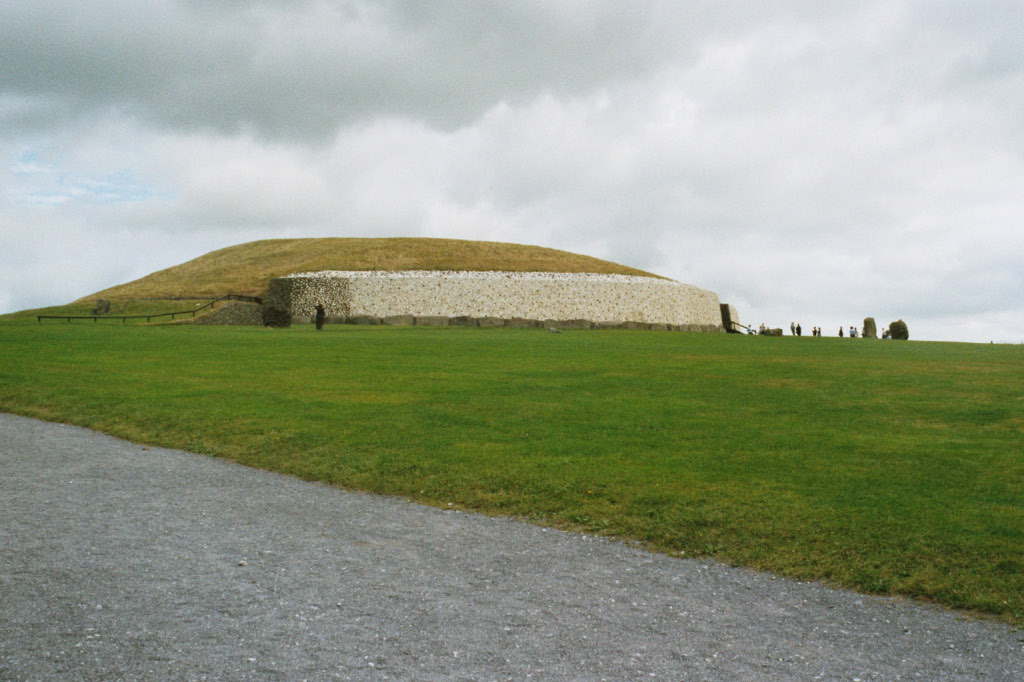
Newgrange
The roof-box was designed so that on one specific morning each year, for seventeen minutes, a beam of light walks the full length of the 19-metre passage to the back chamber. That morning is the winter solstice. The mechanism has worked without interruption for 5,200 years.
At a Glance
- Built
- c. 3200 BC — Neolithic period
- Type
- Passage tomb; Neolithic monument
- Diameter
- 85 metres; passage length 19 metres
- UNESCO
- World Heritage Site 1993 (as Brú na Bóinne)
- Age comparison
- 500 years older than Stonehenge; 1,000 years older than the Egyptian pyramids
- Solstice event
- Dawn, 21 December — admission by lottery only (25,000+ applicants, 50 places)
- Access
- Shuttle from Brú na Bóinne Visitor Centre; managed by Office of Public Works Ireland
The Solar Alignment
Above the entrance, the builders engineered a narrow rectangular opening called the roof-box. It serves no structural purpose. Its only function is to capture the sunrise on the four or five days closest to 21 December and project a shaft of sunlight down the entire length of the passage. For seventeen minutes on the solstice itself, that light reaches the triple-spiral stone at the far chamber wall. Then it withdraws. The chamber returns to complete darkness for another 364 days.
The precision required to build this alignment using Neolithic tools — no metal, no surveying instruments, no written mathematics — remains astonishing to astronomers and engineers today. The passage is oriented to within a fraction of a degree of the solstice sunrise azimuth. The builders understood the solar cycle well enough to encode it permanently in stone and earth.
Archaeologist Michael J. O’Kelly rediscovered the alignment during his excavation of the site from 1962 to 1975. In 1967, he positioned himself alone inside the dark chamber at dawn on 21 December and became the first person in modern times to witness the phenomenon from inside. He described a beam of golden light entering slowly, the floor illuminated section by section, until the whole passage glowed.
Construction and Structure
Newgrange was built by a settled farming community over what archaeologists estimate was multiple generations. The circular mound rises to about 13 metres in height and spans 85 metres across its base. Approximately 200,000 tonnes of material were used in its construction, including water-rolled stones transported from riverbeds up to 70 kilometres away.
The exterior retaining wall was faced with white quartzite cobbles — a deliberate visual choice, making the monument visible from great distances across the Boyne Valley. The kerbstone at the entrance is perhaps the most important single stone in Irish archaeology: a metre-high boulder carved with interlocking triple spirals, concentric arcs, and diamond lozenges. It is the image that has become the emblem of Irish prehistoric art. Around the entire mound, 97 kerbstones form the base ring, many decorated with geometric incised carving.
The cruciform interior passage and three side chambers contain stone basins. Cremated human remains were found in those basins — Newgrange was a tomb as well as a solar observatory. The genetic evidence from excavated remains, published in 2017, indicated that those buried here were of high social status, possibly an elite ruling dynasty of the Boyne Valley community.
History and Rediscovery
After the Neolithic period, the site fell out of active ceremonial use. By the Early Bronze Age it was already an ancient monument to the communities living near it. The Romans knew of Ireland but never conquered it; medieval Irish monks wrote about the cave of Elcmar near the Boyne. The mound was never entirely forgotten by local communities.
In 1699, the landowner Charles Campbell had his workers remove stones for road-building and rediscovered the passage entrance. The site attracted antiquarian attention through the 18th and 19th centuries, but serious scientific excavation did not begin until O’Kelly’s campaign in 1962. His work restored the white quartzite facade, re-erected fallen stones, and ultimately revealed the roof-box alignment — which earlier investigators had overlooked entirely.
Newgrange was inscribed as a UNESCO World Heritage Site in 1993 as part of Brú na Bóinne (Palace/Mansion of the Boyne), a complex that also includes the nearby passage tombs of Knowth and Dowth within the same river loop.
The Triple Spiral and Neolithic Art
The triple spiral carved on the entrance kerbstone — three interlocking spirals flowing from a common centre — appears nowhere else in the Neolithic world at this scale and craftsmanship. Its meaning is unknown. Hypotheses range from a symbol of the three solar moments (solstice, equinox, equinox) to a representation of the triple-aspect of the Neolithic year. Whatever its original meaning, it became the symbol of Irish prehistoric culture and is now used by the Irish government as an emblem of national heritage.
The interior stonework includes further examples of incised spiral art, as well as lozenge patterns and chevrons. The carving was done before the stones were positioned — meaning the builders planned the decorative programme in advance, not after construction. Some stones with elaborate carving face inward, hidden from view within the structure, suggesting the art’s purpose was ritual rather than display.
The Solstice Lottery
Each year, the Office of Public Works holds a public lottery for the right to stand inside Newgrange at dawn on the winter solstice. Typically 50 people per day are admitted for the five mornings around 21 December. In recent years, more than 25,000 applications have been received for those places. Winners are notified by post in October.
The experience — darkness, then a slow line of golden light entering the chamber while standing among 5,200-year-old stones — is described by those who attend as transformative. Cloudy mornings (which do occur) produce no shaft, only the knowledge of what would have appeared. Even cloud cover does not diminish the silence of the moment.
Standard visits to Newgrange run year-round from the Brú na Bóinne Visitor Centre across the River Boyne. The passage is entered in small guided groups; the centre provides context on the wider archaeological landscape, which includes dozens of smaller satellite monuments in the same valley.
Brú na Bóinne: The Wider Landscape
Newgrange is the most celebrated monument in a dense prehistoric landscape. Within the same loop of the Boyne, Knowth contains two passages (one oriented east, one west, aligned to equinox sunrise and sunset) and a larger collection of megalithic art than any other site in Europe. Dowth, slightly to the east, has a winter solstice sunset alignment, forming a bookend to Newgrange’s dawn orientation.
Smaller satellite tombs, standing stones, and enclosures fill the surrounding fields. The entire complex suggests a society that invested extraordinary communal labour — across generations — in the precise astronomical marking of the solar calendar. The Boyne Valley was not simply a burial ground: it was the ritual centre of a society that understood the sky.
Plan Your Visit
- Access is via shuttle bus from the Brú na Bóinne Visitor Centre on the south bank of the River Boyne near Donore, County Meath.
- Open daily year-round (limited hours November–January); advanced booking strongly recommended in summer and around the solstice.
- The visitor centre contains artefacts, models of the passage interior, and the original entrance kerbstone replica. The actual kerbstone remains at the site entrance.
- Driving: 50km north of Dublin via N2 or M1/N51. Nearest town: Drogheda (8km).
- Winter solstice lottery: applications open in September each year via the OPW website.
Find it on the map
See this place and what’s around it →📷 Diventa un fotografo di Cultural Heritage Online
Condividi le tue foto dei luoghi: restano pubblicate con la tua firma come autore. Più vengono viste, più ti fai conoscere — e presto un concorso premierà le foto più apprezzate.
Accedi o registrati gratis per aggiungere una foto