
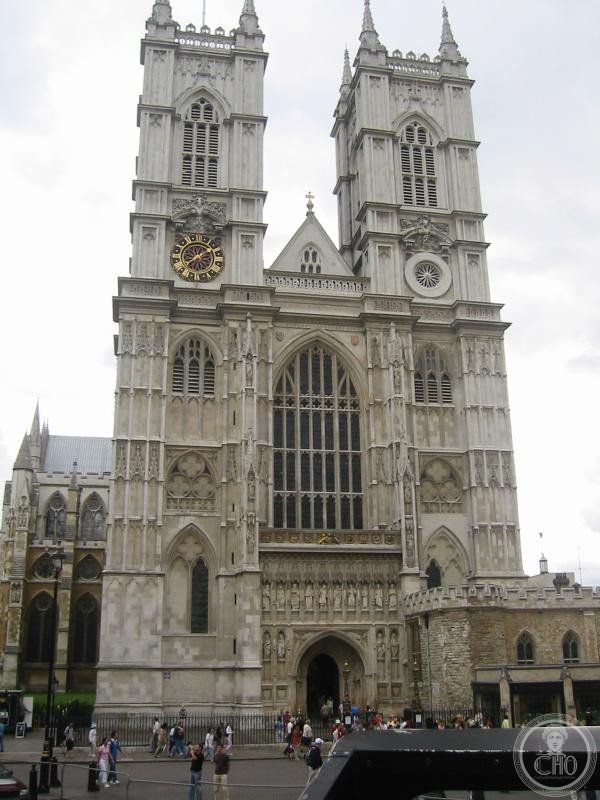
Westminster Abbey — London
Every English and British monarch since 1066 has been crowned in Westminster Abbey; every one since Henry III has been buried here — the building is a working Gothic church, a royal mausoleum, and the closest thing England has to a national pantheon, all in the same space.
At a glance
Westminster Abbey stands in the borough of Westminster, its Gothic twin towers and flying-buttressed nave rising above Parliament Square, a hundred metres from the Palace of Westminster and a hundred from Buckingham Palace’s park. According to tradition, a church was founded on the site in the early 7th century; the historically verifiable abbey was established by Edward the Confessor in 1042. Henry III began rebuilding in the French Gothic style in 1245; the nave — the tallest Gothic nave in England at 31 metres — was completed in 1517. The twin towers above the west facade, the building’s most immediately recognisable feature, were added by Nicholas Hawksmoor in 1745. The abbey has been the coronation church of every English and British monarch since William the Conqueror (1066), and the burial place of over three thousand individuals including seventeen monarchs, Chaucer, Darwin, Newton, Dickens, and the Unknown Warrior. Together with the Palace of Westminster and St. Margaret’s Church, it was inscribed as a UNESCO World Heritage Site in 1987.
Key facts
- Founded: Edward the Confessor, 1042; present Gothic structure begun by Henry III, 1245
- Style: English Gothic; French Gothic influence in the choir and ambulatory; nave completed 1517; towers (Hawksmoor) 1745
- Nave height: 31 metres — the tallest Gothic nave in England
- Coronations: every English/British monarch since Harold Godwinson (1066) except Edward V and Edward VIII
- Notable burials: seventeen monarchs including Henry V, Elizabeth I, Mary I, Mary Queen of Scots; Poets’ Corner (Chaucer, Dickens, Kipling, etc.); Scientists’ Corner (Darwin, Newton, Faraday, Hawking)
- Heritage: UNESCO World Heritage Site, Palace of Westminster, Abbeys and St. Margaret’s Church, inscribed 1987
- GPS: 51.4994° N, 0.1278° W
History
Edward the Confessor built a Romanesque abbey on the West Minster (the western monastery, as opposed to the east minster of St. Paul’s Cathedral in the City of London) beginning around 1042, completing it just days before his death in January 1066. It was in this church — the first post-Roman church to be built on the Perpendicular plan in England — that William the Conqueror was crowned on Christmas Day 1066, establishing the tradition that every subsequent monarch would claim legitimacy through anointing and coronation in the same building. Henry III, devoted to the cult of Edward the Confessor and inspired by the High Gothic of Reims and the Sainte-Chapelle in Paris, demolished the Confessor’s Romanesque building in 1245 and began the current Gothic structure. The choir and transepts were built first to a French design under Henry of Reynes; the nave — in a different, more English Gothic manner — was extended westward over 250 years, completed in 1517 under Abbot Islip.
The abbey was dissolved by Henry VIII in 1540 during the Reformation, briefly reestablished as a Catholic institution under Mary I (1556), and permanently reconstituted as a Royal Peculiar — a church under the direct jurisdiction of the sovereign rather than the Archbishop of Canterbury — by Elizabeth I in 1560. This status has protected it from the ordinary diocesan Church of England hierarchy ever since. The twin towers were added by Hawksmoor between 1735 and 1745 in a Gothic Revival style that did not quite match the medieval fabric but established the west facade’s familiar silhouette.
The Coronation Chair — made for Edward I in 1296 to enclose the Stone of Scone, captured from Scotland — has been used at every coronation from 1308 to the present; Charles III was crowned on it in May 2023. The most recent monarch buried in the abbey is George II (1760); subsequent sovereigns have chosen Windsor Castle. The Grave of the Unknown Warrior, interred on 11 November 1920 to represent the fallen of the First World War, is one of the most visited sites in the building.
What you see
The west facade — the public entrance — presents Hawksmoor’s 1745 twin towers in a Gothic that quotes the medieval forms without replicating them exactly; the towers are slightly broader than they are tall, giving them a solidity that differs from the attenuated profile of French Gothic. Between them, the main portal carries a carved tympanum and triple portal arrangement. The overall height of the towers is 68.8 metres.
Inside, the nave — 31 metres to the ridge of the vault, 155 metres in total length — is the tallest Gothic interior in England. The effect is of great upward aspiration, the triforium and clerestory drawing the eye toward the Lierne vault above. The floor is largely covered by ledger stones marking burials; at the west end, the Grave of the Unknown Warrior is set flush in dark Tournai marble and surrounded by red poppies. Poets’ Corner occupies the south transept; the Lady Chapel of Henry VII, behind the high altar, is the finest example of Perpendicular Gothic fan-vaulting in existence, its ceiling a miraculous exercise in suspended stone lace.
Practical information
- Address: 20 Deans Yard, Westminster, London SW1P 3PA, United Kingdom
- Hours: Monday–Friday and Saturday 9:30 am–3:30 pm (or 5:30 pm); check website for current times; closed during services
- Admission: adults GBP 27; free for worshippers at services
- Services: daily Evensong (sung by the choir, open to all, free) — the most atmospheric way to experience the abbey; check schedule at westminster-abbey.org
- Time needed: 1.5–2.5 hours for a thorough visit; arrive early to avoid peak crowds
Getting there
Westminster Underground station (Circle, District, Jubilee lines) is directly adjacent. St. James’s Park station (Circle, District) is five minutes on foot. Heathrow Airport is 25 km west; Piccadilly Line takes 50 minutes to Westminster. GPS: 51.4994, -0.1278.
Nearby
- Palace of Westminster & Big Ben — the Houses of Parliament and the Elizabeth Tower (containing Big Ben), directly adjacent north; UNESCO WHS
- Buckingham Palace — the principal residence of the British monarch, 10 minutes on foot west through St. James’s Park; Changing of the Guard ceremonially at 11:15 am
- Tate Britain — the national collection of British art, 15 minutes on foot south along Millbank
- Churchill War Rooms — the underground Cabinet War Rooms from which Churchill directed the war effort; ten minutes on foot
Sources
- Wikipedia, Westminster Abbey, accessed June 2026
- Official abbey website: westminster-abbey.org
- UNESCO, Palace of Westminster and Westminster Abbey including Saint Margaret’s Church, WHS reference 426, inscribed 1987
- Christopher Wilson, The Gothic Cathedral: The Architecture of the Great Church 1130–1530, Thames & Hudson, 1990
Find it on the map
See this place and what’s around it →📷 Diventa un fotografo di Cultural Heritage Online
Condividi le tue foto dei luoghi: restano pubblicate con la tua firma come autore. Più vengono viste, più ti fai conoscere — e presto un concorso premierà le foto più apprezzate.
Accedi o registrati gratis per aggiungere una foto