
A neoclassical villa on Rome’s Via Nazionale, built by the German entrepreneur Wilhelm Hüffer and praised by Gabriele D’Annunzio for its elegant, sumptuous interiors.
At a glance
Villino Hüffer is a substantial neoclassical residence designed by French architect Jules Antoine François Auguste Pelléchert. The building stands behind wrought iron gates and a palm-lined courtyard on Via Nazionale, near Rome’s municipal art gallery. Its interior features marble columns, panels, and furnishings that evoke the grandeur of 19th-century European high society.
History
Wilhelm Hüffer (1821–1895), a German entrepreneur born in Münster, built his fortune in the tobacco trade. After training in Bremen in 1838, he worked in Paris for the Pescatore trading house, becoming a partner in 1852 and eventually controlling the firm. His wealth derived largely from importing Cuban cigars and managing French tobacco monopolies.
When the Franco-German War erupted in 1870, Hüffer relocated to Rome at age forty-nine. He purchased the property in 1879 and commissioned construction of the villa between 1880 and 1883, moving in upon completion. In 1871 he had already transferred his business to his younger brother Leopoldo, freeing himself to pursue artistic and philanthropic interests. Hüffer founded an orthopedic hospital in Münster in 1889 and supported restoration of the Trevi Fountain. He died in Rome on 5 May 1895.
What you see
Pelléchert’s design recalls Parisian elegance rather than Roman tradition. The façade measures 24 × 34 meters and rises in three stories, each distinct in character. The ground floor features a series of arched entrance portals; the principal floor—the beletage—displays tall French windows framed by Corinthian columns, with a typical French gable crowning the three central bays. The second floor contains rectangular windows and is proportionally lower than the living floor.
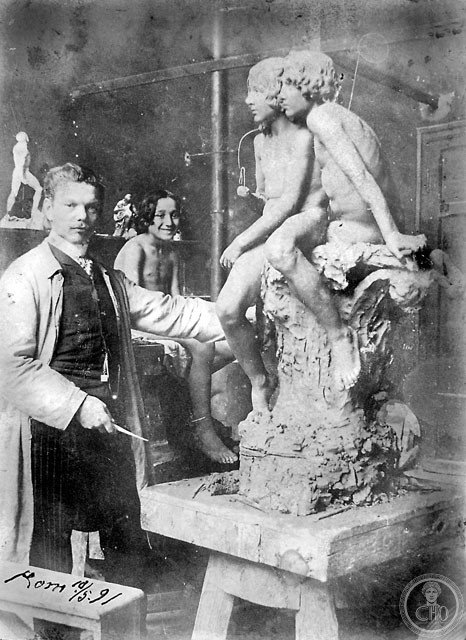
The roof is characteristically Italian: flat without sloping sections. Inside, the arrangement recalls a stage set for the opening act of Verdi’s La traviata, with sumptuous marble columns and wall panels throughout. A sculpture by Wilhelm Haverkamp, commissioned in 1891, stands in the entrance vestibule with Corinthian capitals. The loggia design echoes Palazzo Borghese, where Hüffer lodged upon his initial arrival in the city.
Cultural significance
Villino Hüffer represents a moment when Rome was establishing itself as modern capital of unified Italy—a context reflected in Hüffer’s decision to blend European sophistication with local architectural tradition. The villa exemplifies the cosmopolitan ambitions of wealthy foreign residents in late 19th-century Rome. It also documents the intersection of commerce and culture: Hüffer’s entrepreneurial success funded both his residence and his support for Rome’s artistic heritage.
Key facts
- Address: Via Nazionale 191, Rome
- Coordinates: 41.89882330021087, 12.4899423122406
- Architect: Jules Antoine François Auguste Pelléchert
- Construction: 1880–1883
- Owner: Bank of Italy (since 2001)
- Phone: +39 06 47921
- Website: http://mobile.060608.it/it/cultura-e-svago/beni-culturali/beni-architettonici-e-storici/villino-huffer.html
Practical information
The villa is now managed by Fondazione Ambiente Italiano (FAI) and houses the Banca d’Italia Historical Archive, which preserves documents on the former Italian Lira and Italian economic history. The archive received the European Prize for Best Preserved Company Archive in 2009. Visits are by appointment only; contact the number above or check the official website for booking details.
Getting there
The villa is located on Via Nazionale, one of Rome’s major thoroughfares running northeast from Piazza della Repubblica. Public transportation serves the area well. You can contact the archive directly for visitor information and to arrange an appointment.
Sources & resources
Find it on the map
See this place and what’s around it →Historical events at this place (1)
📷 Become a Cultural Heritage Online photographer
Share your photos of places: they stay published under your name as the author. The more they're seen, the more you get noticed — and soon a contest will reward the most appreciated photos.
Log in or sign up free to add a photoIs this page about you?
This page is read by travellers and heritage enthusiasts who find it on Google. Tell us how you are connected to this place and we will take it from there.