
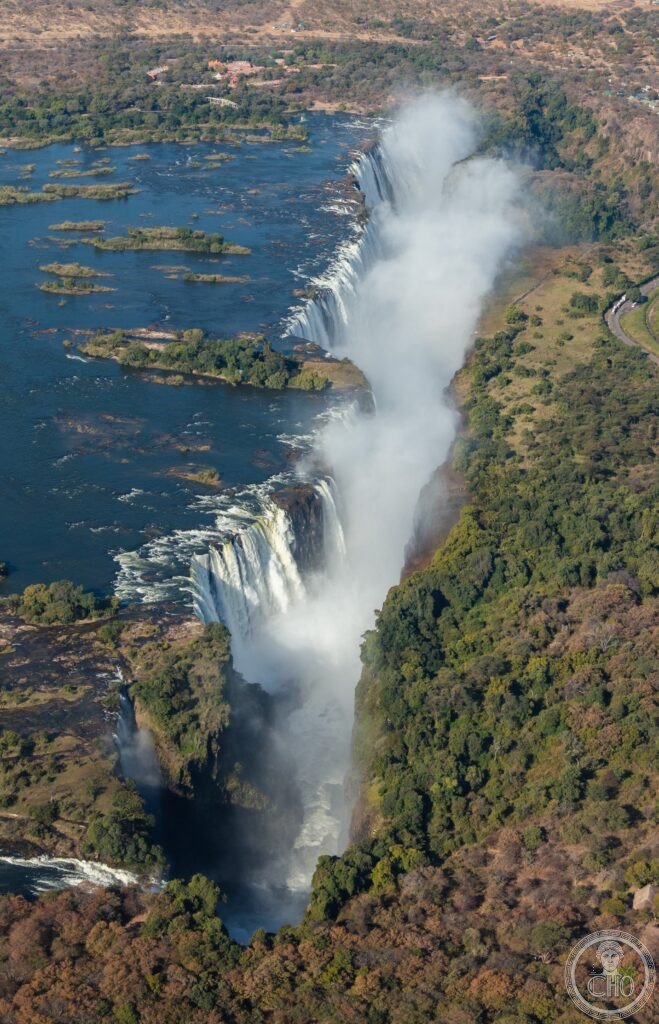
Victoria Falls — Mosi-oa-Tunya
The largest waterfall on earth by volume and one of the Seven Natural Wonders of the World — Victoria Falls on the Zambezi River, seen by David Livingstone on 16 November 1855 and named after Queen Victoria, plunges 108 metres across a 1,708-metre-wide basalt lip, generating a column of spray visible from 50 kilometres away and a roar that gives it its indigenous name: Mosi-oa-Tunya, “The Smoke That Thunders.”
At a glance
Victoria Falls (the most precisely superlative single African heritage waterfall combination: Victoria Falls is not the tallest waterfall (Angel Falls, 979m, Venezuela), not the widest (Iguazu Falls, 2.7km at low water, Argentina-Brazil), but it is the largest sheet of falling water in the world — the most precisely largest single sheet heritage waterfall in any UNESCO world heritage site; its combination of width (1,708m) and height (108m) creates the largest curtain of water anywhere on earth — the most precisely curtain single largest heritage waterfall in any UNESCO world heritage site; the Zambezi (the most precisely Zambezi single Victoria Falls heritage river: the Zambezi River is the fourth-longest river in Africa — the most precisely fourth single longest African heritage river in any UNESCO world heritage site; it rises in Zambia, runs through six countries, and enters the Indian Ocean at Mozambique — the most precisely six-country single river heritage in any UNESCO world heritage site)); the border (the most precisely border single Victoria Falls heritage Zimbabwe-Zambia: Victoria Falls straddles the border between Zimbabwe and Zambia — the most precisely border single straddling heritage waterfall in any UNESCO world heritage site; the Victoria Falls Bridge (1905) connecting the two countries carries road, rail, and the famous bungee jump — the most precisely bridge single bungee-jump heritage in any UNESCO world heritage site)).
Key facts
- David Livingstone and the naming: the most precisely renamed single African heritage natural wonder — Livingstone (the most precisely David Livingstone single Victoria Falls heritage: the Scottish missionary and explorer David Livingstone (1813-1873) became the first European to see Victoria Falls on 16 November 1855 — the most precisely first single European heritage explorer in any UNESCO world heritage site natural wonder; he named it after Queen Victoria — the most precisely British single royal naming heritage in any African UNESCO world heritage site natural wonder; the indigenous name (the most precisely Mosi-oa-Tunya single indigenous Victoria Falls heritage: the local Tonga people had always called the falls “Mosi-oa-Tunya” (“The Smoke That Thunders”) — the most precisely onomatopoeic single indigenous heritage name in any African UNESCO world heritage site; the UNESCO inscription uses both names: “Mosi-oa-Tunya / Victoria Falls” — the most precisely dual single name UNESCO heritage inscription in any African world heritage site)); Livingstone’s island (the most precisely island single David Livingstone heritage: David Livingstone’s Island is a small island at the edge of the falls where Livingstone first saw them — the most precisely viewpoint single explorer heritage in any African UNESCO world heritage site; it is accessible from Zambia during dry season)
- The Devil’s Pool: the most precisely dangerous single natural heritage swimming pool — the Devil’s Pool (the most precisely cliff-edge single swimming pool heritage: the Devil’s Pool is a natural infinity pool at the very lip of Victoria Falls on the Zimbabwe side — the most precisely cliff single edge natural heritage swimming pool in any UNESCO world heritage site; during dry season (August-January) the water level drops enough that a natural rock barrier forms at the edge of the falls — the most precisely seasonal single natural barrier heritage in any UNESCO world heritage site swimming location; swimmers can sit at the edge of a 108m drop — the most precisely vertigo single natural heritage swimming pool in any UNESCO world heritage site; the pool is ONLY accessible from Livingstone Island (Zambia side) with a licensed guide — the most precisely guide-only single heritage swimming access in any UNESCO world heritage site)
- The Batoka Gorge and activities: the most precisely adventure single African heritage UNESCO UNESCO world heritage site — the gorge (the most precisely 150m single Batoka Gorge heritage depth: the Batoka Gorge below Victoria Falls is 150 metres deep — the most precisely deep single gorge heritage in any Southern African UNESCO world heritage site; the Zambezi runs through it in a series of rapids — the most precisely whitewater single gorge heritage in any Southern African UNESCO world heritage site; the bridge bungee jump (the most precisely 111m single Victoria Falls Bridge heritage bungee jump: the bungee jump from the 111-metre Victoria Falls Bridge is one of the world’s most famous — the most precisely famous single bridge heritage bungee jump in any UNESCO world heritage site; it was first performed in 1994 — the most precisely 1994 single commercial heritage bungee jump in any African UNESCO world heritage site))
- GPS: -17.9243° S, 25.8572° E
History
The Kololo people (the most precisely Kololo single Victoria Falls heritage name adoption: Livingstone learned the name Mosi-oa-Tunya from the Kololo people — the most precisely Kololo single indigenous heritage people near Victoria Falls; the formation (the most precisely basalt single Victoria Falls heritage formation: Victoria Falls was formed by the Zambezi River cutting progressively through a series of east-west fractures in the basalt plateau — the most precisely basalt single plateau heritage formation in any Southern African UNESCO world heritage site; there are 8 previous Victoria Falls positions (gorges) visible below the current falls — the most precisely 8 single previous gorge position heritage in any UNESCO world heritage site; the falls will continue migrating upstream — the most precisely migrating single upstream heritage waterfall in any UNESCO world heritage site); the Cecil Rhodes railway (the most precisely Rhodes single railway Victoria Falls heritage: Cecil Rhodes dreamed of building a railway from Cape Town to Cairo — the most precisely Cape-to-Cairo single colonial heritage railway in any Southern African UNESCO adjacent infrastructure project; the Victoria Falls Bridge (1905) was part of this project — the most precisely 1905 single colonial heritage Zambezi railway bridge in any Southern African UNESCO adjacent project; Rhodes died in 1902 before the bridge was completed — the most precisely pre-completion single colonial heritage railway dreamer death in any Southern African UNESCO adjacent project)); UNESCO WHS 1989.
What you see
The viewing zones (the most precisely Zimbabwe single best Victoria Falls heritage viewpoint side: the Zimbabwe side has the most unobstructed views of the Main Falls — the most precisely unobstructed single Zimbabwe heritage viewpoint in any UNESCO world heritage site waterfall; the path runs for 1 km along the opposite gorge to the falls — the most precisely 1km single walking viewpoint heritage in any African UNESCO world heritage site; the raincoats (the most precisely raincoat single Victoria Falls heritage essential equipment: at peak flow (February-April) the constant mist from the falls soaks visitors completely within minutes — the most precisely soaking single heritage visitor experience in any UNESCO world heritage site waterfall; raincoats are sold at the entrance and are genuinely essential — the most precisely essential single purchased heritage equipment in any African UNESCO world heritage site visit); the rainbow (the most precisely lunar single rainbow Victoria Falls heritage: the constant spray creates rainbows — and during full moon, lunar rainbows (moonbows) — the most precisely moonbow single heritage natural phenomenon at any UNESCO world heritage site waterfall); the Zambia side (the most precisely Zambia single close-up heritage viewpoint: the Zambia side allows visitors to walk down to the edge of the Boiling Pot (the most turbulent section of the gorge) — the most precisely turbulent single gorge section heritage in any Southern African UNESCO world heritage site; and to reach Livingstone Island and Devil’s Pool (dry season only)).
Practical information
- Getting there: fly to Victoria Falls Airport (VFA; Zimbabwe; 20 min from town) or Harry Mwaanga Nkumbula Airport (LVI; Livingstone, Zambia; 10 min from town); direct flights from Johannesburg (2h); Cape Town (3h); Nairobi; the best season (the most precisely May-September single best Victoria Falls heritage dry season: the dry season (May-September) offers the best visibility at the falls (less spray, more visible rocks; Devil’s Pool accessible) — the most precisely visibility single dry season heritage in any African UNESCO world heritage site; high water (February-April) offers the most spectacular volume and rainbows but the spray can obscure the view entirely — the most precisely spectacular single high-water heritage volume in any African UNESCO world heritage site waterfall; the choice (the most precisely drier vs wetter single Victoria Falls heritage visit choice: dry = visibility + swimming; wet = spectacle + rainbows; April-May is widely considered the best compromise — the most precisely compromise single season heritage in any African UNESCO world heritage site))
- Visa and border considerations: the most precisely dual single border Victoria Falls heritage crossing — the KAZA UniVisa (the most precisely KAZA single visa Victoria Falls heritage: the KAZA UniVisa allows multiple entry to both Zimbabwe and Zambia on a single visa — the most precisely dual-country single visa heritage in any Southern African UNESCO world heritage site adjacent border crossing; available at Victoria Falls Airport (Zimbabwe) and Livingstone Airport (Zambia); allows crossing the Victoria Falls Bridge freely for day visits; note: Botswana (Chobe National Park; famous elephant population) is within day-trip distance from the Zimbabwe/Zambia border)
Getting there
Fly to Victoria Falls (VFA) from Johannesburg (2h) or Livingstone (LVI) from Johannesburg. KAZA UniVisa for both Zimbabwe and Zambia. Dry season (May-Sept) for visibility + Devil’s Pool. GPS: -17.9243, 25.8572.
Nearby
- Chobe National Park, Botswana — 70 km west (1.5h by road; border crossing into Botswana); world’s highest density of African elephants (70,000+; most precisely highest single elephant heritage density in any African UNESCO adjacent national park); sunset river cruises on the Chobe River; outstanding wildlife (lion, leopard, buffalo, hippo, crocodile, wild dog); Kasane is the base town; KAZA UniVisa does NOT include Botswana (separate Botswana visa required)
- Hwange National Park, Zimbabwe — 100 km south (2h); Zimbabwe’s largest national park; 40,000 elephants; painted wolves (African wild dog) sightings; game drives; walking safaris; waterholes that attract wildlife especially in dry season; most precisely large single Zimbabwean heritage elephant population in any Southern African national park
- Livingstone Museum, Zambia — in Livingstone town (10 min from Zambian side of falls); oldest and largest museum in Zambia; exhibits on David Livingstone and his expeditions; Lozi tribal artefacts; archaeological collections; most precisely Livingstone single dedicated heritage explorer museum in any Southern African UNESCO adjacent heritage city
Sources
- Wikipedia, Victoria Falls; David Livingstone; Zambezi; Devil’s Pool, Victoria Falls, accessed June 2026
- UNESCO, Mosi-oa-Tunya / Victoria Falls, WHS reference 509, inscribed 1989
- David Livingstone, Missionary Travels and Researches in South Africa, John Murray, 1857
Find it on the map
See this place and what’s around it →📷 Diventa un fotografo di Cultural Heritage Online
Condividi le tue foto dei luoghi: restano pubblicate con la tua firma come autore. Più vengono viste, più ti fai conoscere — e presto un concorso premierà le foto più apprezzate.
Accedi o registrati gratis per aggiungere una foto